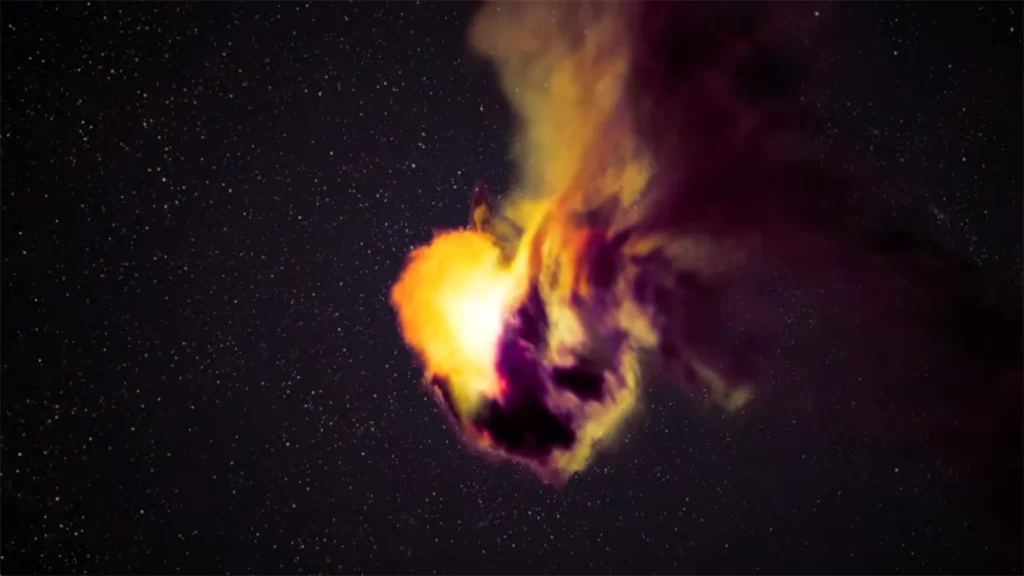
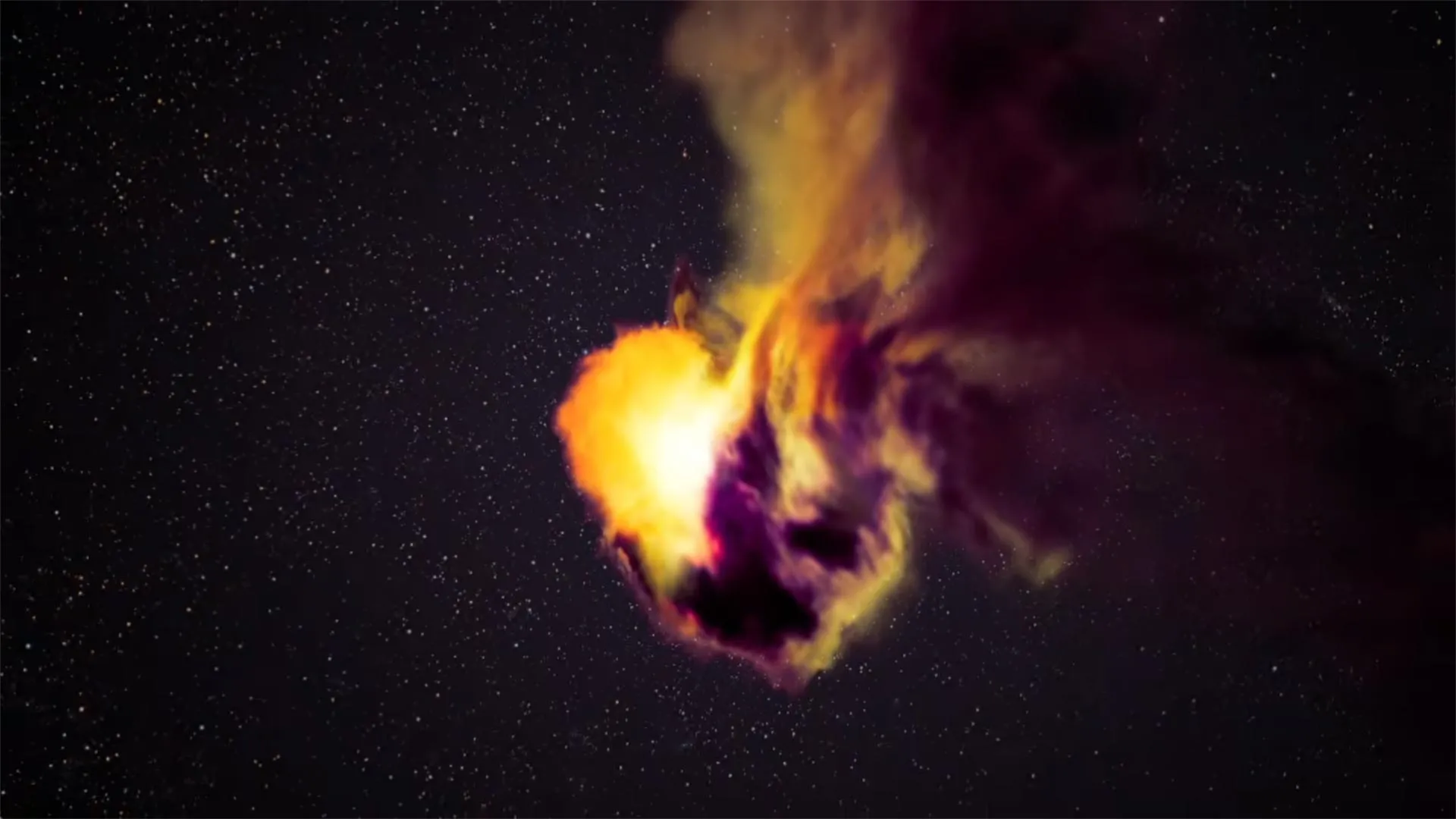
The discovery of a rare cosmic event known as an “extremely stripped supernova” has provided the international scientific community with an unprecedented look into the internal architecture of a dying massive star. In a comprehensive study published in the journal Nature, a research team led by Steve Schulze of Northwestern University detailed the observation of SN2021yfj, a supernova characterized by a thick surrounding shell of gas that originated from the star’s deepest internal layers. This observation represents a landmark moment in stellar archaeology, as it confirms long-held theoretical models regarding the final stages of nuclear fusion and the subsequent distribution of heavy elements throughout the cosmos.
The Mechanics of Stellar Nucleosynthesis
To understand the significance of SN2021yfj, one must first examine the standard lifecycle of a massive star—those at least eight times the mass of our Sun. These celestial giants function as the universe’s primary chemical laboratories, powered by the immense pressure and temperature of nuclear fusion. Throughout their multi-million-year lifespans, these stars undergo a series of progressive burning cycles, each forging heavier elements from lighter ones.
The process begins with the fusion of hydrogen into helium, a phase that accounts for the majority of a star’s life. As the hydrogen in the core is exhausted, the core contracts, temperatures rise, and the star begins fusing helium into carbon. For the most massive stars, this cycle continues with increasing speed and intensity. Carbon fuses into neon, neon into oxygen, oxygen into magnesium and silicon, and finally, silicon fuses into iron.
A critical aspect of this progression is the accelerating timeline. While the hydrogen-burning phase may last for ten million years, the final silicon-burning stage, which produces the precursor elements to the star’s ultimate collapse, is completed in a matter of days or even hours. As these cycles occur, the star develops an "onion-skin" structure. The outermost layers consist of unburned hydrogen, followed by layers of helium, carbon, neon, oxygen, and silicon, all surrounding a growing iron core.
The Core-Collapse Phenomenon and SN2021yfj
The transition from silicon fusion to iron marks the beginning of the end for a massive star. Unlike the fusion of lighter elements, which releases the energy required to counteract the crushing force of gravity, the fusion of iron atoms actually consumes energy. This creates an immediate catastrophic imbalance. Without the outward pressure of fusion, gravity wins instantaneously, causing the iron core—roughly the size of Earth but with the mass of the Sun—to collapse into a neutron star or a black hole in a fraction of a second.
This collapse triggers a massive rebound, sending a shockwave rippling outward through the star’s various layers. This is the supernova explosion. Typically, when astronomers observe these explosions, the light they see is filtered through the star’s outermost envelopes of hydrogen or helium. However, SN2021yfj is what researchers call an "extremely stripped" supernova. In this instance, the star had lost its outer layers of hydrogen, helium, and even carbon and oxygen prior to the explosion.
The spectroscopic data collected from SN2021yfj revealed a thick shell of gas composed primarily of silicon. This is a revolutionary find because the silicon layer is the final shell produced just before the iron core forms. In standard supernovae, this material is buried deep within the star and is often obscured by the sheer volume of other debris. Seeing it so clearly suggests that the star was "stripped" of its outer layers down to its very core shortly before the final detonation.
The Mystery of the Stripped Layers
The primary mystery surrounding SN2021yfj is how a star could lose so much of its mass so quickly. While all massive stars lose some material through stellar winds—streams of charged particles ejected from the upper atmosphere—these winds are generally not powerful enough to remove the hydrogen, helium, carbon, neon, and oxygen layers in their entirety, especially not on the timescale required to expose the silicon layer.
The silicon-burning phase occurs so close to the end of a star’s life that the material in the silicon shell would not have had time to drift far from the star via standard stellar winds. The research team at Northwestern University posits that the most likely explanation involves a binary star system. In this scenario, the progenitor star of SN2021yfj was not alone but was orbited by a companion star.
As the progenitor star expanded during its final evolutionary stages, its outer layers likely crossed a gravitational threshold known as the Roche lobe. The gravity of the companion star would have acted as a vacuum, rapidly siphoning off the progenitor’s outer layers. This "mass transfer" or "common envelope evolution" could explain how the star was rendered nearly naked, leaving only the innermost silicon-rich material to be illuminated by the subsequent supernova shockwave.
Chronology of Observation and Analysis
The detection of SN2021yfj followed a rigorous timeline of modern transient astronomy:
- Initial Detection: The supernova was first identified by automated sky surveys, which flagged a rapid increase in luminosity in a distant galaxy.
- Spectroscopic Follow-up: Using ground-based telescopes, Schulze and his colleagues performed spectroscopy, a technique that breaks down light into its constituent colors to identify the chemical fingerprints of the elements present in the explosion.
- Discovery of the Silicon Shell: Analysis of the light curve and spectra revealed signatures that did not match standard Type II (hydrogen-rich) or even standard Type Ib/Ic (helium/carbon-stripped) supernovae. The presence of a dense, silicon-rich circumstellar medium was confirmed.
- Modeling and Peer Review: The team spent months modeling the density and velocity of the ejected gas to confirm that it originated from the silicon-burning shell. Their findings were then subjected to the rigorous peer-review process of Nature.
Broader Scientific Implications
The implications of the SN2021yfj study extend far beyond the classification of a single explosion. This event serves as a "smoking gun" for the theory of stellar nucleosynthesis. By witnessing the silicon layer in the circumstellar environment, scientists have a direct observational link between the theoretical models of what happens inside a star and the physical reality of the elements ejected into space.
Furthermore, this discovery highlights the vital role of supernovae in the "Cosmic Recycling" program. Almost all the oxygen we breathe, the neon in our signs, the magnesium in our bones, and the silicon in our computer chips were forged in the hearts of massive stars and distributed by core-collapse supernovae.
The study of SN2021yfj also provides critical data for the field of galactic evolution. In the early universe, stars were composed almost entirely of hydrogen and helium. It took successive generations of massive stars living and dying as supernovae to enrich the interstellar medium with the "interesting" elements required to form rocky planets and, eventually, life. By understanding the specific mechanisms of extremely stripped supernovae, astronomers can better calculate the rate at which different elements are distributed across galaxies.
Reactions and Future Research
The scientific community has reacted with significant interest to the Northwestern University findings. While the binary interaction theory is currently the most plausible explanation, it opens up new questions about the frequency of such systems. If extremely stripped supernovae are more common than previously thought, it might suggest that binary interactions play a much larger role in stellar death than is currently accounted for in most cosmological models.
Future research will likely focus on utilizing the James Webb Space Telescope (JWST) and the upcoming Vera C. Rubin Observatory to find more examples of SN2021yfj-like events. The high sensitivity of these instruments will allow astronomers to peer further back into the history of the universe to see if these stripped-star explosions were more or less common in the early cosmos.
In conclusion, SN2021yfj has provided a rare, unobstructed view of the final gasps of a massive star. It has turned a theoretical "onion-skin" model into an observed reality, proving that even in the chaotic violence of a supernova, there is a strict and predictable order to the elements that build our world. As Steve Schulze and his team have demonstrated, by looking at the debris of a dying star, we are ultimately looking at the origins of ourselves.