Cambridge, MA – A revolutionary robot capable of seamless transition between underwater swimming and aerial flight has been unveiled by a collaborative team of engineers from the Massachusetts Institute of Technology (MIT) and EPFL (Swiss Federal Institute of Technology Lausanne). Dubbed the "flapping-wing aerial-aquatic vehicle," or FAAV, this innovative creation draws direct inspiration from nature’s most versatile aviators – diving birds such as loons, gulls, puffins, and petrels, which masterfully navigate both air and water. The research, detailing the design and experimental validation of the FAAV, was published today in the prestigious journal Science, marking a significant advancement in the field of bio-inspired robotics and promising a new era for environmental monitoring and oceanographic exploration.
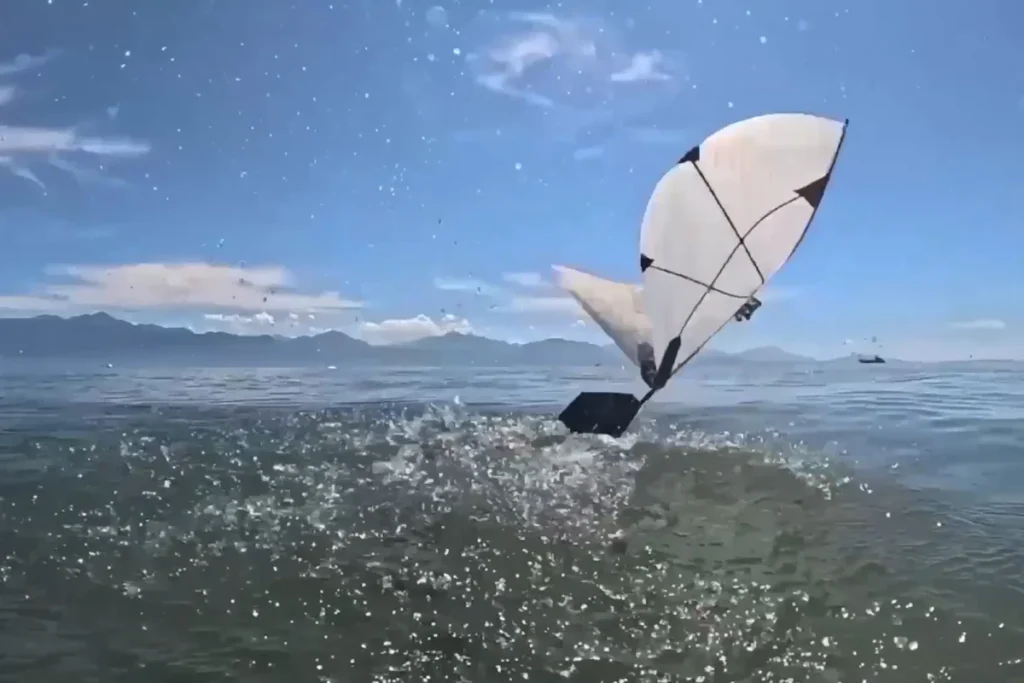
The FAAV, weighing less than 300 grams (approximately half a pound), represents a critical step toward understanding the complex mechanics that allow diving birds to operate efficiently across two vastly different mediums. Its design comprises a central fuselage housing essential electronics, two flexible, flapping wings, and a steerable tail, all modular components that can be adapted in size for various experimental conditions. Initial experiments conducted in a controlled water tank and subsequently in the expansive environment of Lake Geneva in Switzerland have successfully demonstrated the robot’s ability to transition from submerged swimming to a breathtaking leap into the air, where it continues its journey through flight. This dual-medium capability opens up unprecedented possibilities for scientific research and practical applications, particularly in areas deemed too hazardous or inaccessible for conventional human-operated or single-medium robotic systems.
Unveiling the "Flapping-Wing Aerial-Aquatic Vehicle" (FAAV)
The genesis of the FAAV lies in the AURA Lab at MIT, led by Raphael Zufferey, assistant professor of mechanical engineering and the lead author of the new study. Zufferey and his team are dedicated to engineering aerial and aquatic vehicles inspired by biomechanics observed in nature, with a particular focus on small-scale robots designed for unobtrusive exploration and monitoring of marine ecosystems. The challenge of creating a vehicle capable of navigating both air and water is substantial, primarily due to the stark physical differences between the two mediums. Water is approximately 1,000 times denser and significantly more viscous than air, meaning that the forces required for propulsion and control vary dramatically. For centuries, engineers have grappled with designs optimized for one medium, often sacrificing efficiency in another.
Diving birds, however, defy these limitations with remarkable grace and efficiency. Species like puffins are renowned for their ability to fly at considerable speeds through the air before plunging into the ocean to swim after prey at speeds of up to 3 meters per second. This natural mastery served as the ultimate blueprint for the FAAV. "You have to do some adaptation to make that transition work. But there’s a solution that exists in nature," Zufferey explained. "Birds like puffins can fly very fast through the air, and can dive and swim through water at speeds of 3 meters per second. They’re able to do pretty amazing things. So we knew it was possible. Just no one had tried this in a mobile robotic system."
The development process involved an intensive study of ornithological literature, compiling extensive data on the flight and swimming mechanics of various diving bird species, including puffins, petrels, and kingfishers. Researchers noted a consistent pattern: smaller birds typically flap their wings around 10 times per second in air and approximately four times per second in water. Larger birds, owing to their wider wingspans, exhibit slightly lower flapping frequencies in both environments. This crucial bio-mechanical data informed the FAAV’s design, particularly its ability to adjust its flapping frequency to mimic its natural counterparts.
The Engineering Marvel: Bridging Two Worlds
The FAAV’s structure is elegantly simple yet robust, designed to withstand the rigors of rapid transition between air and water. Its bird-like form factor includes a main body (fuselage) that houses a compact battery and a waterproof electric motor. This motor drives a crankshaft mechanism, which, in turn, orchestrates the precise up-and-down flapping motion of the wings at pre-programmed frequencies. The wings themselves are a testament to advanced material science, crafted from thin, flexible membranes coated with hydrophobic nanoparticles. This specialized coating is vital for repelling water, minimizing drag upon re-entry into the air, and ensuring the robot can shed water quickly to maintain aerodynamic efficiency. A motorized tail provides steerability, allowing the robot to adjust its pitch for diving or ascending maneuvers.
One of the FAAV’s most innovative features is its modularity. The wings and tail can be easily swapped out for different sizes, enabling researchers to systematically investigate the optimal configurations for various conditions. For their experimental validation, the team fabricated and tested three distinct wing sets: small (60 centimeters wide), medium (80 centimeters), and large (100 centimeters). This iterative design and testing approach was critical to fine-tuning the robot’s performance.
Rigorous Testing: From Tank to Lake Geneva
The experimental phase began in a controlled laboratory setting, utilizing a small water tank to observe the robot’s fundamental behaviors underwater. These initial tests allowed the team to refine the control algorithms and validate the mechanical integrity of the FAAV. Once these preliminary hurdles were cleared, the team moved to a more challenging, real-world environment: Lake Geneva in Switzerland.
In these lake trials, the robot was submerged approximately half a meter below the surface. Programmed with specific flapping frequencies and tail pitch angles, the FAAV was tasked with executing a submerged ascent, breaking through the water’s surface, and initiating sustained flight. The researchers meticulously observed and recorded the robot’s performance under various combinations of wing size, flapping frequency, and tail angle.
The results were compelling. The FAAV demonstrated reliable flight, swimming, and, most critically, seamless transitions between water and air when equipped with medium-sized wings. The flexibility of the wings proved to be a critical factor; they needed to be pliable enough to minimize amplitude and energy expenditure while swimming underwater, yet sufficiently firm to generate the necessary lift and thrust for aerial flight. This delicate balance highlights the intricate biomechanical optimization seen in natural diving birds.
Performance metrics were impressive: the robot achieved swimming speeds of nearly 1 meter per second with a flapping frequency of approximately 5 Hertz (five flaps per second). In the air, it reached speeds of around 6 meters per second, maintaining a similar flapping frequency. These figures closely mirror the observed speeds and flapping rates of actual diving birds, underscoring the success of the bio-inspired design.
The Leap: A 70-Degree Ascent and the "No Feet" Revelation
The most challenging aspect of the FAAV’s design was achieving a smooth, efficient transition from water to air. The engineers discovered that for a successful launch, the robot needed to be pitched at a relatively steep angle of 70 degrees upon breaking the surface. This specific angle proved crucial in preventing the robot’s wingtips from re-contacting the water’s surface as it flapped upwards, which would disrupt its ascent and potentially cause it to tip back into the water. Any deviation from this optimal pitch would either lead to a failed takeoff or an inefficient expenditure of energy.
Perhaps one of the most surprising findings during the research concerned the necessity of "feet" for takeoff. Many diving birds, such as puffins and ducks, are known to paddle their webbed feet vigorously along with flapping their wings and pitching their tails when launching from water. This complex maneuver provides additional thrust and stability during the critical transition phase. However, the MIT/EPFL team found that their robotic system did not require a similar paddling mechanism. "If you look at birds, most birds need to paddle at the surface to take off. And the question was, do we need the same for robots? And it turns out we don’t," Zufferey noted, highlighting an unexpected efficiency in the robotic design that simplifies its mechanical complexity.
Broader Implications and Future Horizons
The successful development of the FAAV extends far beyond a mere technological curiosity; it carries profound implications for multiple scientific and industrial domains. The most immediate and impactful application lies in oceanography and marine biology. Traditional oceanographic research often relies on large, expensive vessels and remotely operated vehicles (ROVs) or autonomous underwater vehicles (AUVs) that are limited to a single medium. The FAAV, with its dual capability, offers a cost-effective, agile, and rapidly deployable alternative.
Researchers envision scenarios where these winged robots could be launched from a boat or shore, flying directly to areas of interest such as icebergs, remote port facilities, or even over pods of whales. Upon arrival, the robot could dive into the water to collect vital measurements, samples, or imagery, then resurface and fly back to deliver the data – all at a fraction of the cost and risk associated with conventional methods. This capability could revolutionize data collection frequency and spatial coverage. "Our dream vision is for oceanographers, marine biologists, and members of coastal communities to launch this robot from a boat, or from shore, and it would fly close to the area of interest… It would dive into the water to take a measurement or collect a sample, and fly back to deliver the data at a fraction of the cost of traditional methods. Then it could go back out to dive for more," Zufferey elaborated.
Beyond oceanography, the FAAV holds promise for environmental monitoring. It could be deployed to track pollution plumes in coastal waters, monitor changes in marine ecosystems, or assess the health of coral reefs, providing unprecedented real-time data from difficult-to-reach locations. Its ability to repeatedly transition between air and water makes it ideal for observing dynamic interfaces, such as air-sea gas exchange or marine mammal behavior at the surface.
In the realm of search and rescue, the FAAV could offer rapid reconnaissance capabilities in coastal disaster zones, quickly scanning large areas from the air before diving to investigate submerged targets or assess underwater damage. For defense and surveillance, such agile, multi-medium drones could perform covert reconnaissance in littoral environments, inspecting port facilities or monitoring maritime traffic with unparalleled flexibility.
Furthermore, the FAAV’s success deepens our fundamental understanding of biomimetics and fluid dynamics. By successfully replicating and even simplifying certain aspects of natural locomotion, the project provides new insights into how biological systems optimize for multi-medium travel. This knowledge can, in turn, inform the design of future robots and even inspire novel engineering solutions in unrelated fields. The project underscores the principle that nature, through millions of years of evolution, has already solved many of the complex engineering challenges that modern science grapples with.
The Road Ahead: Overcoming New Challenges
While the FAAV represents a monumental achievement, the research team is not resting on its laurels. Future work will focus on further enhancing the robot’s capabilities. One immediate goal is to improve the design of the wings to enable not just flapping, but also rotational movements, which would grant the robot greater maneuverability and control in both air and water.
Crucially, the team plans to test the FAAV’s performance under more challenging, turbulent conditions. This includes navigating choppy waters during takeoff and landing, as well as maintaining stable flight through gusty winds. Real-world deployment will invariably expose the robot to dynamic and unpredictable environments, and robust performance under such conditions is paramount for practical application. "One of the major challenges in ocean science is collecting data both frequently and across many locations, which is something this robot could do in the future," Zufferey emphasized. "You could send this out not just every week, but every hour. It could fly out at high speeds, dive in fly back, deliver its data, and go back out, multiple times."
The interdisciplinary nature of this project, involving collaborators from EPFL and Northwest Indian College in Bellingham, Washington, further highlights the collaborative spirit driving scientific innovation. This work was supported, in part, by a prestigious Marie Skłodowska-Curie Actions fellowship grant, underscoring the international recognition of its potential impact. The FAAV is not just a robot; it is a harbinger of a future where autonomous systems can fluidly traverse the planet’s diverse environments, unlocking new frontiers in scientific discovery and safeguarding our natural world.