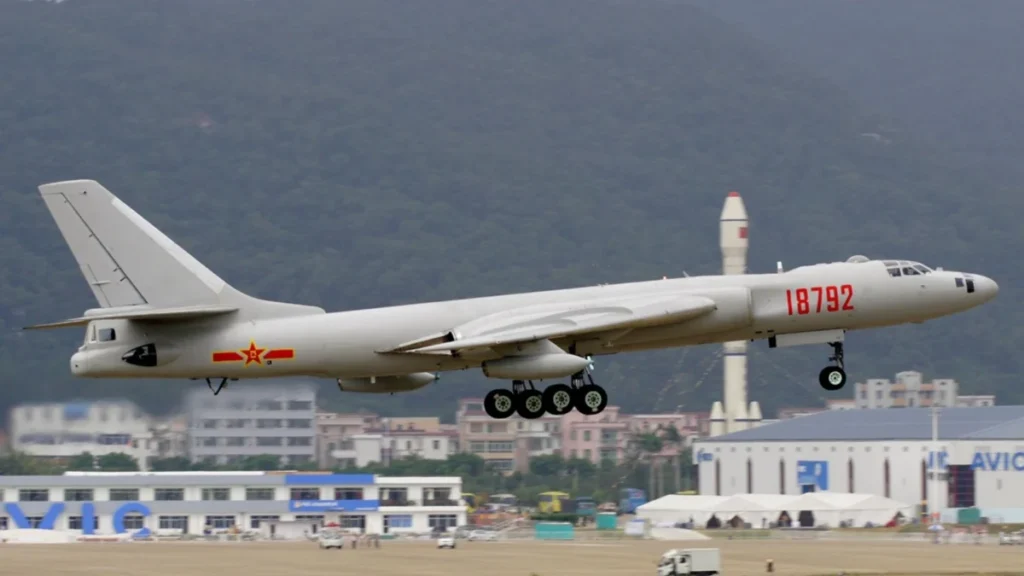
A newly released People’s Liberation Army (PLA) documentary has provided one of the clearest public glimpses yet of China’s H-6N strategic bomber carrying a large, unidentified missile beneath its fuselage during a simulated joint strike exercise. This footage, broadcast in the final episode of the "Zhisheng (Victory)" documentary series by state broadcaster CCTV, has immediately ignited renewed discussion and analysis among military observers regarding Beijing’s rapidly evolving long-range strike capabilities and its sophisticated military modernization efforts.
The high-definition footage depicts an H-6N bomber, a variant specifically designed for air-launched ballistic missiles, flying with a single, substantial weapon mounted on its centerline. This configuration stands in stark contrast to the smaller weapons typically carried under the aircraft’s wings, strongly suggesting a weapon system of considerable size and strategic importance. Notably, the H-6N was not alone; it was escorted by two J-20 stealth fighters, underscoring the integrated and networked approach China’s military is developing for its strategic operations. While Chinese state media refrained from officially identifying the weapon, the visual evidence has led many military analysts to conclude that it represents one of China’s most capable and potentially game-changing air-launched strike systems.
The H-6N and its Evolving Role in China’s Airpower
The H-6 bomber series, based on the Soviet Tupolev Tu-16, has been the backbone of the PLA Air Force’s bomber fleet for decades. However, the H-6N variant represents a significant leap in capability and mission profile. Unlike its predecessors, the H-6N is distinguished by its aerial refueling probe, significantly extending its operational range, and a modified fuselage that eliminates the internal bomb bay in favor of a semi-recessed hardpoint designed to carry a large, heavy missile on its centerline. This modification signals a strategic shift from conventional bombing missions to a primary role as a launch platform for large stand-off weapons, particularly air-launched ballistic missiles (ALBMs).
The H-6N’s introduction is a critical component of China’s broader military modernization, aimed at developing a "three-in-one" strategic deterrent capability encompassing land-based, sea-based, and air-based nuclear and conventional strike options. The H-6N specifically enhances the air-based component, providing a mobile and flexible platform for delivering long-range precision strikes against both land and naval targets. Its ability to operate at extended ranges, coupled with the potential to carry advanced ALBMs, significantly expands China’s anti-access/area-denial (A2/AD) envelope and its power projection capabilities across the Indo-Pacific.
A Different Kind of Missile: The Allure of Air-Launched Ballistic Missiles
According to insights from Wang Yanan, editor-in-chief of the Beijing-based Aerospace Knowledge magazine, cited by the Global Times, the missile observed in the documentary is likely an air-launched ballistic missile (ALBM). Such a weapon would be designed for either anti-ship or land-attack missions, offering versatile strike options. The report noted that the weapon shares visual similarities with the JL-1 air-launched long-range missile, which was previously displayed during China’s 2025 Victory Day parade. However, due to the distant views provided by the documentary footage, Wang cautioned against definitive identification based solely on the available visuals.
If confirmed as an ALBM, this weapon signifies a distinct operational concept compared to conventional cruise missiles. While cruise missiles typically fly at low altitudes for the majority of their flight path, relying on stealth and terrain-following capabilities, ballistic missiles follow a high-speed, parabolic trajectory. This makes them significantly more challenging to intercept, as they spend a substantial portion of their flight at extremely high altitudes and re-enter the atmosphere at hypersonic speeds. The combination of an air-launched platform and ballistic trajectory offers a potent and difficult-to-counter threat to advanced naval assets and heavily defended land targets.
Why Launch a Ballistic Missile from an Aircraft? The Strategic Advantages
The primary advantage of an air-launched ballistic missile system is its unparalleled operational flexibility. As Wang Yanan explained, unlike land-based missile systems, whose launch positions are relatively fixed and therefore more predictable for an adversary, an aircraft like the H-6N can launch from a multitude of locations and approach targets from various directions. This inherent mobility and unpredictability significantly complicate an adversary’s defensive planning, making it harder to establish effective missile defense zones or pre-emptively target launch platforms. The ability to launch from unexpected vectors forces adversaries to deploy more widespread and complex defense systems, stretching their resources.
Furthermore, launching a ballistic missile from an aircraft significantly extends its effective range. The bomber provides an initial boost in both altitude and speed before the missile is released, effectively giving the missile a head start. This initial kinetic energy translates directly into greater reach for the missile, allowing strikes against distant targets that might otherwise be beyond the range of land-based systems or require closer approach by the launch platform. When combined with the H-6N’s already impressive operational range – further enhanced by its aerial refueling capability – this allows the PLA to conduct strikes deep into the Indo-Pacific theater without relying solely on fixed launch sites or incurring the risks associated with operating closer to contested areas. This extended reach is particularly crucial for anti-ship missions against high-value naval assets like aircraft carrier strike groups, which operate far from coastal defenses.
Integrated Warfare Takes Center Stage: A New PLA Doctrine
The missile itself, while a focal point, was only one element of the documentary’s broader strategic message. According to CCTV, the simulated exercise depicted was fundamentally centered on joint operations, illustrating the PLA’s evolving doctrine of integrating various military branches and platforms into a cohesive, networked strike system. This represents a significant shift from the traditional, more siloed approach to military operations, emphasizing synergy and real-time information sharing across the force.
The documentary vividly portrays a complex scenario involving a large hostile surface vessel formation approaching southeast of China. In this simulated environment, multiple unmanned aerial vehicles (UAVs) provide continuous reconnaissance and targeting information, which is then seamlessly shared across the joint force network. The sequence further includes footage of a Type 052D destroyer launching what the documentary identifies as a YJ-20 hypersonic missile, alongside land-based DF-21D anti-ship ballistic missiles, before cutting to the H-6N carrying its large centerline weapon. This multi-platform, multi-domain attack scenario highlights the PLA’s commitment to a "system of systems" approach, where air, sea, land, space, and cyber assets are all orchestrated to achieve a unified strategic objective. The emphasis, according to the documentary, is that modern warfare increasingly depends on connected combat systems capable of sharing information in real time, rather than isolated weapons platforms operating independently. This doctrine aims to overwhelm an adversary’s defenses through coordinated, multi-pronged attacks, leveraging the strengths of each platform.
The Crucial Role of the J-20 Escort
Another notable detail in the documentary is the presence of two J-20 stealth fighters accompanying the H-6N bomber. This escort is strategically significant, as the H-6N, despite its modern upgrades, remains a large aircraft with a much larger radar signature than the stealthy J-20. Consequently, the H-6N would likely require robust protection when operating in contested airspace or within range of advanced enemy air defenses. Wang Yanan suggested that the J-20s would provide a protective screen by engaging long-range threats, such as enemy fighter jets or airborne early warning aircraft, before they could reach and threaten the less stealthy bomber.
The J-20, China’s most advanced stealth fighter, possesses capabilities such as low observability, advanced avionics, and long-range air-to-air missiles, making it an ideal escort for high-value assets like the H-6N. Its presence underscores the comprehensive nature of the PLA’s joint operations doctrine, where different platforms complement each other’s strengths and mitigate weaknesses. In actual combat operations, Wang also noted that the H-6N would likely be supported not only by escort fighters but also by naval forces, land-based missile units, and other aircraft operating as part of an even larger, more complex joint combat network. This layered protection and integrated support system are vital for ensuring the survivability and effectiveness of strategic strike platforms like the H-6N in a high-intensity conflict scenario.
International Reactions and Implications
While specific official reactions from international parties to this particular documentary footage have not been widely publicized, such developments are invariably met with close scrutiny by defense intelligence agencies and military analysts worldwide. The public display of an H-6N carrying what appears to be an ALBM sends a clear signal about China’s growing military capabilities and its intent to project power across the Indo-Pacific.
From the perspective of nations like the United States, Japan, and Australia, these advancements contribute to an evolving threat landscape. The increased range and unpredictability offered by ALBMs could complicate defensive strategies for naval assets, particularly aircraft carrier strike groups, which are cornerstones of regional security architectures. The deployment of such systems could force these nations to rethink their anti-access/area-denial countermeasures and invest further in advanced missile defense systems. The integrated joint operations doctrine also suggests a highly sophisticated and coordinated PLA, capable of mounting multi-domain attacks, which requires a robust, multi-layered response.
This development also contributes to the ongoing arms race and technological competition in the region. Other nations may feel compelled to accelerate their own missile defense programs, invest in similar long-range strike capabilities, or enhance their intelligence, surveillance, and reconnaissance (ISR) assets to track and counter such threats. The strategic ambiguity surrounding the missile’s exact identity and capabilities further complicates threat assessment, adding another layer to the geopolitical dynamics of the region. Ultimately, the documentary serves as a public declaration of the PLA’s advanced state of modernization and its commitment to developing sophisticated, integrated long-range strike platforms as a cornerstone of its national defense and power projection strategy.