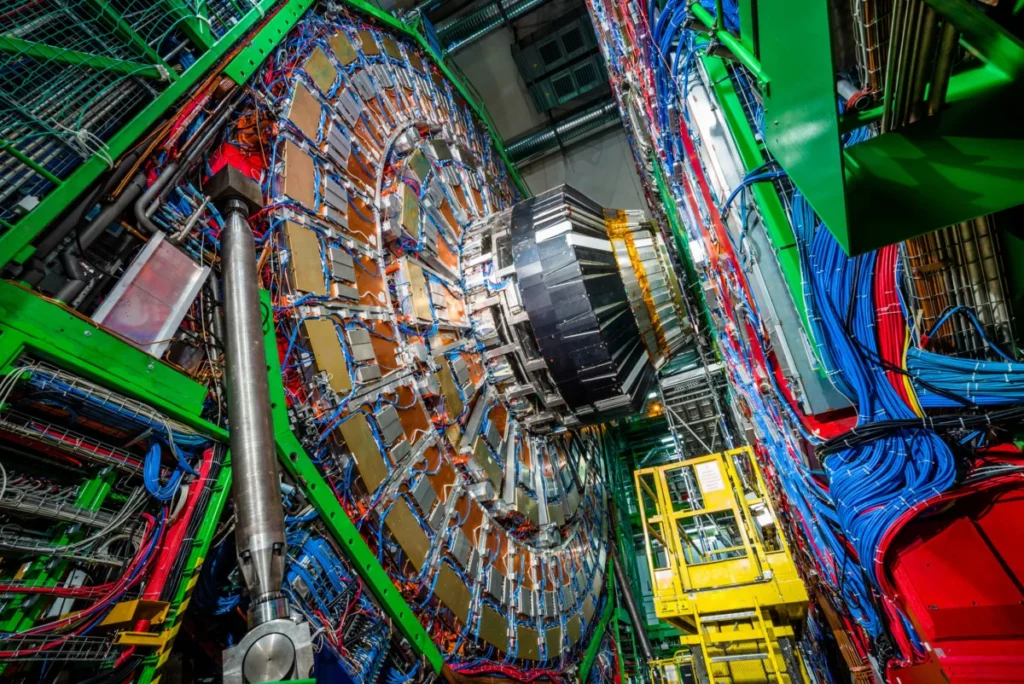
The fundamental architecture of the universe relies on the precise characteristics of subatomic particles, where even the slightest deviation in mass can signal a revolutionary shift in our understanding of reality. In a landmark study published today in the journal Nature, an international collaboration of physicists, including a significant contingent from the Massachusetts Institute of Technology (MIT), has announced a new, ultra-precise measurement of the W boson’s mass. This measurement, conducted using the Compact Muon Solenoid (CMS) experiment at the Large Hadron Collider (LHC), has effectively reset the scientific balance by aligning with the long-standing predictions of the Standard Model of particle physics. The result provides a critical counterpoint to a controversial 2022 finding that threatened to upend the established laws of physics.
The W boson is a cornerstone of the Standard Model, acting as one of the two elementary particles—alongside the Z boson—that mediate the weak nuclear force. This force is one of the four fundamental interactions in nature, alongside gravity, electromagnetism, and the strong nuclear force. The weak force is unique in its ability to facilitate the transformation of one type of subatomic particle into another, such as the conversion of protons into neutrons. This process is the engine behind nuclear fusion in the sun and the mechanism that drives radioactive decay on Earth. Because the W boson is so integral to these processes, its mass is more than just a number; it is a vital parameter that links several other fundamental constants of the universe.
The Quest for Precision in Particle Physics
For decades, the Standard Model has served as the definitive "rulebook" for particle physics, successfully predicting the existence and behavior of particles ranging from the Higgs boson to the top quark. However, the model is known to be incomplete, as it does not account for dark matter, dark energy, or the force of gravity. Consequently, physicists are constantly searching for "new physics"—phenomena that cannot be explained by the Standard Model. One of the most promising ways to find these anomalies is by measuring the mass of known particles with extreme precision. If a particle is found to be significantly heavier or lighter than the model predicts, it suggests the presence of undiscovered forces or particles.
The history of the W boson began with its discovery in 1983 at CERN, an achievement that earned the Nobel Prize in Physics. Since then, multiple experiments at various particle accelerators, including the Tevatron at Fermilab in the United States and the Large Electron-Positron Collider (LEP) at CERN, have sought to refine the measurement of its mass. Until recently, these measurements generally clustered around the Standard Model’s prediction of approximately 80,357 megaelectron volts (MeV).
The scientific community was jolted in 2022 when the Collider Detector at Fermilab (CDF) collaboration released a measurement based on ten years of data. The CDF result placed the W boson mass at 80,433.5 ± 9.4 MeV. This was significantly higher than the Standard Model prediction and represented a seven-standard-deviation discrepancy. Such a gap suggested that the Standard Model might be fundamentally flawed or that unknown particles were interacting with the W boson to increase its observed mass. The "Fermilab anomaly" sparked hundreds of theoretical papers attempting to explain the discrepancy through supersymmetry, dark matter candidates, or multi-Higgs doublet models.
Methodology: Deciphering the Invisible at the LHC
The new measurement from the CMS collaboration represents the culmination of a decade of rigorous analysis. To achieve a level of precision comparable to the CDF experiment, the CMS team analyzed a massive dataset from the LHC’s 2016 run. The LHC, located at the CERN facility in Switzerland, is the world’s most powerful particle accelerator, propelling protons toward one another at nearly the speed of light within a 27-kilometer circular tunnel.
When these protons collide, they release immense bursts of energy that condense into a variety of short-lived particles. Among these is the W boson. However, detecting a W boson is an extraordinary challenge. The particle exists for only a fraction of a second—approximately 10⁻²⁴ seconds—before it decays into other particles. In the specific decay channel studied by the CMS team, the W boson transforms into a muon (a heavier cousin of the electron) and a neutrino.
While muons are electrically charged and can be tracked with high precision by the CMS detector’s powerful magnetic fields, neutrinos are "ghost particles." They have no charge, nearly no mass, and pass through the detector—and the entire Earth—without interacting. Because the neutrino carries away a portion of the W boson’s energy and momentum, scientists are left with an incomplete picture. They must infer the W boson’s total mass by meticulously measuring the muon and using complex mathematical models to account for the missing energy of the neutrino.
The CMS team identified approximately 100 million W boson events from billions of proton-proton collisions. To ensure the accuracy of their measurement, they performed over 4 billion simulated events using state-of-the-art theoretical calculations. These simulations accounted for every conceivable variable, including the motion of the W boson before it decayed, the physical characteristics of the detector, and the uncertainties inherent in the proton-collision process.
Findings and Statistical Analysis
After years of cross-referencing experimental data with their simulations, the CMS collaboration determined the mass of the W boson to be 80,360.2 ± 9.9 MeV. This result is strikingly close to the Standard Model prediction of 80,357 MeV.
The precision of this measurement is notable, as it matches the statistical weight of the 2022 CDF result but arrives at a very different conclusion. By aligning with previous experiments and the theoretical framework of the Standard Model, the CMS result suggests that the 2022 Fermilab outlier may have been the result of an undetected systematic error or an environmental factor specific to the Tevatron collider, rather than a sign of "new physics."
The data breakdown for the new CMS measurement is as follows:
- Central Mass Value: 80,360.2 MeV
- Uncertainty: ± 9.9 MeV
- Dataset: 2016 LHC proton-proton collisions
- Events Analyzed: 100 million W boson decays
- Theoretical Simulations: 4 billion events
This new value places the W boson firmly back within the expected boundaries of the Standard Model, providing a "huge relief" to many in the physics community who rely on the model as the foundation for their research.
Official Responses and Scientific Impact
The study involved more than 3,000 members of the CMS Collaboration, with a core group of approximately 30 scientists from 10 institutions leading the specific mass analysis. This core group was spearheaded by researchers at MIT’s Laboratory for Nuclear Science.
"This new measurement is a strong confirmation that we can trust the Standard Model," said Kenneth Long, a lead author of the study and a senior postdoc at MIT. Long emphasized that while the search for new physics is the ultimate goal of many researchers, ensuring the reliability of the current framework is a prerequisite for any future discovery.
Christoph Paus, a professor of physics at MIT and a principal investigator in the Particle Physics Collaboration, noted the tension created by the 2022 CDF results. "If you take the CDF measurement at face value, you would say there must be physics beyond the Standard Model. And of course, that was the big mystery," Paus explained. He described the CMS effort as an independent check intended to resolve the discrepancy through sheer experimental precision.
The consensus among the researchers is that while the CMS result bolsters the Standard Model, it does not mean the work is finished. The discrepancy between the CDF and CMS results remains a subject of investigation. Physicists will continue to examine the methodologies of both experiments to understand why two highly precise measurements yielded such different values.
Broader Implications and Future Research
The confirmation of the W boson’s mass has significant implications for the future of particle physics. By validating the Standard Model, the CMS result narrows the "search space" for new physics. It suggests that if undiscovered particles or forces exist, they likely interact with the weak force in ways that are more subtle than previously hypothesized following the 2022 anomaly.
Furthermore, this measurement demonstrates the incredible capability of the LHC and the CMS detector. Measuring the mass of a particle to an accuracy of 0.01% is equivalent to weighing a Boeing 747 to within the weight of a small loaf of bread. This level of precision is necessary for testing the limits of our current understanding.
Looking ahead, the CMS collaboration plans to analyze larger datasets from more recent LHC runs, including data from the "Run 3" phase which began in 2022. "We want to add more data, make our analysis techniques more precise, and basically squeeze the lemon a little harder," Paus added. "There is always some juice left. With a better look, then we can say for certain whether we truly understand this one fundamental building block."
The upcoming High-Luminosity LHC (HL-LHC) upgrade, scheduled for later this decade, will further increase the rate of collisions, providing an even larger pool of data. This will allow physicists to reduce the margin of error even further, potentially revealing discrepancies that are currently hidden by statistical noise. For now, however, the Standard Model remains the undisputed king of the subatomic world, its crown secured by the precision of 100 million vanishing bosons.
The research was supported by a global network of funding agencies, including the U.S. Department of Energy and the MIT Department of Physics through the SubMIT computing facility. As the scientific community absorbs these findings, the focus shifts back to the LHC, where the search for the secrets of the universe continues at the edge of the known.