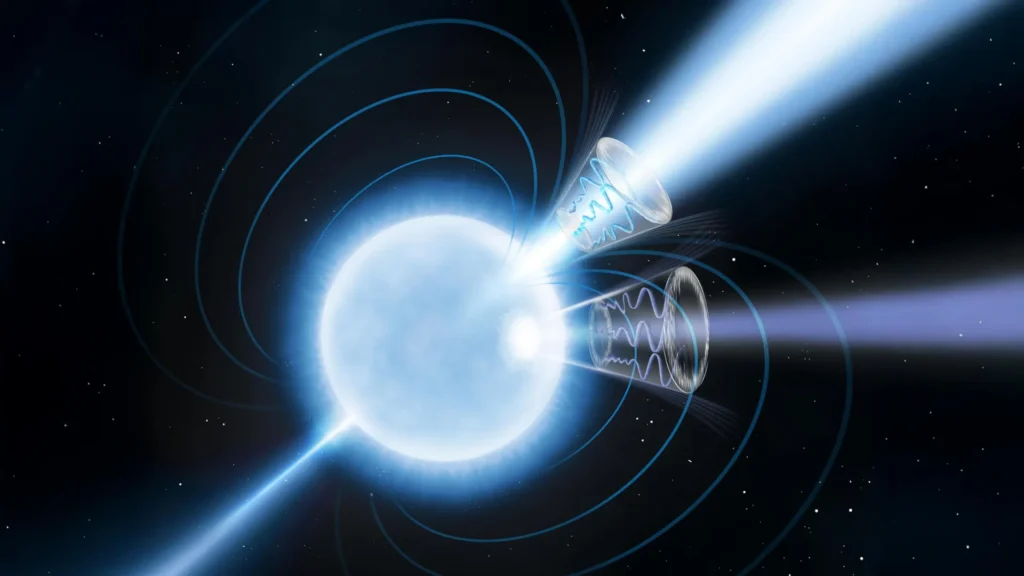
Nearly 90 years after theoretical physicist Werner Heisenberg first posited the existence of vacuum birefringence, a peculiar quantum effect where seemingly empty space can alter the behavior of light, scientists may have finally found conclusive evidence for this phenomenon. The groundbreaking observations, centered on one of the universe’s most extreme objects—a magnetar—offer a tantalizing glimpse into the quantum fabric of reality and could revolutionize our understanding of fundamental physics under conditions unattainable on Earth. This long-sought confirmation would validate a key prediction of Quantum Electrodynamics (QED), one of the most successful theories in modern physics, and open new avenues for exploration in the cosmos.
Heisenberg’s Enduring Legacy: A Quantum Prediction from the 1930s
The journey to potentially confirm vacuum birefringence began in the nascent days of quantum mechanics. In 1936, Werner Heisenberg, along with Hans Euler, published a pioneering paper that explored the quantum nature of the vacuum itself. Their work, predating the full development of Quantum Electrodynamics (QED), suggested that even a perfect vacuum is not truly empty, but rather a seething sea of "virtual particles." These ephemeral particles, including electron-positron pairs, are thought to constantly pop into and out of existence for fleeting moments, governed by the Heisenberg uncertainty principle.
According to this early quantum prediction, an extraordinarily strong electromagnetic field could polarize these virtual particles, much like a crystal polarizes light. This interaction would cause the vacuum itself to become birefringent, meaning it would affect light differently depending on the light’s polarization direction. For light passing through such a magnetized vacuum, its polarization plane would rotate, a distinctive signature of this quantum effect. Despite the profound implications for our understanding of the vacuum, the immense magnetic fields required to induce a detectable effect were—and largely remain—far beyond the capabilities of terrestrial laboratories. Decades of work with particle accelerators and advanced laser experiments have pushed the boundaries, but the sheer scale of the magnetic fields needed has rendered definitive laboratory confirmation elusive.
Decoding Vacuum Birefringence: A Quantum Optical Phenomenon
To fully appreciate the significance of this discovery, it is crucial to understand vacuum birefringence (VB) itself. In classical optics, birefringence occurs when light passes through certain anisotropic materials, like calcite crystals. These materials have different refractive indices for different polarizations of light, causing a single ray of unpolarized light to split into two polarized rays that travel at different speeds. The vacuum, in classical physics, is considered an isotropic medium with a refractive index of exactly one, meaning light travels through it uniformly regardless of polarization.
However, QED introduces a radical departure from this classical view. Within QED, the vacuum is not void but a dynamic medium filled with virtual particles. These virtual electron-positron pairs, though existing for infinitesimally short durations, can be influenced by external electromagnetic fields. When an intense magnetic field permeates a vacuum, these virtual pairs become transiently aligned with the field lines. This alignment effectively imparts a directional anisotropy to the vacuum itself, mimicking the properties of a birefringent crystal. Consequently, light propagating through this magnetized vacuum experiences a tiny, yet measurable, difference in its refractive index depending on whether its polarization is parallel or perpendicular to the magnetic field. This difference manifests as a rotation in the plane of polarization of the light, offering a unique observational signature of VB. The challenge lies in the minuscule nature of this effect; the refractive index difference is incredibly small, requiring magnetic fields orders of magnitude stronger than anything that can be sustained on Earth.
The Cosmic Laboratory: Unveiling the Power of Magnetars
The key to potentially unlocking Heisenberg’s nearly century-old prediction lies not in terrestrial experiments but in the most extreme cosmic environments imaginable. Magnetars, a rare subtype of neutron stars, are the universe’s most powerful known magnets. These incredibly dense stellar remnants are formed from the supernova collapse of massive stars. Packed into a sphere only about 20 kilometers (12 miles) in diameter—roughly the size of a city—is more mass than our Sun. What truly sets magnetars apart, however, are their unfathomable magnetic fields.
While a typical laboratory magnet might generate fields of a few Tesla (tens of thousands of Gauss), and even the most powerful superconducting magnets reach tens of Tesla, magnetars boast surface magnetic fields exceeding 10^10 Tesla (10^14 Gauss), and potentially even higher in their interiors. To put this into perspective, these fields are over a trillion times stronger than Earth’s magnetic field and over 100 million times stronger than anything ever created in a laboratory. Such extreme conditions are precisely what theory predicts are necessary to make the subtle effects of vacuum birefringence detectable. Dr. Marcus Lower, an Australian Research Council DECRA Fellow at the Center for Astrophysics and Supercomputing (CAS) at Swinburne University of Technology, emphasized this point: "Detecting vacuum birefringence requires a magnetic field that is over 100 million times stronger than any we’ve ever made on Earth. Thankfully, nature has provided us with magnetars, which are the perfect cosmic laboratories to go looking for this effect."
A Collaborative Quest: Observing Magnetar 1E 1547.0-5408
The recent study, published in the prestigious journal Nature, represents a monumental collaborative effort involving scientists from numerous institutions worldwide. Key contributors included the Center for Space Sciences and Technology, the South African Radio Astronomy Observatory (SARAO), the Los Alamos National Laboratory, NASA’s Marshall Space Flight Center, the Center for Research and Exploration in Space Science & Technology (CRESST), and the Astrophysics Science Division at NASA’s Goddard Space Flight Center, alongside various universities. The research was notably led by Rachael E. Stewart, a Graduate Student of Physics at George Washington University, highlighting the significant contributions of emerging scientists in this field.
The team focused their observations on a specific magnetar, 1E 1547.0-5408 (often simply referred to as 1E1547). This particular magnetar, located approximately 15,000 light-years away in the constellation Carina, is one of the fastest-spinning known magnetars, completing a rotation in just 2.07 seconds. Its relative proximity and active nature make it an excellent target for detailed study.
The observational campaign was multifaceted, combining data from several cutting-edge astronomical instruments:
- CSIRO’s Murriyang (Parkes) Radio Telescope: Dr. Marcus Lower spearheaded the radio observations using this iconic 64-meter dish in Australia. Radio waves emitted by magnetars are a crucial probe of their magnetospheres and surrounding environments. The resulting data from Murriyang were meticulously analyzed using Swinburne University’s Ngarrgu Tindebeek supercomputer.
- NASA’s Imaging X-ray Polarimetry Explorer (IXPE): Launched in 2021, IXPE is a space-based observatory specifically designed to measure the polarization of X-rays from cosmic sources. X-ray polarization provides unique information about the magnetic fields and particle acceleration mechanisms in extreme environments like magnetars. Its ability to detect subtle changes in X-ray polarization was paramount for this study.
- NICER X-ray Telescope (Neutron Star Interior Composition Explorer): Mounted on the International Space Station, NICER primarily measures X-ray timing and spectroscopy, providing complementary data on the magnetar’s emissions and rotation.
By tracking the orientation of the radio and X-ray waves’ oscillations (their "polarization state") as 1E1547 rotated, the scientists could precisely map the environment surrounding the magnetar. Crucially, their measurements revealed two key characteristics that made 1E1547 an ideal candidate for detecting vacuum birefringence:
- Nearly Aligned Axes: The magnetar’s magnetic axis and rotational axis were found to be almost perfectly aligned. This simplifies the interpretation of polarization signals, as the magnetic field geometry is more predictable.
- Pole-on Perspective: Observers on Earth view 1E1547 from a nearly pole-on perspective. This orientation means that light travels predominantly along the magnetic field lines for a significant portion of the magnetar’s rotation, maximizing the potential for observing vacuum birefringence effects.
The Quantum Signature: Highly Polarized X-rays
The most compelling evidence for vacuum birefringence emerged from the X-ray observations conducted by IXPE. The X-rays emanating from 1E1547 exhibited an exceptionally high degree of polarization, far greater than what would typically be expected from standard emission mechanisms in such an object. Moreover, and critically, the direction of this X-ray polarization remained consistently aligned with the magnetar’s inferred magnetic field as it rotated, mirroring the behavior of its radio waves.
Both these observations—the high degree of X-ray polarization and its alignment with the magnetic field—are considered strong indicators that vacuum birefringence may indeed be occurring in the extreme environment around the magnetar. Dr. Lower elaborated on the theoretical basis for this observation: "Because of the magnetic field’s strength, Heisenberg’s virtual particles become aligned with the direction the field is pointing. By carefully tracking the direction the radio waves and X-rays oscillate as the magnetar rotates, the team found that the alignment of 1E1547’s magnetic and rotational poles was ideal for detecting vacuum birefringence." This alignment of virtual particles creates the anisotropic vacuum medium predicted by QED, leading to the observed polarization effects.
Broader Implications for Quantum Electrodynamics and Beyond
If these results are definitively confirmed through further analysis and observation, the implications for physics would be profound. The direct detection of vacuum birefringence would represent a monumental experimental validation of Quantum Electrodynamics in conditions far beyond those achievable in terrestrial laboratories. QED is renowned for its extraordinary precision in describing the interactions between light and matter, making it one of the most rigorously tested theories in physics. However, testing its predictions in the extreme magnetic fields of magnetars pushes the theory to its absolute limits, probing aspects of the vacuum that have remained elusive.
Such a confirmation would not only solidify our understanding of the quantum vacuum but also open up entirely new avenues for fundamental research. Magnetars could become invaluable "natural laboratories" for studying quantum physics under conditions that cannot be replicated on Earth. This could lead to:
- Refining QED: While QED is incredibly successful, there are still open questions and potential areas for refinement, especially when confronted with such extreme conditions.
- Exploring New Physics: Deviations from QED predictions in these environments could hint at the existence of new particles or forces beyond the Standard Model of particle physics. For instance, some theories propose exotic particles like axions, which could interact with strong magnetic fields and influence light polarization.
- Understanding Extreme Astrophysical Phenomena: A better understanding of how light propagates through magnetar magnetospheres would also enhance our models of these mysterious objects themselves, shedding light on their emission mechanisms, energy dissipation, and evolution.
- Technological Advancement: While seemingly abstract, breakthroughs in fundamental physics often lay the groundwork for future technological innovations, albeit on long timescales.
The Path Forward: More Evidence and Advanced Simulations
While the current observations provide compelling evidence, the scientific community emphasizes the need for further confirmation before definitively declaring the discovery of vacuum birefringence. The journey started by Heisenberg nearly a century ago is far from over. Future research will focus on several critical areas:
- Additional Observations: Continued monitoring of 1E1547 and other suitable magnetars with instruments like IXPE and future observatories will be crucial to accumulate more data and verify the consistency of the observed polarization signatures. Observing different magnetars with varying geometries and field strengths could provide a broader dataset for comparison.
- Advanced Computer Simulations: Developing more sophisticated computer simulations is paramount. These simulations must accurately model the complex interactions between light, matter, and ultra-strong magnetic fields in magnetar environments. They will help differentiate between the unique signature of vacuum birefringence and other potential physical processes that could mimic similar polarization effects, such as resonant cyclotron scattering or anisotropic particle distributions in the magnetar’s plasma.
- Ruling Out Alternatives: Scientists must meticulously rule out any conventional astrophysical explanations for the observed polarization. This involves detailed analysis of the magnetar’s emission mechanisms, plasma properties, and the geometry of its magnetosphere.
As Dr. Lower optimistically stated, "With these future data on hand and our updated simulations, we may finally be able to complete the quest started by Heisenberg nearly 90 years ago." The potential confirmation of vacuum birefringence would not only be a triumph for theoretical physics but also a testament to humanity’s enduring quest to unravel the deepest secrets of the universe, leveraging the most powerful natural laboratories it has to offer. The quantum vacuum, once thought to be empty, continues to reveal itself as a vibrant and dynamic stage for the fundamental laws of nature.