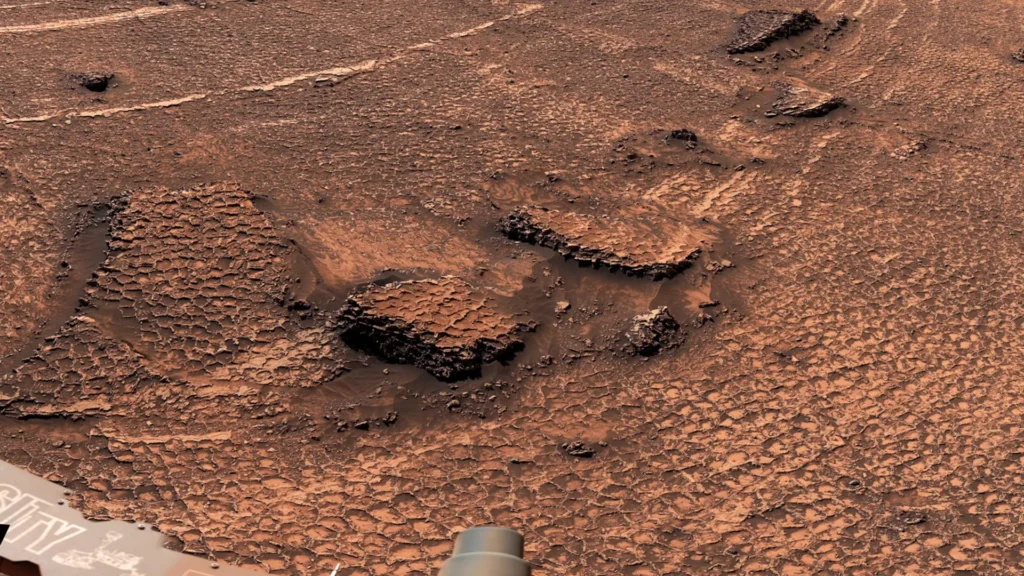
NASA’s Mars Science Laboratory rover, Curiosity, has made a breathtaking discovery within a Martian valley nicknamed "Valle Grande," uncovering an expansive landscape patterned with geometric, honeycomb-like formations. These polygonal fractures, each measuring approximately 1.5 to 3 inches (4 to 8 centimeters) across, stretch across the terrain as far as the rover can observe, presenting an unprecedented geological spectacle on the Red Planet. While Curiosity has previously documented smaller aggregations of similar geometric shapes, the sheer scale of this newly revealed field in Valle Grande is extraordinary and has captivated the scientific community.
A Monumental Discovery in Valle Grande
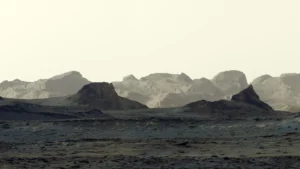
The remarkable extent of these polygonal formations was captured in a comprehensive 360-degree panorama taken by Curiosity on June 19 and 20, during the 4,930th and 4,931st Martian days, or sols, of its mission. The images reveal a seemingly endless expanse of these intricate patterns carpeting the valley floor and even ascending the flanks of a nearby butte, dubbed "Miraflores." This prominent geological feature rises about 20 feet (6 meters) above the surrounding landscape and is distinguished by a thick cap of sand.
"We’ve seen a lot of fascinating landscapes through Curiosity’s eyes, but this sea of polygons took our breath away," stated Ashwin Vasavada, the mission’s project scientist at NASA’s Jet Propulsion Laboratory (JPL) in Southern California. "We measured their shapes and chemistry carefully and are hopeful there are clues in the data as to how these features formed." The unprecedented scale of this discovery suggests that the geological processes responsible for creating these patterns were active over a significant area, offering a unique opportunity to study Martian geological history in detail.
Unraveling the Mystery of the Honeycomb Patterns
The origin of these striking polygonal formations has long been a subject of scientific inquiry. Previously observed polygons on Mars, examined by Curiosity, have shown clear evidence of originating from cracks in drying mud. However, the formation of such geometric patterns can be attributed to several distinct geological mechanisms.
One primary hypothesis involves the cyclical process of warming and cooling. As Martian soil, rich in moisture, undergoes repeated temperature fluctuations, it can expand and contract. This mechanical stress can lead to the formation of cracks that propagate through the material, often resulting in polygonal geometries. The size and regularity of these polygons can offer insights into the magnitude and frequency of these temperature cycles.
Another significant factor contributing to polygonal fracture formation is compression. This process can occur when sediments are buried beneath subsequent layers. The pressure exerted on the buried material can force interstitial water out, leading to desiccation and contraction. This contraction can, in turn, induce cracking and the formation of polygonal patterns. The presence of buried layers and the properties of the soil and any contained water are crucial in understanding this mechanism.
Scientists are now meticulously analyzing the data gathered from the new formations in Valle Grande. By examining the precise shapes, sizes, and chemical composition of these polygons, researchers aim to determine which of these processes, or perhaps a combination of them, was responsible for shaping this particular Martian landscape. The careful measurement of crack widths, polygon angles, and the presence of specific mineral indicators will be vital in distinguishing between different formation theories.
A Legacy of Martian Surprises: Fourteen Years of Discovery
The monumental polygon field in Valle Grande represents the latest in a remarkable series of unexpected and significant discoveries made by the Curiosity rover since its landing on Mars on August 5, 2012. Over its 14-year mission, Curiosity has traversed diverse terrains within Gale Crater, providing an unprecedented look into the planet’s geological and environmental past.
During its extensive exploration, Curiosity has encountered an array of unusual geological features, including crystalline sulfur deposits that hint at past hydrothermal activity, highly reflective meteoritic fragments, and intricate rock formations that tell stories of ancient Martian environments. Beyond these visually striking finds, Curiosity’s most profound contribution has been its role in fundamentally altering our understanding of ancient Mars. The rover’s findings have unequivocally demonstrated that the Red Planet once harbored conditions conducive to life, including the presence of liquid water, essential chemical ingredients, and vital nutrients.
Evidence of Mars’ Watery Past: A Cradle for Life?
Billions of years ago, the landscape within Gale Crater was dramatically different from the arid desert we see today. Evidence gathered by Curiosity indicates that lakes and streams were once widespread across the lower foothills of Mount Sharp, the 3-mile-tall (5-kilometer-tall) mountain that has been the rover’s primary destination since its descent into the crater in 2014.
The rover has meticulously collected chemical traces left behind by this ancient, wetter period. Among the most significant discoveries are carbon-based molecules, the fundamental building blocks of life as we know it. Some of these organic molecules have been identified as potential precursors to RNA and DNA, the nucleic acids that carry genetic information in all known life forms.
While the presence of these organic molecules is a critical finding, scientists emphasize that their origin remains an open question. They could have been produced through biological processes, originating from ancient Martian life, or they could have formed through abiotic, or geological, processes. Both explanations remain scientifically plausible, and ongoing research seeks to differentiate between these possibilities. Regardless of their origin, the confirmation that ancient Mars possessed the necessary chemical ingredients for life significantly bolsters the hypothesis that the planet could have once supported microbial ecosystems.
Broader Implications for Planetary Science and Astrobiology
The discovery of the "sea of polygons" in Valle Grande is not merely a visually stunning geological find; it carries significant implications for our understanding of planetary evolution and the potential for life beyond Earth. The scale and complexity of these formations suggest that Mars has experienced prolonged periods of dynamic geological activity, potentially involving significant hydrological cycles and thermomechanical stresses.
The investigation into the formation of these polygons could provide crucial insights into the climate history of Mars, offering clues about past temperature regimes, precipitation patterns, or subsurface water movement. If these formations are indeed linked to repeated freezing and thawing cycles or subsurface water expulsion, they would paint a picture of a more geologically active and potentially wetter Mars than some models have suggested for certain periods.
Furthermore, the continued exploration of regions like Valle Grande, known for their geological diversity and potential for preserving ancient biosignatures, remains a top priority for astrobiology. Each new discovery, from complex organic molecules to intricate geological patterns, adds another piece to the puzzle of Mars’ habitability. The success of the Curiosity mission, and its ongoing contributions, underscores the value of long-term, in-situ exploration of other worlds.
The Role of NASA’s Mars Exploration Program
The Curiosity rover is a testament to the dedication and ingenuity of NASA’s Mars Exploration Program. Managed by the California Institute of Technology (Caltech) in Pasadena, JPL leads the mission on behalf of NASA’s Science Mission Directorate in Washington. This collaborative effort has consistently pushed the boundaries of our knowledge about Mars, revealing a planet far more complex and dynamic than previously imagined.
The enduring success of Curiosity, now in its 14th year of operation, highlights the importance of sustained investment in planetary science and robotic exploration. The data collected by the rover continues to inform future mission planning, including the Perseverance rover’s ongoing search for signs of ancient microbial life and sample return objectives, as well as conceptual designs for future human missions to Mars. The "sea of polygons" is another compelling chapter in this ongoing narrative, reminding us that Mars still holds many secrets waiting to be uncovered. The scientific community eagerly anticipates further analysis of the data from Valle Grande, which promises to deepen our understanding of this enigmatic world and the processes that have shaped it over billions of years.