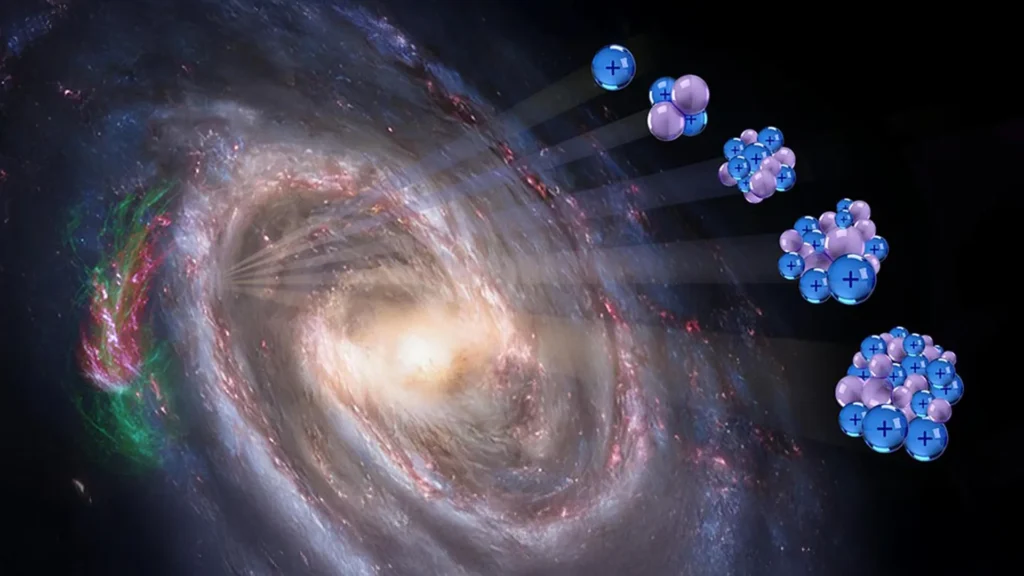
For over a century, scientists have been grappling with the enigma of cosmic rays—incredibly powerful particles that traverse the vast expanse of the universe at extreme energies. Despite persistent research spanning decades, fundamental questions surrounding their precise origins and the mechanisms behind their astonishing acceleration have largely eluded definitive answers. Now, a significant breakthrough by researchers leveraging data from the DAMPE (Dark Matter Particle Explorer) space telescope promises to shed new light on this enduring cosmic mystery. Their groundbreaking findings, meticulously detailed and published in the prestigious journal Nature, pinpoint a common, overarching feature shared by these elusive particles, a discovery poised to profoundly advance scientific understanding of their genesis.
The Enduring Mystery of Cosmic Rays
Cosmic rays represent the highest-energy particles ever observed in the natural world. Their individual energies far surpass those achievable even by the most advanced particle accelerators here on Earth, such as the Large Hadron Collider. Scientists have long theorized that these particles are forged in some of the most cataclysmic and violent phenomena known in the universe. These include the explosive remnants of supernovae, the powerful relativistic jets emanating from supermassive black holes at the centers of galaxies, and the rapidly spinning, highly magnetized neutron stars known as pulsars. Pinpointing which of these extreme astrophysical environments are the primary factories for cosmic rays, and how they impart such immense energy, has been a central challenge in astrophysics.
The journey to understand cosmic rays began over 100 years ago. In 1912, Austrian physicist Victor Hess made pioneering balloon flights that demonstrated an increase in ionizing radiation with altitude, leading to the discovery of cosmic rays, for which he later received the Nobel Prize. Subsequent research revealed their diverse composition, predominantly protons (atomic nuclei of hydrogen), but also including heavier atomic nuclei like helium, carbon, oxygen, and iron, as well as electrons and positrons. These particles constantly bombard Earth’s atmosphere, initiating cascades of secondary particles that are detectable on the ground. Studying these primary cosmic rays before they interact with the atmosphere requires instruments in space, making missions like DAMPE indispensable.
DAMPE: A Beacon for High-Energy Astrophysics
Launched in December 2015 from the Jiuquan Satellite Launch Center in China aboard a Long March 2D rocket, the DAMPE space telescope, also known as "Wukong" (after the mythical Monkey King), was specifically engineered to address critical questions in high-energy astrophysics. Its primary mission objectives included a comprehensive investigation into the nature of cosmic rays, particularly their spectra and composition at very high energies, and an exploration of potential connections between cosmic rays and the elusive dark matter—a hypothetical form of matter thought to constitute roughly 27% of the universe’s mass.
The DAMPE mission is a testament to international scientific collaboration, featuring major contributions from institutions across China, Switzerland, and Italy. Notably, the astrophysics group at the Department of Nuclear and Particle Physics (DPNC) at the University of Geneva (UNIGE) played a crucial role in the mission’s development and ongoing data analysis. DAMPE is equipped with a sophisticated suite of detectors designed to precisely measure the energy, charge, and direction of incoming cosmic ray particles. Its main detectors include the Plastic Scintillator Detector (PSD) for charge measurement, the Silicon-Tungsten Tracker (STK) for precise trajectory reconstruction and charge identification, the Bismuth Germanate (BGO) calorimeter for energy measurement, and the Neutron Detector (NUD) for distinguishing between electrons and protons. This multi-layered approach allows DAMPE to achieve unprecedented accuracy in its observations of high-energy cosmic rays and gamma rays.
Unveiling a Universal Pattern: Spectral Softening
By meticulously analyzing highly precise data collected by DAMPE over several years, the research team made a profound discovery: a universal pattern embedded within the energy spectra of primary cosmic ray nuclei. This pattern manifests across a wide range of nuclei, from the lightest, most abundant protons, to much heavier iron nuclei.
"Cosmic rays are primarily composed of protons, but also of helium, carbon, oxygen, and iron nuclei," explains Andrii Tykhonov, an associate professor at the DPNC in the Faculty of Science at UNIGE, and a co-author of the seminal study. He further elaborates on the categorization of these particles by their energy levels: "These particles are also categorised according to their energy: low, up to a few billion electron-volts (GeV); intermediate, from a few billion to several hundred billion electron-volts (GeV); and high, from 1,000 billion electron-volts (TeV) and beyond."
The core finding of the research is that for every type of nucleus studied, the observed number of particles begins to decrease much more rapidly after reaching a certain energy threshold. This phenomenon is scientifically termed "spectral softening." In general, it is expected that higher-energy cosmic rays are less common than lower-energy ones; the universe simply produces fewer particles at extreme energies. However, the DAMPE observations revealed that this natural decline in particle flux becomes dramatically steeper and more pronounced beyond a rigidity of approximately 15 TV (teraelectron-volts).
Rigidity: The Key to Cosmic Ray Behavior
The concept of "rigidity" is central to this discovery. Rigidity, often expressed in volts (V), represents a particle’s momentum-to-charge ratio. More precisely, it describes how strongly a particle’s path resists being bent or deflected by magnetic fields. A particle with higher rigidity will follow a straighter path through a magnetic field compared to a particle with lower rigidity, assuming similar initial trajectories. In the context of cosmic rays, which must navigate the intricate and pervasive magnetic fields of interstellar space within our galaxy, as well as potentially intergalactic magnetic fields, rigidity plays a critical role in their propagation.
The observation that this "spectral softening" feature appears consistently across many different types of cosmic ray particles—protons, helium, carbon, oxygen, and iron nuclei—provides extremely strong support for theoretical models that propose cosmic ray acceleration and their subsequent movement through space are primarily governed by rigidity. This universality suggests a common mechanism at play, irrespective of the particle’s mass or atomic number, as long as its charge-to-mass ratio is consistent with typical atomic nuclei.
Crucially, this comprehensive dataset from DAMPE largely rules out competing explanations for cosmic ray behavior that are based on "energy per nucleon." Energy per nucleon refers to the total kinetic energy of a particle divided by the number of nucleons (protons and neutrons) it contains. If cosmic ray acceleration and propagation were primarily dependent on energy per nucleon, different types of nuclei would exhibit spectral features at different total energies, since heavier nuclei have more nucleons. The DAMPE data, however, shows the softening occurring at the same rigidity for various nuclei, effectively refuting models centered on energy per nucleon. According to the researchers, the confidence level against these alternative models reaches an astounding 99.999%, a statistical certainty that strongly validates their rigidity-dependent hypothesis.
The Role of AI and Advanced Detectors: Geneva’s Contribution
The breakthrough achieved by DAMPE is not merely a testament to the telescope’s advanced hardware but also to the sophisticated analytical techniques employed by the international collaboration. Researchers from Geneva, Switzerland, played an indispensable role in this discovery, particularly through their expertise in data science and detector technology.
The UNIGE team developed and implemented highly sophisticated artificial intelligence (AI) and machine learning methods to reconstruct particle events detected by the telescope. Cosmic ray detection is a complex process; when a high-energy particle strikes a detector, it produces a cascade of signals. AI algorithms are crucial for accurately interpreting these signals, distinguishing between different particle types, determining their precise energies, and reconstructing their trajectories with high fidelity. This advanced data processing capability was fundamental to extracting the subtle, yet universal, "spectral softening" pattern from the raw detector data.
Beyond AI, the Geneva group also made significant direct contributions to critical measurements. They were instrumental in analyzing and understanding the fluxes of protons and helium nuclei, which constitute the most abundant components of cosmic rays. Furthermore, their expertise extended to the analysis of carbon nuclei data, providing key pieces of the puzzle that ultimately revealed the rigidity-dependent pattern across different particle species.
In a cornerstone contribution, the Geneva group led the development and construction of one of DAMPE’s key instruments: the Silicon-Tungsten Tracker (STK). This detector is absolutely essential for the mission’s success. The STK is designed to accurately trace the paths of incoming charged particles through multiple layers of silicon sensors. By precisely measuring the deflection of these particles in a magnetic field (though DAMPE itself doesn’t have a magnet, it relies on the particles’ interactions with the detector material and precise timing), and by determining the amount of energy deposited in its layers, the STK enables the accurate determination of a particle’s electrical charge. Knowing the charge is vital for calculating the particle’s rigidity and for distinguishing between different types of nuclei, which is paramount for detailed spectral analysis. The STK’s high resolution and robust performance were critical enablers for the precision measurements that led to this discovery.
Broader Impact and Future Implications
The findings from the DAMPE mission mark a pivotal advance in our comprehension of how cosmic rays are accelerated to extreme energies and how they subsequently travel through the vast and complex magnetic landscapes of our galaxy. By establishing that cosmic ray spectra exhibit a universal softening at a specific rigidity, the new results place much tighter constraints on existing theoretical models of particle acceleration in astrophysical sources.
For decades, models like Fermi acceleration (particularly diffusive shock acceleration at supernova remnants) have been the leading candidates for accelerating cosmic rays. This new data suggests that the efficiency of these acceleration mechanisms, or the escape of particles from their acceleration sites, must be rigidity-dependent. This means that at a certain rigidity, particles find it harder to gain more energy or are more prone to escaping the magnetic confinement of the acceleration region. This insight will necessitate refinements to these models, pushing theorists to incorporate rigidity-dependent parameters more explicitly.
Furthermore, the discovery profoundly improves our understanding of how high-energy particles propagate through interstellar space. The Milky Way galaxy is permeated by a complex network of magnetic fields. As cosmic rays traverse these fields, their paths are bent and scattered. The observed spectral softening at 15 TV rigidity suggests that the transport properties of cosmic rays—how quickly they diffuse or escape the galaxy—are also rigidity-dependent. This implies that higher rigidity particles might escape the galaxy more readily, leading to their reduced abundance at extreme energies. This finding will help refine models of cosmic ray diffusion and convection within the galactic halo, ultimately leading to a more accurate picture of the cosmic ray "budget" and lifetime within our galaxy.
The implications extend beyond just cosmic ray origins. A more precise understanding of cosmic ray spectra is also crucial for the search for dark matter. Many dark matter detection strategies involve looking for subtle anomalies in cosmic ray fluxes that could be produced by the annihilation or decay of dark matter particles. By better characterizing the "astrophysical background" of standard cosmic rays, scientists can more effectively distinguish potential dark matter signals from the noise of conventional particle interactions. The DAMPE results, by providing a clearer picture of this background, contribute indirectly but significantly to the ongoing quest for dark matter.
The DAMPE mission, planned for a three-year operational lifetime, has far exceeded expectations, continuing to collect valuable data well beyond its initial design. This longevity, coupled with the precision of its instruments and the ingenuity of its scientific teams, underscores the power of dedicated space-based observatories. This latest publication in Nature is a testament to the collaborative spirit of international science and a significant step forward in unraveling one of the universe’s most enduring and energetic mysteries. While many questions about cosmic rays still remain, the universal rigidity-dependent spectral softening uncovered by DAMPE provides a firm new footing for future investigations, guiding astronomers and particle physicists toward a more complete understanding of the extreme universe.