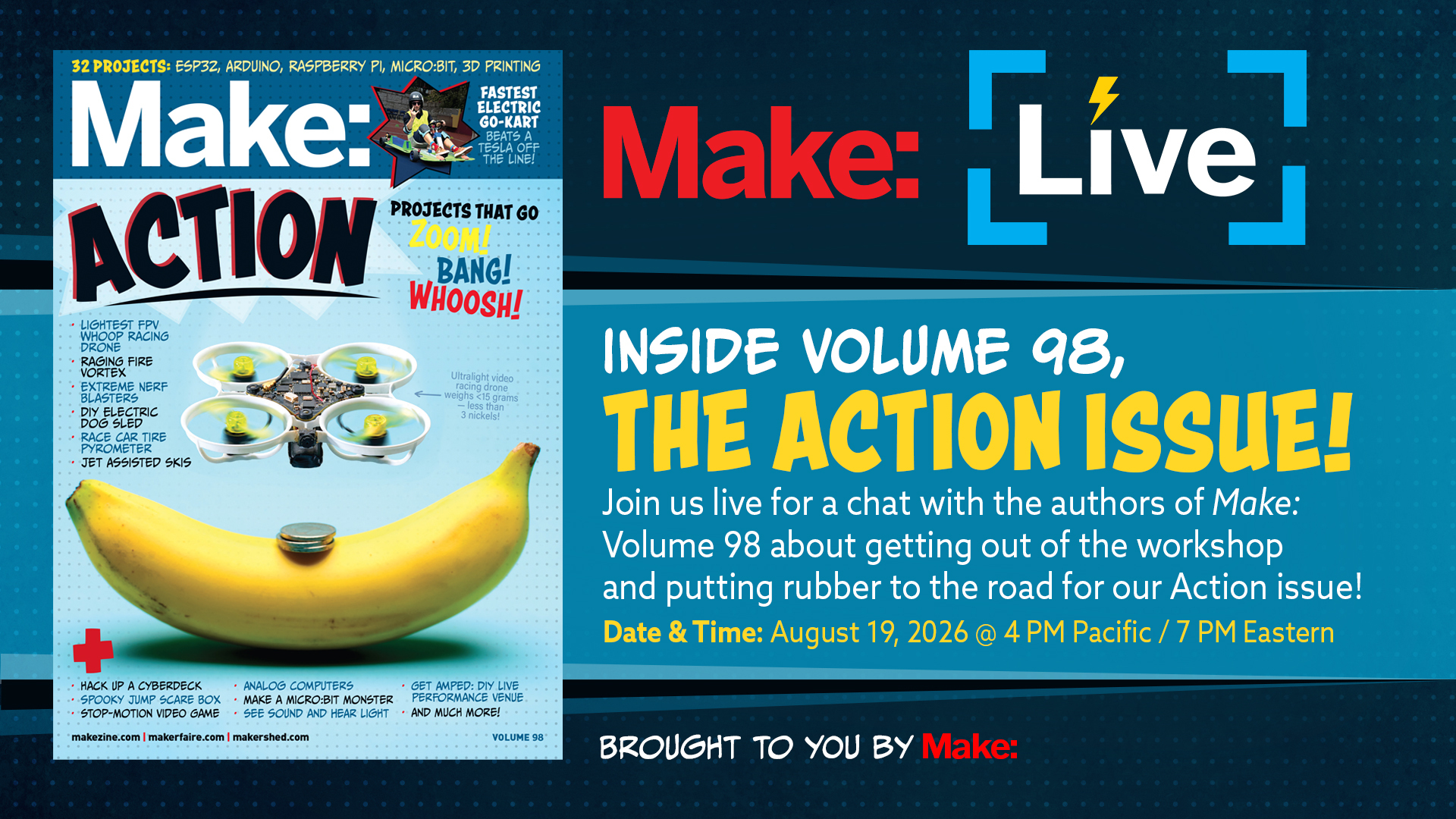
The editorial leadership of Make: Magazine has announced a comprehensive live-streamed event scheduled for Wednesday, August 19, 2026, at 4:00 PM Pacific Time, to showcase the technical innovations featured in its latest publication, Volume 98. Titled "The Action Issue," this edition marks a strategic shift in the magazine’s focus, moving from stationary workshop projects toward high-performance, mobile, and kinetic engineering. The upcoming live broadcast is designed to provide a platform for prominent inventors and engineers to demonstrate their latest builds, ranging from high-acceleration electric vehicles to sophisticated jet-propulsion systems for winter sports.
The event serves as a digital town hall for the global maker community, facilitating direct interaction between the creators and an audience of hobbyists, professional engineers, and educators. By focusing on "Action," the editorial board aims to highlight the increasing accessibility of high-grade components—such as high-torque brushless motors, advanced lithium-polymer batteries, and micro-turbine technology—which were previously reserved for industrial or military applications.
High-Performance Electrification: The Saul Griffith AWD Go-Cart
A primary highlight of the Volume 98 showcase is the work of Saul Griffith, a renowned engineer, inventor, and MacArthur "Genius" Grant recipient. Griffith, who has long been a proponent of aggressive decarbonization through electrification, will present an all-wheel-drive (AWD) electric go-cart. This project is positioned not merely as a recreational vehicle but as a demonstration of the power-to-weight advantages inherent in modern DIY electric drivetrains.
According to preliminary technical briefs, Griffith’s go-cart utilizes a sophisticated power management system that allows for instantaneous torque delivery. The vehicle is theoretically capable of outperforming high-end commercial electric vehicles, such as those produced by Tesla, in short-distance acceleration tests (zero to thirty miles per hour). This feat is achieved through the elimination of heavy structural components found in consumer automobiles and the optimization of individual motor controllers for each wheel. The discussion during the live stream is expected to delve into the mathematics of traction control and the specific battery chemistry required to sustain high-discharge rates without thermal runaway.
The Evolution of Competitive Foam Blasting
The "Action Issue" also addresses the growing subculture of competitive foam tag, a hobby that has evolved from simple children’s toys into a sophisticated field of mechanical engineering. Ryan Cho, a representative from Bay Area Foam Tag, will discuss the engineering rigor required to build and maintain custom "Nerf-style" blasters used in high-intensity sporting events.
In the last decade, the "maker" influence on this hobby has resulted in the development of 3D-printed internals, high-tension spring mechanisms, and flywheel systems capable of propelling foam darts at velocities exceeding 200 feet per second. Cho’s presentation will focus on the iterative design process, highlighting how community-driven open-source designs have forced a paradigm shift in how recreational projectiles are manufactured. The segment will also touch upon the logistical challenges of organizing large-scale "Foam Tag" events, which require rigorous safety protocols and specialized field equipment.
Mechanical Illusion and the Engineering of Fear
As the publication date approaches the autumn season, Volume 98 incorporates elements of "scare-tech" and theatrical engineering. Bizzaro, a professional magician and escape room designer, is set to reveal a Halloween-themed treasure box that utilizes mechanical triggers to deliver a "surprise scare."
The intersection of magic and engineering—often referred to as "automata" in historical contexts—requires a deep understanding of timing, sensor integration, and human psychology. Bizzaro’s contribution demonstrates how makers can use low-cost microcontrollers, such as Arduinos or ESP32s, to create immersive environments. The discussion will likely provide insights into the durability of such builds, which must withstand repeated use by the public in high-stress environments like haunted houses or escape rooms.
Portable Aviation: Handheld Jet Turbines for Skiing
Perhaps the most extreme application of "Action" in this issue is the work of Alex, the creator behind the "Methodical Maker" platform. Alex has developed handheld jet turbines designed to provide supplemental thrust for skiers. This project represents a significant leap in DIY aerospace engineering, involving the stabilization of micro-turbines that can rotate at speeds exceeding 100,000 RPM.
The engineering challenges associated with handheld turbines are immense, involving fuel delivery systems, heat dissipation, and gyroscopic effects that can impact the user’s balance. Alex’s segment is expected to focus on the "methodical" nature of the build—stressing the importance of safety margins and rigorous testing when dealing with combustible fuels and high-velocity rotating masses. This project exemplifies a broader trend in the maker community where individuals are increasingly tackling "prosumer" level aerospace challenges at home.
The Broader Context of the Maker Movement in 2026
The release of Make: Volume 98 and its accompanying live stream occurs at a pivotal moment for the maker movement. Since its inception in 2005, Make: Magazine has tracked the transition from basic "do-it-yourself" repairs to the creation of complex, original hardware. In 2026, the availability of desktop CNC mills, high-speed 3D printers, and sophisticated simulation software has lowered the barrier to entry for advanced engineering.
Data from recent industry reports suggest that the global maker market—encompassing tools, components, and educational resources—has grown by approximately 12% annually over the last five years. This growth is driven by a desire for personalized technology and a growing skepticism toward the "black box" nature of proprietary consumer electronics. The projects featured in the "Action Issue" are emblematic of this shift; they are transparent, repairable, and highly optimized for specific performance metrics that commercial products often ignore.
Technical Implications and Safety Standards
A recurring theme in the upcoming live chat will be the balance between innovation and safety. As DIY projects move "out of the workshop and onto the road," they enter the realm of kinetic energy and potential liability. The engineers featured in Volume 98 are expected to address how they mitigate risks through redundant systems, protective gear, and rigorous software debugging.

For instance, the use of handheld jet turbines or high-speed go-carts requires a fundamental understanding of physics that goes beyond simple assembly. The "Methodical Maker" approach emphasizes the documentation of failure points, a practice that the editorial team at Make: has long championed. By sharing these processes live, the authors provide a roadmap for others to follow, ensuring that the pursuit of "action" does not come at the expense of physical safety.
Interactive Engagement and Community Response
The live format on August 19 is designed to foster a two-way dialogue. Viewers will be able to submit questions via the Make: Discord server, a platform that has become the central hub for the magazine’s community discussions. Early reactions on social media indicate a high level of interest in Saul Griffith’s AWD system, with many enthusiasts eager to see if his design can be adapted for smaller personal mobility devices or larger utility vehicles.
The maker community’s response to the "Action" theme has been largely positive, with many noting that the focus on mobility and outdoor testing is a refreshing change from the software-heavy or purely aesthetic projects that often dominate the DIY space. There is a clear appetite for projects that result in tangible, high-energy experiences.
Conclusion and Future Outlook
Make: Volume 98, The Action Issue, represents more than just a collection of projects; it is a testament to the current state of independent engineering. By bringing together experts like Saul Griffith, Ryan Cho, Bizzaro, and Alex the Methodical Maker, the magazine continues to push the boundaries of what is possible for the individual creator.
The live stream on Wednesday, August 19, 2026, will likely serve as a catalyst for a new wave of builds, as viewers take the principles of electrification, propulsion, and mechanical design and apply them to their own unique challenges. As technology continues to decentralize, the role of publications like Make: in providing a curated, high-quality venue for knowledge exchange remains more critical than ever. Those interested in the future of DIY technology and high-performance making are encouraged to secure a copy of Volume 98 through the Maker Shed and participate in the upcoming digital event.