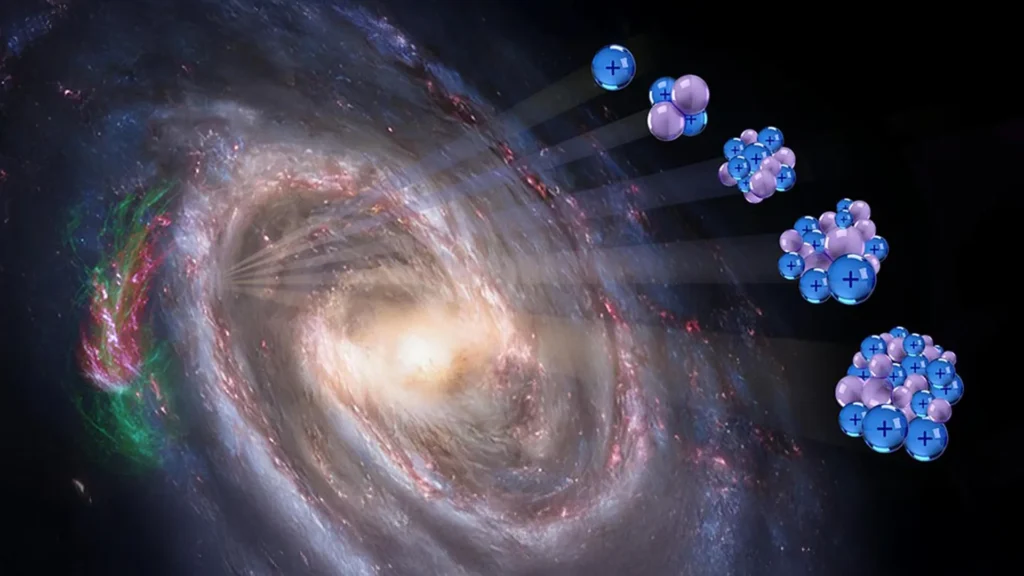
For more than a century, scientists have grappled with the profound mysteries surrounding cosmic rays—incredibly powerful particles that traverse the universe at energies far beyond anything achievable on Earth. Despite extensive research spanning decades, fundamental questions concerning their precise origins and the mechanisms by which they are accelerated to such extreme energies have largely remained unanswered. A significant new clue has now emerged from researchers utilizing the DAMPE (Dark Matter Particle Explorer) space telescope. Their groundbreaking findings, meticulously detailed in the prestigious journal Nature, reveal a universal characteristic shared across various types of these enigmatic particles, promising to fundamentally advance scientific comprehension of their genesis.
The Enduring Enigma of Cosmic Rays
Cosmic rays represent the highest-energy particles ever observed in nature, carrying energies that dwarf those produced by even the most sophisticated particle accelerators on our planet, such as the Large Hadron Collider (LHC), which can accelerate protons to 6.5 teraelectron-volts (TeV) for collisions, resulting in a center-of-mass energy of 13 TeV. Cosmic rays, however, can reach energies up to 10^20 electron-volts (eV), or 100 exa-electron-volts (EeV), which is millions of times higher than the LHC’s capabilities for individual particles. Scientists widely postulate that these ultra-energetic particles are forged in some of the most cataclysmic and violent events in the cosmos, including the explosive deaths of massive stars (supernovae), the powerful jets emanating from supermassive black holes, and the rapidly spinning, highly magnetized remnants of supernovae known as pulsars. Understanding the precise contributions of these different sources, and the physics governing their acceleration processes, has been a central challenge in high-energy astrophysics.
The study of cosmic rays began in earnest in the early 20th century. In 1912, Austrian physicist Victor Hess famously conducted balloon experiments, ascending to altitudes of over 5,000 meters, where he observed that ionization levels in the atmosphere increased significantly with altitude. This groundbreaking discovery conclusively demonstrated the existence of a pervasive radiation originating from space, for which Hess was later awarded the Nobel Prize in Physics in 1936. Since then, an array of ground-based and space-based observatories has been developed to probe the nature of these particles, revealing their diverse composition. Cosmic rays are primarily composed of atomic nuclei, with protons (hydrogen nuclei) being the most abundant, followed by helium nuclei. Heavier nuclei, including carbon, oxygen, and iron, are also present, albeit in smaller proportions. Their energy spectrum spans an immense range, typically categorized into low (up to a few billion electron-volts or GeV), intermediate (from a few GeV to several hundred GeV), and high (from 1,000 GeV or 1 TeV and beyond) energy ranges. A well-known feature of this spectrum is the "knee" at around 10^15 eV (1 PeV) and the "ankle" at around 10^18 eV (1 EeV), where the power-law slope of the spectrum changes, hinting at different acceleration mechanisms or source populations at these energies.
The DAMPE Mission: A Cutting-Edge Cosmic Eye
The Dark Matter Particle Explorer (DAMPE) space telescope, affectionately nicknamed "Wukong" after the Monkey King in Chinese mythology, was launched into orbit on December 17, 2015, from the Jiuquan Satellite Launch Center in China. Conceived as a joint mission primarily led by the Chinese Academy of Sciences, DAMPE was specifically designed with dual primary objectives: to conduct highly precise measurements of the energy spectra and composition of high-energy cosmic rays, and to search for potential signatures of dark matter annihilation or decay in space. The mission represents a significant international scientific collaboration, with major contributions from European partners, including the astrophysics group at the Department of Nuclear and Particle Physics (DPNC) at the University of Geneva (UNIGE) in Switzerland.
DAMPE’s sophisticated payload consists of four main detectors: a Plastic Scintillator Detector (PSD) for charge measurement and anti-coincidence, a Silicon-Tungsten Tracker (STK) for precise particle trajectory reconstruction and charge identification, a BGO (Bismuth Germanate) electromagnetic calorimeter (ECAL) for energy measurement, and a Neutron Detector (ND) for hadron/electron discrimination. The combination of these instruments provides DAMPE with unprecedented capabilities to identify cosmic ray species and accurately measure their energies over a broad range, from a few GeV to several TeV for electrons and gamma rays, and up to hundreds of TeV for protons and heavy nuclei.
The Breakthrough: A Universal Cosmic Ray Pattern Uncovered
By meticulously analyzing the extensive and highly precise data collected by DAMPE since its launch, researchers identified a remarkable and previously unrecognized universal pattern in the energy spectra of primary cosmic ray nuclei. This pattern was observed across a wide range of nuclei, from the lightest (protons) to much heavier species like iron nuclei. The core of this discovery lies in the observation that for every type of nucleus studied, the number of particles detected begins to diminish much more rapidly after reaching a specific energy threshold. Scientists refer to this critical phenomenon as "spectral softening."
Typically, the flux of cosmic rays follows a power-law distribution, meaning that higher-energy particles become progressively less common as energy increases. However, DAMPE’s high-resolution observations revealed a dramatic shift in this decline. Beyond a specific threshold, the rate at which the particle count drops becomes significantly steeper. This critical transition point was found to occur consistently at a rigidity of approximately 15 teravolts (TV). Rigidity, a fundamental concept in particle physics, describes how strongly a charged particle’s path resists being bent by magnetic fields. It is defined as a particle’s momentum divided by its charge (R = p/Z, where p is momentum and Z is charge). This parameter is crucial for understanding how cosmic rays propagate through the galaxy, as their trajectories are constantly influenced by the complex, pervasive interstellar magnetic fields.
The profound significance of this finding stems from its universality. The fact that this identical feature—spectral softening at 15 TV rigidity—manifests across numerous distinct types of particles (protons, helium, carbon, oxygen, iron) provides compelling and robust support for theories that posit that both the acceleration of cosmic rays and their subsequent movement through the vast expanse of space are primarily controlled by rigidity, rather than solely by their total energy or energy per nucleon.
Rigidity vs. Energy Per Nucleon: A Decisive Verdict
For decades, theoretical models attempting to explain cosmic ray acceleration and propagation have largely fallen into two competing categories. One set of models proposed that the cut-off or softening in the spectrum is dependent on the total energy per nucleon (E/A, where A is the mass number of the nucleus). Under this hypothesis, particles with the same E/A would exhibit similar spectral features, regardless of their charge. The alternative set of models, strongly supported by the DAMPE findings, suggested that these phenomena are primarily rigidity-dependent. In a rigidity-dependent scenario, heavier nuclei (with larger charge Z) would experience the spectral softening at higher total energies compared to lighter nuclei, because their rigidity would be the same at that higher total energy.
The DAMPE data has provided a definitive answer, strongly disfavoring the energy-per-nucleon-dependent explanations. The observed common rigidity threshold of 15 TV for spectral softening across all measured nuclei stands as a direct refutation of models based on energy per nucleon. The statistical confidence level against these alternative models is remarkably high, reaching 99.999%. This level of certainty in scientific findings is rarely achieved and underscores the robustness of the DAMPE measurements and analysis. "This decisive evidence points towards a common acceleration mechanism or a universal propagation effect that acts on cosmic rays based on their rigidity, not just their raw energy," stated Dr. Jingjing Zang, a leading astrophysicist not directly involved with DAMPE, commenting on the implications of the Nature publication. "It allows us to refine our theoretical frameworks significantly."
Geneva’s Pivotal Role: AI and Advanced Instrumentation at the Forefront
Researchers from the University of Geneva played an indispensable role in this monumental breakthrough, contributing critical expertise and technological innovation to the DAMPE mission. The team at the Department of Nuclear and Particle Physics (DPNC) in the Faculty of Science at UNIGE developed highly sophisticated artificial intelligence (AI) methods. These advanced algorithms were crucial for accurately reconstructing the complex particle events detected by the telescope, sifting through vast amounts of raw data to identify and characterize individual cosmic ray interactions with unprecedented precision. This capability was vital for extracting the subtle spectral features that led to the discovery of the universal pattern.
Beyond data analysis, the Geneva group made significant contributions to key measurements, including those involving proton and helium fluxes, which are fundamental to understanding the overall cosmic ray spectrum. They also provided essential support in analyzing data pertaining to carbon nuclei, further strengthening the universality of the observed spectral softening.
Moreover, the UNIGE team led the design, development, and construction of one of DAMPE’s most critical instruments: the Silicon-Tungsten Tracker (STK). This state-of-the-art detector is absolutely essential for accurately tracing the paths of incoming cosmic rays and precisely determining their electrical charge. The STK’s exceptional spatial resolution and charge identification capabilities were paramount to distinguishing between different types of nuclei and accurately measuring their energies, without which the discovery of the common rigidity threshold would have been impossible. "The development of the STK was a monumental effort, requiring years of dedicated work and cutting-edge engineering," explains Andrii Tykhonov, associate professor at the DPNC in the Faculty of Science at UNIGE and a co-author of the study. "Its performance in orbit has exceeded our expectations, allowing us to gather the high-quality data necessary for such a profound discovery. Cosmic rays are primarily composed of protons, but also of helium, carbon, oxygen, and iron nuclei. These particles are also categorised according to their energy: low, up to a few billion electron-volts; intermediate, from a few billion to several hundred billion electron-volts; and high, from 1,000 billion electron-volts and beyond. Identifying and accurately measuring these different components at extreme energies is a formidable challenge that our technology helped overcome."
Decades of Inquiry: A Chronology of Cosmic Ray Science
The journey to this DAMPE discovery spans over a century of scientific endeavor:
- 1912: Victor Hess discovers cosmic radiation, marking the birth of cosmic ray physics.
- 1930s-1940s: Discovery of new particles like the positron and muon through cosmic ray interactions, driving the development of particle physics.
- 1960s-1970s: First satellite-borne detectors begin to provide more precise measurements of cosmic ray composition and spectra.
- 1990s-2000s: Development of large ground-based arrays (e.g., Pierre Auger Observatory) to detect ultra-high-energy cosmic rays, revealing the "ankle" in the spectrum and probing extragalactic origins.
- 2006: Launch of the Advanced Thin Ionization Calorimeter (ATIC) balloon experiment, providing early hints of spectral anomalies in electron cosmic rays.
- 2008: Launch of the Fermi Gamma-ray Space Telescope, contributing significantly to cosmic ray electron and gamma-ray studies.
- 2011: Launch of the Alpha Magnetic Spectrometer (AMS-02) on the International Space Station, delivering unprecedented precision in cosmic ray measurements.
- December 2015: Launch of the DAMPE space telescope, specifically designed for high-energy cosmic ray and dark matter research.
- 2017 onwards: DAMPE begins publishing its initial groundbreaking results, including an unexpected "break" in the electron cosmic ray spectrum.
- Recent Publication in Nature: The current discovery of the universal spectral softening at 15 TV rigidity across multiple nuclei types.
This chronological progression highlights a continuous scientific quest, with each new instrument and discovery building upon previous knowledge, gradually unveiling the complex picture of cosmic ray physics.
Unpacking the Implications: Refining Astrophysical Models
The findings from DAMPE represent an important and fundamental advance in understanding how cosmic rays are created and how they propagate through the vast expanse of the Milky Way galaxy. The discovery of a universal rigidity-dependent spectral softening places much tighter constraints on existing theoretical models of particle acceleration in astrophysical sources. For instance, it provides critical insights into the efficiency and limitations of shock acceleration mechanisms, such as those thought to operate in supernova remnants, where particles gain energy by repeatedly crossing the shock front. The 15 TV rigidity threshold suggests a common maximum rigidity achievable by these accelerators or a universal propagation effect that limits their energy.
Furthermore, the results significantly improve our understanding of how these high-energy particles move through interstellar space. The galactic magnetic field, a complex and turbulent entity, plays a crucial role in scattering and confining cosmic rays. A rigidity-dependent spectral softening strongly implies that the diffusion coefficient of cosmic rays within the galaxy is also rigidity-dependent, meaning that higher rigidity particles escape the galaxy more easily or are diffused differently. This forces a re-evaluation of models describing cosmic ray diffusion and confinement within the galactic halo, impacting predictions for their residence time in the galaxy and their contribution to the diffuse gamma-ray background.
Beyond the Discovery: Future Directions and Broader Impact
The DAMPE discovery opens several exciting avenues for future research. Scientists will now focus on developing more refined theoretical models that can fully incorporate the observed rigidity-dependent spectral softening, aiming to identify the specific astrophysical processes—be it at the source, during propagation, or a combination thereof—that dictate this universal pattern. Future missions with even higher energy reach and improved resolution will be crucial to probe these phenomena at higher rigidities and to further differentiate between subtle variations among different cosmic ray species.
This research also has broader implications for multi-messenger astronomy, a burgeoning field that seeks to understand the universe by combining observations from various cosmic messengers, including photons, neutrinos, gravitational waves, and cosmic rays. By better understanding the acceleration and propagation of cosmic rays, scientists can improve their models for predicting associated neutrino and gamma-ray fluxes from potential cosmic ray sources, thereby enhancing our ability to pinpoint the most violent accelerators in the universe. While the immediate discovery focuses on cosmic ray origins, DAMPE’s overarching mission also includes the search for dark matter. A clearer understanding of the "background" cosmic ray spectrum is essential for identifying any anomalous signals that could be attributed to dark matter annihilation or decay. By precisely characterizing the standard cosmic ray flux, this work indirectly aids in narrowing down the parameter space for dark matter searches, making it easier to distinguish exotic physics from known astrophysical phenomena.
"This finding is a significant step forward in a century-long quest," remarked Dr. Tykhonov. "It provides a clear directive for theorists and experimentalists alike, pointing towards rigidity as the key parameter governing the highest energy particles in our galaxy. The journey to fully understand cosmic rays is far from over, but DAMPE has provided us with a powerful new compass." This landmark research not only sheds light on the fundamental physics of extreme environments in the universe but also underscores the power of international collaboration and advanced technological innovation in pushing the boundaries of human knowledge.