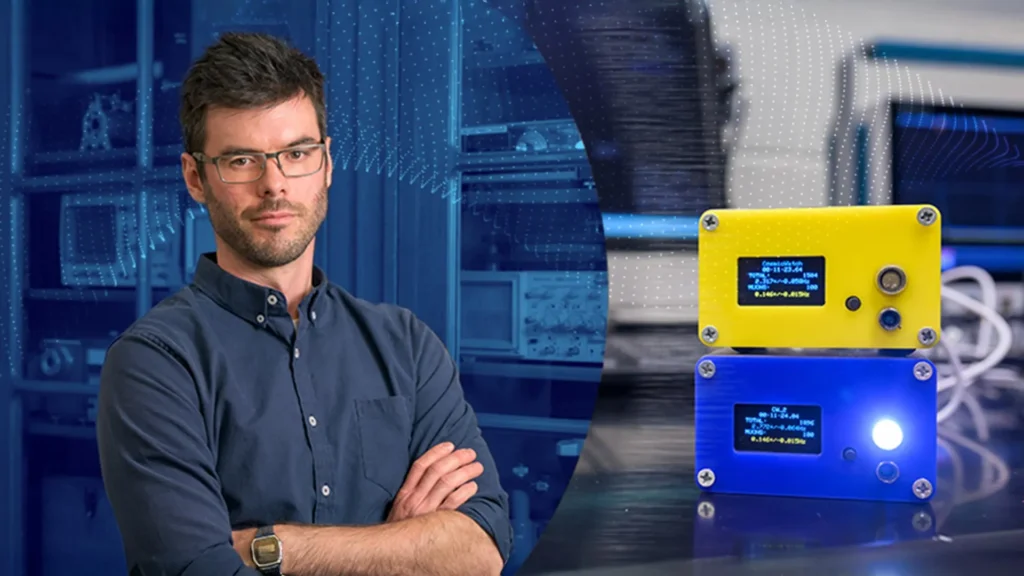
The silent rain of subatomic particles falling from the depths of space has long been a subject of intense scientific scrutiny, yet until recently, the tools required to observe this phenomenon were confined to multi-million-dollar laboratories and massive underground observatories. Every second, trillions of tiny particles pass through the Earth, its buildings, and the human body without leaving a trace perceptible to the five human senses. Among these invisible travelers are muons—heavy, short-lived cousins of the electron that serve as messengers from some of the most violent and energetic events in the known universe. To bridge the gap between these cosmic mysteries and the average classroom, Spencer Axani, a physics professor at the University of Delaware, has spearheaded the development of CosmicWatch, a compact, $100 detector that is transforming how students and professional researchers alike engage with particle physics.
The Science of the Invisible: Muons and Cosmic Rays
To understand the significance of the CosmicWatch device, one must first look toward the edges of the galaxy. The story begins with cosmic rays—extremely high-energy protons and atomic nuclei that zip through space at nearly the speed of light. These rays originate from cataclysmic events such as supernovae (the explosive deaths of massive stars), gamma-ray bursts, and blazars—the blazing cores of active galaxies powered by supermassive black holes. When these primary cosmic rays collide with oxygen and nitrogen atoms in the Earth’s upper atmosphere, they trigger a cascade of secondary particles known as an air shower.
Among the debris of these collisions are muons. Muons are particularly valuable to scientists because they are highly penetrating. Unlike electrons, which are easily absorbed or deflected, muons can travel through kilometers of atmosphere and even penetrate deep underground or through solid rock. Despite their fleeting existence—lasting only about 2.2 microseconds before decaying—their near-light-speed velocity allows them to reach the Earth’s surface due to the effects of time dilation, a cornerstone of Einstein’s theory of relativity.
By detecting and counting these muons, researchers can reverse-engineer the properties of the original cosmic ray, gaining insights into the energy, mass, and trajectory of particles that may have traveled millions of light-years to reach our planet. However, for decades, the equipment required to perform these measurements was prohibitively expensive and cumbersome, often requiring racks of electronics the size of bookshelves.
The CosmicWatch Breakthrough: Portability Meets Precision
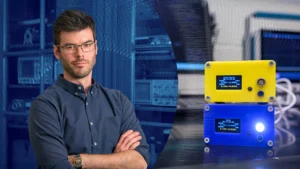
The CosmicWatch project represents a paradigm shift in experimental physics. The device, which is roughly the size of a standard box of animal crackers, is built from off-the-shelf electronic components, keeping the total cost of materials to approximately $100. Despite its modest price tag, the detector is a sophisticated piece of hardware. When a muon passes through the device’s plastic scintillator, it produces a tiny flash of light. This light is captured by a silicon photomultiplier (SiPM), which converts the photons into an electrical signal. The onboard microcontroller then processes this signal, flashes an LED to provide visual feedback, and records the event on a digital log.
Spencer Axani first conceptualized the device in 2017 while serving as a graduate student at the Massachusetts Institute of Technology (MIT). His initial objective was highly specialized: he needed a compact, energy-efficient muon detector to assist the IceCube Neutrino Observatory in Antarctica. IceCube is a massive facility buried deep beneath the Antarctic ice, designed to detect neutrinos—nearly massless particles that are even more elusive than muons. In that environment, muons are often considered "noise" that can obscure neutrino data. Axani’s small detectors were intended to help filter out this interference.
However, Axani soon realized that the technology’s simplicity and low power consumption made it an ideal candidate for educational outreach. Since moving to the University of Delaware (UD) in 2022, he has continued to iterate on the design, recently releasing the third version of the CosmicWatch hardware. This latest iteration, detailed in the October issue of the Journal of Instrumentation, features enhanced data-gathering speeds, better radiation tolerance, and the ability to monitor environmental variables such as temperature and pressure.
A Chronology of Innovation and Adoption
The timeline of CosmicWatch reflects a rapid transition from a niche laboratory tool to a global educational phenomenon.
- 2017: Initial development at MIT. The first prototypes are used to demonstrate the feasibility of low-cost SiPM-based muon detectors.
- 2018–2020: The design is made open-source. Physics departments at universities like Cornell and various high schools begin building their own units based on Axani’s blueprints.
- 2021: CosmicWatch technology is integrated into larger research frameworks, including the NuDot experiment, which investigates the fundamental nature of neutrinos.
- 2022: Axani joins the University of Delaware faculty, establishing a dedicated lab for further development.
- 2023: Doctoral students like Musarate Shams begin taking the detectors into extreme environments, including high-altitude balloon flights to the edge of space.
- 2024: Version 3 is officially documented and released, offering a robust platform for both citizen science and advanced aerospace applications.
Expanding the Research Frontier: From Pyramids to Dark Matter
While education is a primary driver of the project, the research implications of low-cost muon detectors are vast. Historically, muons have been used for "muography," a technique similar to an X-ray but on a geological scale. Because muons are absorbed differently by materials of varying densities, they can be used to image the interior of large structures. In 2016, a team of international researchers used muon detectors to discover a previously unknown corridor within the Great Pyramid of Giza. CosmicWatch-style technology makes such experiments more accessible, potentially allowing for the monitoring of volcanic activity or the inspection of nuclear reactor cores at a fraction of the traditional cost.
In the realm of fundamental physics, CosmicWatch is being utilized in dark matter research. At the Coherent CAPTAIN-Mills (CCM) detector in Los Alamos, New Mexico, these small detectors help calibrate large-scale experiments designed to find the "hidden sector" of particles that make up the majority of the universe’s mass. By providing a cheap and reliable way to monitor muon flux, CosmicWatch allows researchers to account for background radiation that might otherwise be mistaken for a dark matter signal.
Furthermore, the technology is being adapted for spaceflight. Standard cosmic ray detectors on satellites are heavy and power-hungry. A version of CosmicWatch currently under development could be deployed on small satellites (CubeSats) to monitor primary cosmic rays directly in the space environment. This could lead to better early-warning systems for solar flares, which can damage sensitive satellite electronics.
Educational Impact: "Real Science" in the Classroom
For many students, physics can feel like an abstract collection of formulas and theoretical constructs. CosmicWatch changes this by providing a tangible connection to the universe. At the University of Delaware, students in Axani’s lab do not just use the detectors; they build them. This process involves soldering components, programming microcontrollers, and troubleshooting high-speed electronics.
Masooma Sarfraz, a doctoral student at UD and the lead author of the recent journal article, noted that the hands-on nature of the project provides a crucial bridge between theory and practice. For a student transitioning from theoretical physics to experimental work, the ability to "see" atmospheric particle production through a device they helped build is transformative.
The impact is echoed at Cornell University, where Natasha Holmes, the Ann S. Bowers Associate Professor of Physics, uses CosmicWatch in introductory courses. Holmes emphasizes that the device moves students away from "cookbook" lab experiments where the outcome is predetermined. Instead, students engage in authentic experimental physics—dealing with equipment failures, data noise, and the excitement of discovering something invisible yet real.
Supporting Data and Technical Specifications
The success of CosmicWatch is rooted in its technical efficiency. Traditional muon detectors, such as Geiger-Müller tubes or large liquid scintillator tanks, often require high-voltage power supplies and specialized cooling systems. In contrast, the CosmicWatch Version 3 operates on a standard USB power source and utilizes:
- Scintillator Material: A small slab of plastic that emits light when struck by ionizing radiation.
- SiPM Technology: A solid-state sensor that can detect single photons, replacing the bulky vacuum-tube photomultipliers used in the past.
- Onboard Processing: An Arduino-compatible microcontroller that handles signal discrimination and data logging.
- Environmental Sensors: Integrated probes for temperature and barometric pressure, allowing for the correction of muon counts based on atmospheric density.
Data collected by student Musarate Shams during a high-altitude balloon flight to 100,000 feet provided empirical evidence of the Pfotzer curve—the point in the atmosphere where cosmic ray intensity reaches its peak before declining at higher altitudes where the atmosphere is too thin to produce secondary showers. Such data, once the exclusive domain of national space agencies, can now be gathered by a doctoral student in a single afternoon.
The Future: A Global Citizen Science Network
Looking forward, Spencer Axani envisions a world where thousands of CosmicWatch detectors are interconnected. This "citizen science" initiative would create a global network of cosmic ray observatories. If participants across different continents uploaded their data to a centralized platform, scientists could track "cosmic ray weather" in real-time. Such a network could identify large-scale patterns in particle activity and perhaps even detect the influence of solar activity on the Earth’s magnetosphere with unprecedented granularity.
Additionally, Axani is exploring the potential for these detectors to serve as a decentralized communication and synchronization system for satellite constellations. By using the arrival times of cosmic rays—which are essentially random but hit large areas simultaneously—satellites could potentially synchronize their clocks or alert one another to incoming solar radiation bursts without relying on ground-based commands.
What began as a specialized tool for an Antarctic neutrino hunt has evolved into a versatile platform for education, archaeology, dark matter research, and aerospace engineering. By lowering the barrier to entry for particle physics, CosmicWatch is not just detecting muons; it is fostering a new generation of scientists equipped to explore the invisible forces that shape our universe. As Axani aptly summarized, the transition of this technology from a niche educational program to a multi-disciplinary research tool is a testament to the power of accessible, low-cost scientific innovation. The universe is constantly speaking to us through a rain of subatomic particles; thanks to CosmicWatch, more people than ever before are finally able to listen.