The Engineering Behind the KeyboaStick
At its core, the KeyboaStick is a study in mechanical efficiency and accessibility. The device is designed to be printed using standard Fused Deposition Modeling (FDM) 3D printers, which are common in many households and maker spaces. One of the most notable technical achievements of the design is its "print-in-place" construction for the articulated joints. In 3D printing, print-in-place refers to a design where moving parts are printed as a single unit, requiring no assembly of the hinges or pivots after the printing process is complete. This reduces the margin of error for the end-user and ensures that the mechanical tolerances are maintained according to the designer’s specifications.
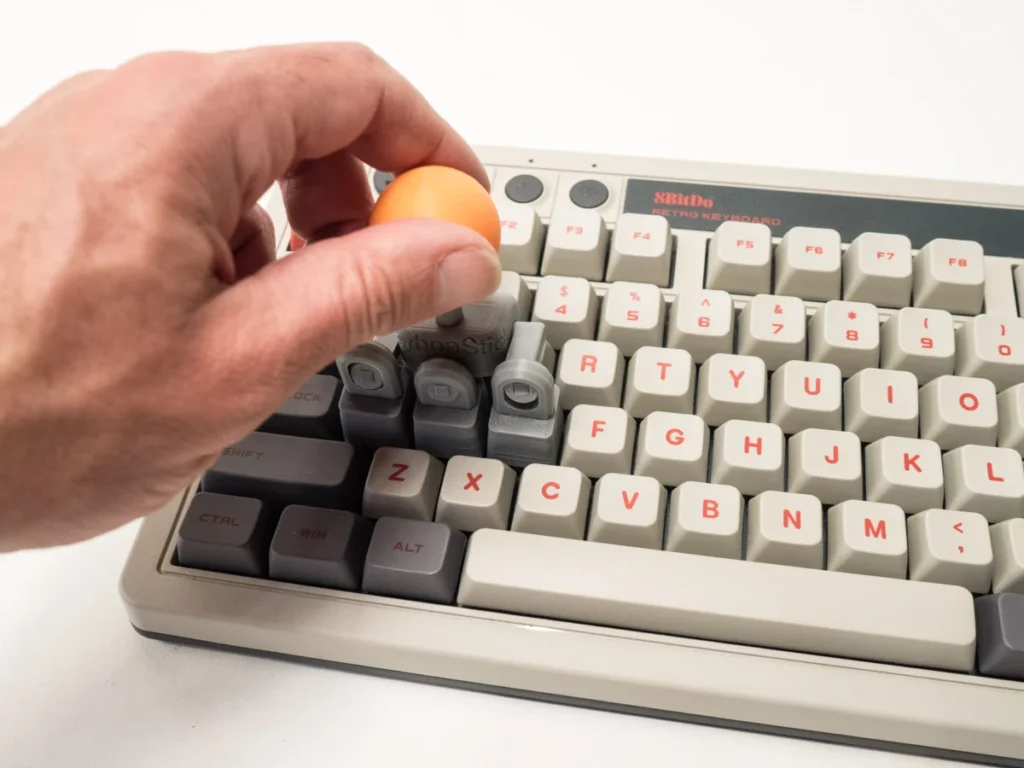
The standard version of the KeyboaStick is engineered specifically for the WASD cluster—the traditional movement keys for the majority of PC games. The device consists of a base that fits over the mechanical switches, four custom-molded keycap interfaces, and a central control stick. When the user tilts the stick in a specific direction, the articulated linkages distribute the force downward onto the corresponding switch. This mechanism effectively provides a tactile, analog-like feel to digital inputs, although it remains a digital controller at its heart, as it still triggers the on/off binary state of the underlying mechanical switches.
The designer, FunOrNothing, prioritized "forgiving" tolerances in the model’s architecture. This design philosophy ensures that the KeyboaStick remains functional even when produced on older or less precisely calibrated 3D printers. This democratic approach to hardware design allows a broader range of hobbyists to experiment with the device without requiring industrial-grade manufacturing equipment.
User Experience and Performance Validation
The practical application of the KeyboaStick has been tested across various gaming genres, most notably in high-speed platformers where precise directional input is paramount. In performance evaluations, the device demonstrated sufficient responsiveness to navigate complex levels in classic titles such as Sonic the Hedgehog 2. Specifically, the "Emerald Hill Zone" served as a testing ground for the device’s ability to handle rapid directional shifts and sustained movement.
While the device offers a novel and engaging way to interact with a keyboard, testers have noted certain mechanical nuances. In some iterations, lateral movements—specifically aiming to the far sides—can exhibit a slight "stickiness" or resistance. This is often attributed to the friction inherent in 3D-printed plastic surfaces. However, the design allows for easy assembly and disassembly, and the parts generally fit together with high precision even without extensive post-processing or sanding.

For users seeking a more refined experience, a "Pro" version of the KeyboaStick has been developed. This iteration features a redesigned linkage system aimed at minimizing friction and improving the fluidity of the joystick’s travel. The Pro version is currently available as a physical product, catering to users who may not own a 3D printer or who prefer a professionally finished component made from high-durability materials.
Intellectual Property and the Maker Economy
The rise of the KeyboaStick also highlights a growing challenge within the global maker community: the protection of intellectual property in an era of digital distribution. Because the design files (STLs) for the KeyboaStick were made available on platforms like MakerWorld, the design quickly gained popularity. However, this visibility led to the unauthorized reproduction and sale of the design by third-party vendors on various international e-commerce sites.
This phenomenon, often referred to as "design "cloning" or "file poaching," is a persistent issue for independent creators. FunOrNothing has addressed this by maintaining official channels for both the digital files and the physical products. While the files can be downloaded for personal use on MakerWorld, the official commercial outlet for finished prints is the RadianLab store on Etsy. This dual-track approach—offering free files for makers while providing a premium, finished product for consumers—has become a standard model for successful independent designers attempting to navigate the complexities of digital copyright.
Contextualizing the Mechanical Keyboard Market
To understand the impact of the KeyboaStick, one must look at the broader mechanical keyboard industry. The global mechanical keyboard market was valued at approximately $1.3 billion in 2023 and is projected to grow at a compound annual growth rate (CAGR) of over 6% through 2030. This growth is driven by a shift in consumer preference toward durable, customizable, and tactile input devices.
The "artisan keycap" subculture, in particular, has paved the way for products like the KeyboaStick. What began as a hobby of creating decorative, hand-painted escape keys has evolved into a sophisticated market for functional modifications. Modern mechanical keyboards, such as those produced by 8BitDo (often pictured with the KeyboaStick), are designed with hot-swappable switches and standard keycap mounts, making them the perfect "chassis" for mechanical experiments. The KeyboaStick leverages this modularity, turning a standard office tool into a specialized gaming peripheral without requiring any permanent modifications to the keyboard’s internal electronics.
Timeline of Development and Iteration
The journey of the KeyboaStick from a conceptual drawing to a viral gaming accessory follows a clear chronological path:

- Conceptualization: FunOrNothing identifies the ergonomic gap between keyboard tapping and joystick fluid motion, beginning initial sketches of a mechanical linkage system.
- Prototyping: Early versions are tested for fitment on standard Cherry MX-style stems, which are the industry standard for mechanical keyboards.
- Initial Release: The "Standard" version is uploaded to MakerWorld, offering a free solution for the WASD and arrow key clusters.
- Community Feedback: Users report high satisfaction with the "print-in-place" joints but suggest improvements for smoother diagonal movement.
- Professional Expansion: In response to demand for higher quality and the threat of unauthorized clones, FunOrNothing partners with RadianLab to produce the "Pro" version.
- Diversification: New versions are released to accommodate different keyboard layouts and specialized key groupings, including a "quick-replace" version for users who frequently switch between typing and gaming.
Broader Implications for Human-Computer Interaction
The KeyboaStick is more than just a gaming novelty; it represents a micro-trend in "hybridized" input devices. As professional tasks and gaming continue to converge on the same hardware, the demand for versatile peripherals increases. The ability to temporarily transform a high-end mechanical keyboard into a flight stick or a platforming controller offers a level of utility that dedicated, single-purpose controllers cannot match.
Furthermore, the project underscores the power of community-driven innovation. Traditional peripheral manufacturers often face high R&D costs and long production cycles, which can stifle experimental designs. In contrast, the maker community can iterate on a design like the KeyboaStick in real-time, incorporating user feedback within days and distributing updates globally at the click of a button.
Conclusion and Future Outlook
The KeyboaStick by FunOrNothing stands as a testament to the creativity currently flourishing in the 3D printing and mechanical keyboard sectors. By providing a low-cost, high-engagement solution to keyboard gaming, it has successfully carved out a niche in a crowded market. While challenges regarding intellectual property theft remain a hurdle for independent designers, the success of the official RadianLab store suggests that consumers are willing to support original creators when provided with a high-quality, authentic product.
As 3D printing technology continues to improve—with materials like carbon-fiber-infused filaments and resin printing becoming more accessible—the potential for even more complex mechanical keyboard modifications is vast. The KeyboaStick may very well be the precursor to a new category of "mechanical overlays" that allow users to customize their tactile experience with unprecedented precision. For now, it remains an essential curiosity for any maker looking to add a touch of mechanical ingenuity to their desktop setup, proving that sometimes, the best way to make a keyboard more fun is to simply add a stick.