The silence of a decommissioned or temporarily shut-down nuclear reactor is, to the human ear and standard instrumentation, absolute. However, deep within the atomic structure of the cooling fuel, a ghostly activity persists. For decades, physicists have theorized that even after the primary fission process in a nuclear reactor is halted, the core continues to emit a faint but steady stream of antineutrinos—elusive subatomic particles that act as the fingerprints of radioactive decay. Recently, an international team of scientists led by researchers from the Max-Planck-Institut für Kernphysik (MPIK) in Heidelberg, Germany, successfully measured this lingering antineutrino emission for the first time. This landmark achievement, published in the prestigious journal Physical Review Letters, marks a significant leap in our ability to monitor nuclear activity non-invasively, offering transformative potential for global nuclear safeguards, safety protocols, and the tracking of spent nuclear fuel.
The research was spearheaded by Anthony Onillon and Thierry Lasserre of MPIK, utilizing the sophisticated infrastructure of the Double Chooz experiment located in northern France. By isolating the minute signal produced by decaying fission products within the reactor core and nearby spent-fuel cooling pools, the team has provided the first direct experimental confirmation of the "residual" antineutrino flux. This discovery proves that even when a reactor is "dark," it remains visible to the sensitive eyes of neutrino detectors, providing a continuous stream of data that cannot be shielded or spoofed.
The Physics of the Ghost Particle: Why Antineutrinos Matter
To understand the magnitude of this discovery, one must first look at the nature of the antineutrino itself. Antineutrinos are the antimatter counterparts of neutrinos—near-masseless, neutral particles that interact with matter only via the weak nuclear force and gravity. Because they lack an electromagnetic charge, they can pass through light-years of lead or the entire diameter of the Earth without ever touching an atom.
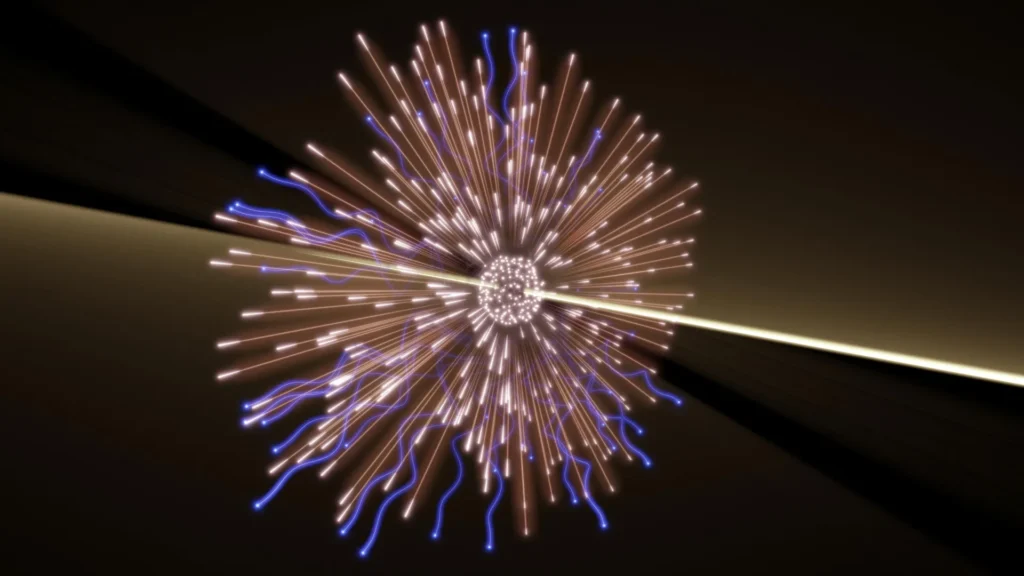
In a nuclear reactor, antineutrinos are produced in staggering quantities during the process of beta decay. When a heavy nucleus like Uranium-235 or Plutonium-239 undergoes fission, it splits into unstable "fission products." These daughter nuclei are neutron-rich and achieve stability by converting a neutron into a proton, emitting an electron and an antineutrino in the process. While a reactor is operational, it emits approximately 10 to the power of 20 antineutrinos per second. However, once the control rods are inserted and the chain reaction stops, the immediate flux of neutrinos from active fission ceases.
What remains are the "long-lived" radioactive isotopes. These isotopes, such as Strontium-90, Cesium-137, and Cerium-144, continue to undergo beta decay for months or even years. They produce a significantly weaker, but still present, stream of antineutrinos. Until the Double Chooz measurement, this residual signal was considered too faint to be reliably separated from the background noise of the universe.
The Double Chooz Experiment: A Decade of Precision
The measurement took place at the Chooz Nuclear Power Plant, situated in a meander of the Meuse River in the Ardennes region of France. The facility consists of two pressurized water reactors (PWRs), each capable of producing 1,500 megawatts of electricity. The Double Chooz experiment was originally designed not for reactor monitoring, but for fundamental particle physics. Its primary goal was to measure the "neutrino mixing angle θ13," a parameter that describes how neutrinos oscillate between three known flavors (electron, muon, and tau) as they travel.
The experiment utilizes a detector located approximately 400 meters from the reactor cores, buried deep underground to shield it from cosmic radiation. The heart of the detector is a 30-cubic-meter tank filled with a specialized liquid scintillator—an oil-based cocktail laced with gadolinium. When an antineutrino enters the detector, it occasionally strikes a proton in the scintillator, a process known as "Inverse Beta Decay" (IBD). This interaction creates a positron and a neutron. The positron immediately annihilates, creating a "prompt" flash of light. A few microseconds later, the neutron is captured by a gadolinium nucleus, releasing a "delayed" flash of light. This characteristic "double-pulse" signature allows scientists to distinguish a true antineutrino event from random background radiation.
Chronology of the Discovery: Seizing the 17-Day Window
The path to this discovery was a matter of timing and meticulous data analysis. For most of its operational life, the Double Chooz detector was flooded with the massive antineutrino flux from the two active reactors. Detecting the residual signal required a rare occurrence: a total shutdown of the entire facility.
In a specific window of 17.2 days, both reactor units at the Chooz plant were fully shut down for maintenance and refueling. This provided the researchers with a "quiet" environment, though the term is relative. Even with the reactors off, the detector is bombarded by "background" events—natural radioactivity from the surrounding rock and cosmic rays that penetrate the earth.
Over these 17.2 days, the team recorded approximately 100 antineutrino candidate events. While 100 events may seem small compared to the millions recorded during reactor operation, the statistical significance was profound. By applying advanced noise-reduction algorithms developed over a decade of research, Dr. Onillon and his colleagues were able to filter out the background and isolate the signal coming directly from the cooling reactor cores and the adjacent spent-fuel pools.
Supporting Data: Matching Predictions with Reality
The most critical aspect of the study was the comparison between the experimental data and theoretical models. Nuclear physicists have long used computer simulations to predict the isotopic inventory of a reactor core over time. These models account for the "burn-up" of fuel and the accumulation of specific long-lived isotopes.
The Double Chooz team found that their detected signal matched the predicted emissions with remarkable accuracy. The detected antineutrinos were consistent with the decay of isotopes such as Ruthenium-106, Cerium-144, and Strontium-90, which are known to be the primary sources of antineutrinos in the weeks following a shutdown.
"Until now, reactor antineutrino experiments have mainly focused on operating reactors, where the antineutrino flux is much larger," explained Dr. Anthony Onillon. "Detecting the tiny residual signal after shutdown required exceptionally low backgrounds and careful analysis techniques." This alignment between the "faint glow" and the simulations provides the first experimental benchmark for a new field of "off-reactor" neutrino science.
Reactions and the Global Scientific Context
The scientific community has reacted with significant interest to the Double Chooz findings. While Double Chooz is the first to publish these results in a peer-reviewed format like Physical Review Letters, other international projects are beginning to see similar signals.
At the "Neutrino 2024" and subsequent conferences leading into 2026, initial results from the JUNO-TAO (Jiangmen Underground Neutrino Observatory – Taishan Antineutrino Observatory) in China were presented. Researchers there are also utilizing "reactor-off" data to study the faint signals from spent fuel. The convergence of these independent experiments validates the Double Chooz methodology and suggests that antineutrino detection is moving from the realm of abstract physics into the realm of practical, applied technology.
Thierry Lasserre, representing the OMINA research group at MPIK, emphasized the collaborative nature of the work. He noted that the ability to distinguish the signal from the background is the culmination of years of refining the liquid scintillator’s chemistry and the detector’s electronics.
Analysis of Implications: A New Era for Nuclear Safeguards
The most immediate and impactful application of this discovery lies in the field of nuclear non-proliferation and safeguards. Currently, the International Atomic Energy Agency (IAEA) relies on physical inspections, seals, and cameras to ensure that nuclear material is not diverted for weapons programs. However, these methods require access to the interior of the facility and can be subject to tampering or diplomatic hurdles.
Antineutrino detectors offer a "non-intrusive" alternative. Because antineutrinos cannot be blocked by any known material, a detector placed outside a reactor building—or even buried nearby underground—could provide a real-time, 24/7 audit of the reactor’s status.
- Verification of Shutdown: The Double Chooz results prove that a detector can independently confirm if a reactor is truly shut down or if it is being operated at a low power level in secret.
- Monitoring Spent Fuel: One of the greatest risks in nuclear security is the diversion of "spent" fuel, which contains plutonium. Because the Double Chooz experiment detected signals from the cooling pools, this technology could be used to ensure that spent fuel rods remain where they are supposed to be. If rods were removed, the antineutrino flux would drop in a way that models could predict.
- Core Inventory Assessment: By analyzing the energy spectrum of the residual antineutrinos, it may eventually be possible to determine the exact isotopic composition of the core, ensuring that no weapons-grade material is being bred during the cycle.
Future Outlook: From Massive Detectors to Portable Units
While the Double Chooz detector is a massive, stationary installation, the success of this research is driving interest in more compact, mobile antineutrino detectors. Efforts are already underway in several countries to develop "near-field" detectors that use new materials, such as plastic scintillators or water-based liquid scintillators, which are easier to transport and deploy.
The ability to detect the "residual glow" of a reactor adds a new dimension to the "Neutrino for Peace" initiative. As the world looks toward a future that may include a greater number of small modular reactors (SMRs) distributed in various locations, having a reliable, external method for monitoring nuclear inventories becomes essential.
In conclusion, the Double Chooz collaboration has achieved more than just a feat of particle physics; they have opened a new window into the heart of nuclear technology. By capturing the faint, ghostly whispers of decaying atoms in a silent reactor, they have provided a tool that could one day be the cornerstone of global nuclear security. The "faint neutrino glow" is no longer a theoretical prediction—it is a measurable reality that ensures that even when a reactor goes dark, it is never truly hidden from the watchful eyes of science.