The intricate world of mechanical engineering frequently presents scenarios where seemingly contradictory demands must be reconciled to achieve optimal performance. Much like an individual striving for the "perfect beach body" through rigorous diet and exercise, only to face the temptation of indulgent relaxation that could lead to a "dad bod," mechanical systems often grapple with the trade-offs between ideal design parameters and real-world operational realities. In the realm of power transmission and motion control, this dichotomy is vividly illustrated by the persistent challenge of backlash in worm gear pairs. While engineers can design systems to achieve specific speed reductions at particular torque loads, the inherent phenomenon of backlash can severely compromise the repeatability, accuracy, and overall reliability of a mechanism. This fundamental issue has spurred the development of advanced solutions, with duplex worm gears emerging as a highly effective method for achieving precise, adjustable backlash control, thereby revolutionizing the performance capabilities of critical machinery.
The Enduring Challenge of Backlash in Gearing Systems
Backlash, in the context of gear trains, refers to the clearance or lost motion between mating gear teeth. It is the amount by which a tooth space exceeds the thickness of the engaging tooth. While a small amount of clearance is necessary to prevent jamming, allow for lubrication, and accommodate thermal expansion, excessive backlash is detrimental to system performance. In applications demanding high precision and repeatability, such as robotics, CNC machining, and indexing systems, backlash can lead to:
- Positional Inaccuracy: The output shaft may not immediately respond to input shaft movement, leading to errors in positioning.
- Reduced Repeatability: The inability to consistently return to the exact same position after multiple cycles.
- Increased Wear and Noise: During changes in direction, the teeth can impact each other, causing accelerated wear, vibration, and audible noise.
- Dynamic Instability: In control systems, backlash can introduce non-linearity, making it difficult to achieve stable and precise control.
- Reduced Stiffness: The "play" in the system reduces its overall torsional stiffness, affecting load transmission and response.
Worm gear pairs, known for their high reduction ratios, smooth operation, and often self-locking properties, are particularly susceptible to the issues exacerbated by backlash. Their inherent design, involving a screw-like worm meshing with a helical worm wheel, relies on precise engagement for efficient power transfer. Any deviation from this ideal engagement due to backlash can significantly degrade their performance, especially in reversing applications where the direction of rotation changes frequently.
Traditional Approaches to Backlash Management and Their Limitations
Historically, engineers have employed several methods to mitigate backlash in worm gear assemblies, each with its own set of advantages and inherent drawbacks. Understanding these traditional approaches provides crucial context for appreciating the innovative leap offered by duplex worm gears.
One of the most common conventional methods involves modifying the center distance between the worm and the worm wheel. By slightly reducing the center distance, the meshing teeth are brought closer together, thereby decreasing the clearance and minimizing backlash. However, this adjustment is typically performed during the initial assembly phase. Once a gearbox is constructed, altering the center distance requires a significant rework of the gearbox housing, often necessitating partial or complete disassembly. This process is time-consuming, labor-intensive, and costly, making on-site or post-installation adjustments impractical for many applications. Moreover, aggressively reducing the center distance to achieve minimal backlash can lead to increased contact pressure and friction between the gear teeth, resulting in accelerated wear, reduced efficiency, and a shorter operational lifespan for the gear pair. This creates a delicate balance where optimizing one parameter (backlash) can negatively impact another (durability).

Another approach involves the use of spring-loaded split worms or spring-loaded split-worm wheels. In these designs, one component (either the worm or the worm wheel) is split into two sections, with springs introduced to force the two halves apart, effectively taking up the backlash. The spring tension maintains continuous contact between the gear teeth, thereby eliminating play. While this method offers continuous backlash compensation, it comes with significant limitations. The primary constraint is the loading capacity, which is directly tied to the spring rate. The springs can only exert a finite force; if the torque load on the gear pair exceeds this force, the springs can compress, allowing backlash to reappear. This limits their applicability to light-duty or low-torque scenarios, making them unsuitable for robust industrial applications that experience varying or high load conditions. Furthermore, springs are subject to fatigue over time, potentially leading to a degradation in performance and requiring periodic replacement.
These traditional methods, while functional within their specific niches, highlight a persistent need for a more versatile, robust, and easily adjustable solution for backlash control in worm gear systems, especially as industrial demands for precision continue to escalate.
The Genesis and Evolution of Precision Gearing
The history of gearing is as old as the industrial revolution itself, with early engineers constantly striving for smoother, more reliable power transmission. From simple spur gears to more complex helical and bevel gears, each innovation addressed specific challenges related to load capacity, noise, and efficiency. Worm gears, with their unique ability to provide high reduction ratios in a compact space, have been integral to many mechanical designs, particularly where precise positioning or high torque multiplication is required.
The challenge of backlash, however, has been a constant companion. As manufacturing tolerances improved over the 20th century, the demand for even tighter control over mechanical play grew. The 21st century, with its proliferation of sophisticated automation, robotics, and advanced manufacturing processes, has amplified this demand, pushing the boundaries of what is considered acceptable precision. This intensified requirement for accuracy, coupled with the limitations of existing backlash mitigation techniques, paved the way for the development of more advanced solutions like duplex worm gears. The evolution wasn’t a sudden leap but a gradual refinement, driven by a deep understanding of gear kinematics and the need for practical, maintainable systems.
Duplex Worm Gears: An Innovative Solution for Adjustable Backlash
The advent of duplex worm gears represents a significant advancement in the field of precision gearing, specifically designed to overcome the inherent limitations of conventional backlash adjustment methods. This innovative design offers a robust and easily adjustable solution, fundamentally simplifying assembly and maintenance operations while ensuring high accuracy and repeatability.
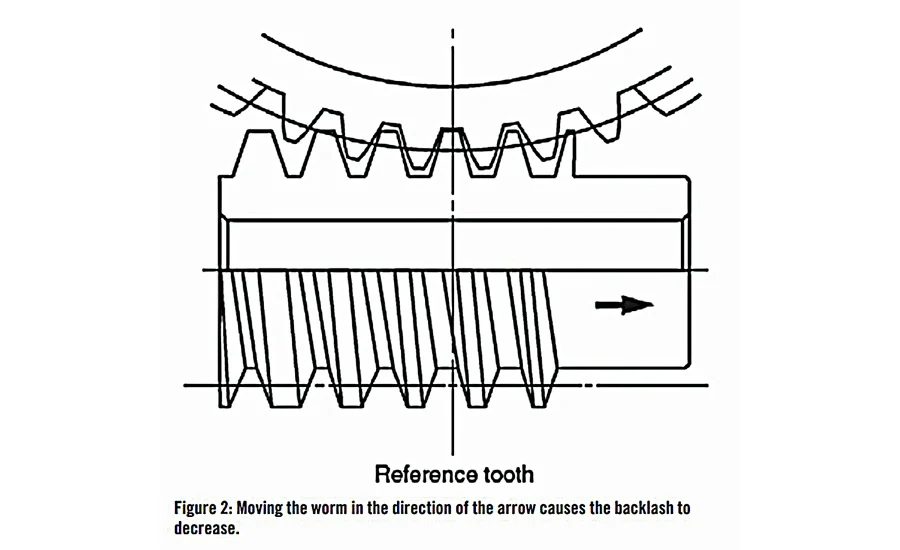
At the heart of the duplex worm gear system is a unique dual-lead worm paired with a corresponding worm wheel. Unlike a standard worm, which has a uniform lead across its threads, the dual-lead worm is meticulously manufactured to exhibit a subtle yet critical difference between its right and left tooth surfaces. This difference results in a unique tooth profile where the tooth thickness varies continuously along the axial length of the worm, corresponding precisely with the lead difference. Imagine a worm where one side of the thread helix is subtly "thicker" or "thinner" than the other, and this variation is carefully engineered to change along its length.

The genius of this design lies in its adjustability. When such a dual-lead worm and its mating worm wheel are set up at a constant assembly distance—meaning the physical center distance between the two components remains fixed—backlash adjustment becomes remarkably straightforward. By simply axially shifting the worm, the section of the worm engaging with the worm wheel changes. As the worm is moved along its axis, different sections of its continuously varying tooth thickness come into mesh with the worm wheel.
For instance, if the worm is designed such that its teeth are thinner on one end and progressively thicker towards the other, moving the worm axially towards the "thicker" end will cause the thicker teeth to engage with the worm wheel. This increased tooth thickness effectively reduces the clearance, thereby minimizing or even eliminating backlash. Conversely, shifting the worm towards the "thinner" end would increase backlash. This elegant mechanism allows for precise, micro-level adjustments without the need to modify the gearbox housing or disassemble the entire system.
Technical Deep Dive and Performance Metrics
The precision offered by duplex worm gears is not merely conceptual but quantifiable. The relationship between axial movement of the duplex worm shaft and the resultant change in backlash can be accurately calculated using specific engineering formulas. These formulas, derived from the geometry of the dual-lead design, provide engineers with a predictable and controllable means of achieving desired backlash settings.
For example, manufacturers like KHK-USA Inc. have engineered their duplex worms with standardized adjustment characteristics. For all modules (a measure of gear tooth size), their duplex worms are designed such that the backlash reduces by a precise 0.02 millimeter for every 1 millimeter that the worm is axially shifted. This standardized rate of adjustment is crucial for predictable performance and ease of implementation.
Furthermore, the manufacturing process ensures that the corresponding worm wheels are produced with a specific backlash range, typically from -0.045 to +0.045 millimeters relative to the worm. This inherent range, combined with the precise adjustment capability of the dual-lead worm, means that a relatively small axial adjustment of just 2 millimeters can result in a zero-backlash pair. This level of precision and ease of adjustment is a game-changer for applications where even minute amounts of play can be detrimental.
It is also critical to reiterate that worm gear pairs operate as friction-drive mechanisms to a significant extent, particularly under high loads. This characteristic underscores the importance of material properties. To ensure longevity and prevent premature wear, it is paramount that the worm has a surface strength greater than that of the worm wheel. Typically, worms are made from hardened steel, while worm wheels are often made from bronze or specialized plastics, which allows for a controlled wear pattern and reduces friction, contributing to smoother operation and extended lifespan.

The issue of wear is also intricately linked to backlash. When backlash is minimized by simply reducing the center distance in traditional systems, there is an increase in wear due to the increased contact area and pressure between the teeth. Duplex worm gears circumvent this problem by optimizing the tooth engagement through geometry, rather than forcing a tighter mesh through excessive pressure. When the worm reverses rotation in a system with backlash, there is a momentary loss of engagement of the worm-wheel teeth as the play is taken up. By minimizing this play through precise axial adjustment, duplex worm gears reduce the impact forces during reversal, thereby enhancing durability and reducing wear over time.
Applications and Broader Industrial Impact
The superior precision and adjustability of duplex worm gears make them an excellent choice for a wide array of demanding applications across various industries. Their ability to provide ultra-low or even zero backlash is critical for systems where accuracy, repeatability, and smooth motion are non-negotiable.
Key Applications Include:
- Rotary Tables: Essential components in CNC machine tools, inspection equipment, and assembly lines, rotary tables require extreme precision for indexing and positioning. Duplex worm gears ensure that the table rotates to the exact desired angle without any angular play, improving machining accuracy and part quality.
- Ultra-Low Backlash Gearboxes: Used in robotics, automation, and aerospace, these gearboxes are designed to transmit motion with minimal lost motion. Duplex worm gears enable the construction of such gearboxes, which are vital for tasks requiring precise manipulator movements or sensor positioning.
- High Accuracy Reversing Applications: Any mechanism that frequently changes direction, such as indexing mechanisms, antenna positioning systems, or robotic joints, benefits immensely from backlash-free operation. Duposing worm gears eliminate the "slop" that can accumulate during reversals, maintaining positional integrity.
- Medical Devices: Precision surgical robots, diagnostic equipment, and laboratory automation systems rely on highly accurate motion control, where even minor inaccuracies can have significant consequences.
- Scientific Instrumentation: Telescopes, microscopes, and experimental setups that require fine adjustments and stable positioning benefit from the precise, repeatable motion offered by duplex worm gears.
- Defense and Aerospace: Guidance systems, radar mounts, and weapon platforms demand absolute precision and reliability under harsh conditions, making duplex worm gears an ideal component.
The broader impact of duplex worm gears extends beyond mere technical specifications; they contribute significantly to operational efficiency and economic benefits. By enabling greater precision, they facilitate the production of higher quality goods, reduce scrap rates, and minimize the need for post-process adjustments. The simplified maintenance and assembly, due to the ease of backlash adjustment, translate into reduced downtime and lower labor costs over the lifespan of the machinery. This improved reliability also extends the operational life of equipment, delaying capital expenditure on replacements.
Expert Perspectives and Future Outlook
Industry experts consistently emphasize the growing demand for precision and efficiency across all manufacturing sectors. "Technologies like duplex worm gears are no longer a niche solution but a crucial enabler for next-generation automation and advanced manufacturing processes," states a leading mechanical engineering consultant, highlighting the shift from ‘good enough’ to ‘perfect’ in critical applications. "The ability to finely tune backlash on an assembled system without extensive rework is a significant advantage, reducing both initial setup time and ongoing maintenance costs."
Manufacturers like KHK-USA Inc., who are at the forefront of developing and supplying these advanced gearing solutions, underscore their commitment to pushing the boundaries of mechanical precision. Their standardized duplex worm designs, offering predictable adjustment rates and zero-backlash capabilities, demonstrate a deep understanding of customer needs and engineering requirements.

Looking ahead, the evolution of precision gearing will likely continue to integrate with broader technological trends. We may see duplex worm gears incorporated into "smart" systems with integrated sensors that monitor backlash in real-time and provide feedback for automated adjustment. Further advancements in materials science could lead to even more durable and efficient worm and worm wheel combinations. Miniaturization will also be a key driver, allowing these high-precision components to be utilized in micro-robotics and compact devices.
In conclusion, duplex worm gears represent a sophisticated and highly effective solution to a long-standing challenge in mechanical engineering. By offering unparalleled ease and precision in backlash adjustment through an ingenious dual-lead design, they eliminate the compromises inherent in traditional methods. This innovation not only enhances the accuracy, repeatability, and reliability of worm gear systems but also contributes significantly to improved operational efficiency and reduced maintenance costs across a diverse range of high-precision industries. As the demand for mechanical systems capable of executing tasks with ever-increasing accuracy continues to grow, duplex worm gears stand as a testament to the ongoing pursuit of engineering excellence, bridging the gap between ideal design and flawless real-world performance.