The landscape of high-energy astrophysics underwent a significant shift on July 4, 2025, when the Einstein Probe (EP) satellite captured a phenomenon that had long eluded the scientific community: the immediate, soft X-ray aftermath of a short gamma-ray burst (GRB). For decades, these cataclysmic events—triggered by the violent merger of two compact objects, typically neutron stars—were understood primarily through their fleeting flashes of high-energy gamma radiation. However, the detection of the event designated EP250704a (also known as GRB 250704B) has provided the first direct observation of a "hidden" phase of these explosions, revealing that the initial half-second burst is merely the prologue to a much longer and more complex energetic episode. This discovery, facilitated by the Einstein Probe’s unique wide-field soft X-ray monitoring capabilities, offers a new window into the remnants of neutron star mergers and the fundamental physics of the universe’s most extreme environments.
The Detection of EP250704a: A New Benchmark in Transient Astronomy
The discovery began as a routine monitoring session for the Einstein Probe mission. An Li, a doctoral student at Beijing Normal University and the designated Transient Advocate for the mission, was managing the real-time data stream when the signal appeared. The event initially presented the hallmarks of a standard short GRB—a category of explosion that usually lasts less than two seconds and is thought to signal the birth of a black hole or a highly magnetized neutron star following a binary merger.
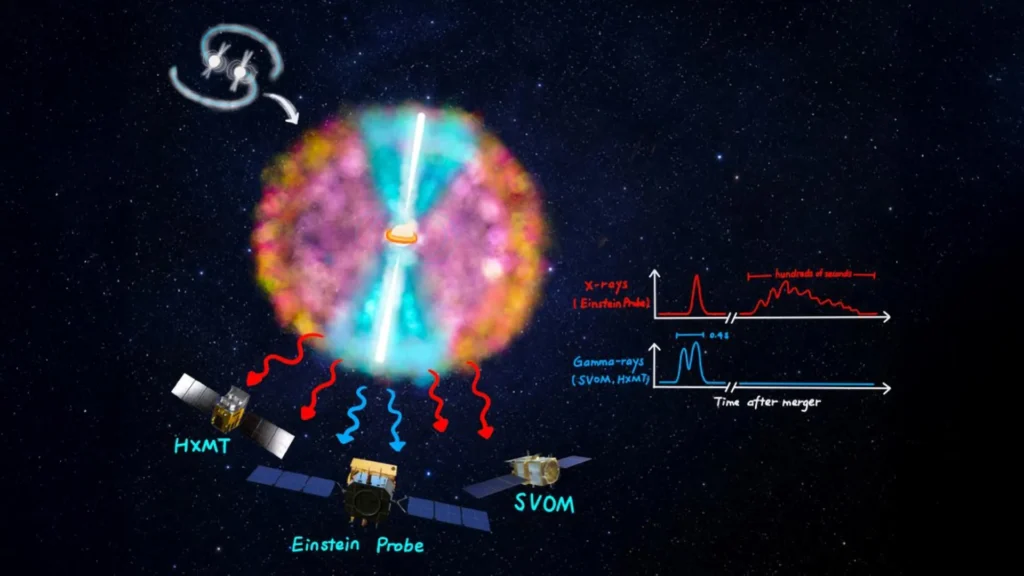
Simultaneous detections were recorded by multiple instruments: the Space-based multi-band Variable Object Monitor (SVOM-GRM) and the Hard X-ray Modulation Telescope (Insight-HXMT) captured the high-energy gamma-ray flash, while the Einstein Probe’s Wide-field X-ray Telescope (EP-WXT) caught the X-ray signature. While the gamma-ray burst itself was over in less than half a second, the data from the EP-WXT showed something extraordinary. Instead of the signal rapidly decaying into the background noise, the source continued to pulse with soft X-ray emissions for nearly ten minutes. This extended activity was invisible to traditional gamma-ray instruments, which are not calibrated to detect the lower-energy "soft" X-ray wavelengths where this activity was most prominent.
The Technical Challenge of Observing Early X-Ray Emissions
The difficulty in observing this specific stage of a GRB lies in the limitations of previous-generation hardware. Historically, astronomers have relied on narrow-field X-ray telescopes that require an external trigger—usually a gamma-ray alert from a satellite like Swift or Fermi—to know where to point. By the time these telescopes could slew to the coordinates of a burst, the earliest and most critical moments of the X-ray emission had often already passed.
The Einstein Probe circumvents this limitation using innovative "lobster-eye" optics, which allow for a massive field of view combined with high sensitivity in the soft X-ray band (0.5–4.0 keV). This allowed the EP to be "already looking" when EP250704a occurred. Professor Bin-Bin Zhang of Nanjing University, a co-corresponding author of the research, emphasized that previous missions would have recorded only the brief gamma-ray flash, missing the prolonged activity entirely. Because the spectrum of this extended emission was so "soft"—meaning it consisted of lower-energy photons—it remained below the detection thresholds of the Burst Alert Telescope (BAT) on the Swift mission, despite carrying a substantial amount of total energy.
Chronology of the Event and Global Follow-Up
The timeline of the July 4 event highlights the speed and coordination of modern multi-messenger astronomy. Following the initial onboard alert from the Einstein Probe, a global network of observatories was mobilized to track the event across the electromagnetic spectrum.
- T+0 Seconds: The merger occurs, sending out gravitational waves and a 0.5-second flash of gamma rays detected by SVOM and Insight-HXMT.
- T+1 to T+600 Seconds: The Einstein Probe records continuous, fluctuating soft X-ray emissions, indicating a "central engine" that remains active long after the initial blast.
- T+Hours to Days: An international follow-up campaign begins. Optical telescopes and radio arrays are directed toward the coordinates to identify the host galaxy.
- Spectroscopic Analysis: Professor Eleonora Troja’s team at the University of Rome "Tor Vergata" performed critical spectroscopic analysis. This allowed the team to measure the redshift of the event, placing it at a typical cosmological distance and confirming its immense intrinsic luminosity.
The multi-wavelength data was crucial for two reasons. First, it allowed researchers to rule out a supernova—which would be expected if the burst had been caused by the collapse of a single massive star (a long GRB). Second, the specific decay patterns in the optical and radio afterglows provided strong evidence that the event was indeed the result of a compact object merger.
Evidence of a Magnetar: The Persistence of the Central Engine
One of the most significant findings from the analysis of EP250704a is the evidence it provides regarding the nature of the merger’s remnant. In many models of neutron star mergers, the two stars collide and immediately collapse into a black hole. However, the ten-minute duration of the soft X-ray activity suggests a different outcome in this instance.
Yi-Han Iris Yin, a PhD student at The University of Hong Kong and a lead analyst for the high-energy data, noted that the rapidly changing brightness and evolving spectrum point toward continued energy injection from a "central engine." The most plausible candidate for this engine is a magnetar—a rapidly rotating neutron star with an incredibly strong magnetic field. If the merger produced a magnetar rather than a black hole, the magnetar’s rotational energy would be converted into the soft X-ray radiation observed by the Einstein Probe.
This "long-lived remnant" hypothesis is a vital piece of the puzzle for nuclear physicists. It helps constrain the "equation of state" for neutron stars—the mathematical description of how matter behaves under extreme pressure. If a merger can produce a stable or meta-stable magnetar instead of collapsing immediately into a black hole, it suggests that neutron star matter is "stiffer" and more resilient than some theoretical models predict.
Multi-Messenger Astronomy and the Search for Gravitational Waves
The discovery of EP250704a has profound implications for the field of multi-messenger astronomy, which seeks to study cosmic events using both electromagnetic radiation and gravitational waves. Since the historic 2017 detection of GW170817—the first time gravitational waves and light were seen from the same neutron star merger—scientists have been searching for more "counterparts" to these events.
The soft X-ray phase revealed by the Einstein Probe represents a new type of electromagnetic counterpart. Professor Troja pointed out that these fast X-ray transients may serve as a reliable signature for identifying gravitational-wave sources, even when the gamma-ray signal is weak or directed away from Earth. As gravitational-wave detectors like LIGO, Virgo, and KAGRA become more sensitive, the ability of the Einstein Probe to identify these soft X-ray signatures will be essential for localizing mergers in the vastness of space.
Implications for Future Research and the Einstein Probe Mission
The findings suggest that the "hidden" soft X-ray phase may not be a rarity but rather a common feature of short gamma-ray bursts that was simply invisible to previous instruments. This realization could lead to a re-evaluation of decades of GRB data. If a significant portion of short GRBs are followed by minutes of soft X-ray activity, our understanding of the energy budgets of these explosions and the frequency of magnetar formation must be revised.
The Einstein Probe, a mission led by the Chinese Academy of Sciences (CAS) in collaboration with the European Space Agency (ESA) and the Max Planck Institute for Extraterrestrial Physics (MPE), has demonstrated that it is more than just a monitoring satellite; it is a discovery machine. By filling the gap in the soft X-ray spectrum, it is allowing astronomers to witness the "opening moments" of the universe’s most violent acts.
As the mission continues, the data from EP250704a will serve as a template for identifying similar events. Researchers expect that the Einstein Probe will uncover an entire class of transient phenomena that were previously obscured. "The findings demonstrate Einstein Probe’s unique capability to uncover new classes of transient phenomena," said Professor Zhang. "It strengthens the role of X-ray monitoring in an era where we are no longer just looking at the light, but listening to the ripples in spacetime."
Conclusion: A New Window into the Extreme
The observation of EP250704a/GRB 250704B marks the beginning of a new chapter in the study of compact object mergers. By revealing the 10-minute soft X-ray "aftermath" of a half-second burst, the Einstein Probe has proven that there is much more to a neutron star merger than meets the gamma-ray eye. This discovery not only provides a new probe for multi-messenger astronomy but also challenges existing models of stellar evolution and the death of stars. As astronomers continue to analyze the data from this landmark event, the focus shifts toward the next detection, with the hope that each new soft X-ray transient will bring us closer to understanding the fundamental nature of matter and gravity in the most extreme corners of the cosmos.