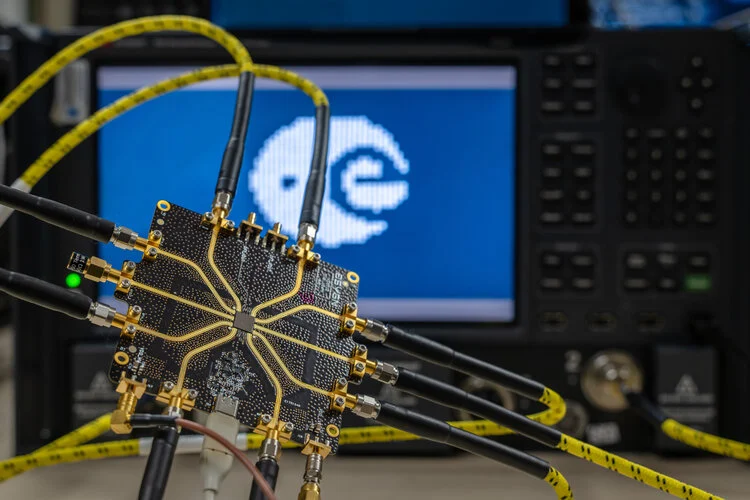
The future of satellite communications and beyond is being quietly shaped by a miniature marvel nestled at the heart of electronic circuit boards: a black microchip, unassuming in its size but profound in its capability. This tiny component is the linchpin in the development of phased array antennas, a technology revolutionizing how we communicate across vast distances. Unlike traditional antennas that rely on cumbersome mechanical tilting to maintain a connection, phased array antennas offer a sophisticated, solid-state approach, eliminating moving parts and ushering in an era of greater precision, reliability, and efficiency.
The fundamental difference lies in their method of directing radio beams. Where conventional antennas physically rotate to lock onto a target, phased array systems employ specialized microchips, known as beamforming integrated circuits (ICs), to achieve the same goal electronically. These chips exert precise control over the phase and amplitude of the radio signals, effectively steering the beam without any physical movement. This digital control is crucial for applications demanding rapid repositioning or the simultaneous tracking of multiple targets, a feat impossible for mechanically steered antennas.
The Evolution of Beamforming: From Concept to Compact Reality
The journey of beamforming technology has been a long and intricate one, with significant advancements driven by the relentless progress in silicon semiconductor manufacturing. Over the past few decades, these once-large and complex systems have been miniaturized to an unprecedented degree. The advent of modern silicon fabrication processes has allowed for the integration of intricate functionalities onto single chips, drastically reducing the size, weight, and power consumption of beamforming ICs. This miniaturization has been a pivotal factor in making phased array antennas not only more compact and reliable but also significantly more affordable. Consequently, these antennas are now finding widespread adoption across a diverse spectrum of applications, from the critical infrastructure of satellite communications and global navigation systems to the vital insights provided by Earth observation satellites and the ambitious endeavors of deep space missions.
ESA’s Longstanding Commitment to Beamforming Leadership
The European Space Agency (ESA) has consistently positioned itself at the vanguard of beamforming technology. For decades, the agency has actively fostered research and development into innovative methods for electronically steering radio beams, not just for space-based applications but also for terrestrial uses. Vclav Valenta, an engineer and recognized expert in phased array technology at ESA, emphasized the agency’s sustained commitment. "For decades, ESA has been at the forefront of beamforming technology, exploring innovative ways to electronically steer radio beams for space and terrestrial applications," Valenta stated. He further highlighted the current strategic direction: "Today, the focus is increasingly shifting towards highly integrated analogue and digital beamforming chips both designed and manufactured in Europe. These developments combine cutting-edge performance with the strategic advantage of a secure European supply chain." This strategic emphasis on European design and manufacturing underscores a dual objective: achieving technological superiority while simultaneously bolstering the continent’s self-sufficiency in a critical sector.
Asygn’s Breakthrough in Next-Generation Beamforming ICs
A recent and significant demonstration of this European innovation took place at ESA’s Radio Frequency (RF) Active Technology Laboratory at the European Space Research and Technology Centre (ESTEC). During this event, the French company Asygn unveiled its latest generation of beamforming integrated circuits, showcasing a tangible leap forward in the technology.
The impact of Asygn’s advanced microchips was vividly illustrated through a visually striking demonstration. To highlight the exceptional level of control these chips offer over the beamforming process, Asygn engineers meticulously arranged hundreds of individual dots to form the iconic blue-and-white ESA logo. Each dot represented a precisely steered beam, its position determined by a specific amplitude and phase setting meticulously managed by Asygn’s beamformer. This artistic yet technically profound display underscored the granular control and sophisticated manipulation of radio waves that these new ICs enable.
Clement Jany, Radio Frequency business unit co-director at Asygn, elaborated on the company’s strategic approach and the benefits of their new technology. "By designing single-chip solutions dedicated to specific frequency bands – notably X and Ka – we achieve the very high levels of performance required for mission-critical satellite communication applications," Jany explained. The X-band (8-12 GHz) and Ka-band (26.5-40 GHz) are particularly important for high-throughput satellite communications due to their larger bandwidth availability, enabling faster data transfer rates. Jany continued, "Our objective is to simplify system integration for phased array antenna manufacturers by delivering high-precision phase and amplitude control and an ultra-low noise figure on a single chip." This focus on simplifying integration for antenna manufacturers is a key factor in accelerating the adoption of advanced phased array systems. An ultra-low noise figure is critical for ensuring the signal integrity of received data, especially in the weak signal environments often encountered in space communications.
The Broader Implications: A New Era for Connectivity and Observation
The advancements showcased by Asygn, in collaboration with ESA, signal a paradigm shift in the capabilities of satellite systems. The increased performance, reduced size, and enhanced affordability of phased array antennas powered by these cutting-edge beamforming ICs have far-reaching implications:
Enhanced Satellite Communications
The ability to precisely steer radio beams electronically means that satellites can maintain more stable and robust connections with ground terminals, even in challenging conditions. This is particularly vital for applications requiring continuous connectivity, such as global broadband internet services, critical military communications, and remote area connectivity. The higher frequencies utilized in Ka-band, facilitated by these advanced chips, promise significantly increased data throughput, enabling services like high-definition video streaming, real-time data analytics from remote sensors, and even immersive virtual and augmented reality experiences delivered via satellite.
More Sophisticated Earth Observation
For Earth observation missions, phased array antennas offer unprecedented flexibility. They can rapidly switch their focus to different geographical areas, track dynamic events like natural disasters in near real-time, and conduct multi-spectral imaging with greater precision. This enhanced observational capability can provide invaluable data for climate change monitoring, agricultural management, disaster response, and urban planning. The ability to dynamically adjust beam patterns also allows for more efficient use of satellite resources, enabling longer observation periods over critical regions or faster coverage of larger areas.
Advancements in Navigation and Space Exploration
In navigation, more precise and reliable satellite signals can lead to improved accuracy for GPS and other global navigation satellite systems (GNSS). This is crucial for autonomous vehicles, precision agriculture, and safety-critical navigation applications. For space exploration, phased array antennas can enable more robust communication links with deep-space probes, allowing for the transmission of larger scientific datasets and more responsive control commands.
Strategic Significance of European Supply Chain
The emphasis on designing and manufacturing these critical components within Europe carries significant strategic weight. It reduces reliance on external suppliers, thereby mitigating geopolitical risks and ensuring greater control over the technology’s development and deployment. This secure supply chain is vital for maintaining Europe’s competitive edge in the global space and telecommunications markets. It also fosters a stronger domestic industrial base, creating high-skilled jobs and stimulating further innovation within the European technological ecosystem.
A Glimpse into the Future: The Technological Trajectory
The demonstration at ESTEC is not an endpoint but rather a milestone in an ongoing technological evolution. The trend towards greater integration, combining analogue and digital beamforming functions onto single chips, promises even more compact, power-efficient, and cost-effective solutions. Future developments are likely to focus on:
- Higher Frequencies: Exploration of even higher frequency bands (e.g., V-band and W-band) to unlock even greater bandwidth potential.
- Advanced Digital Beamforming: Increased digital signal processing capabilities within the chips to enable more complex beamforming algorithms, adaptive beam steering, and interference mitigation.
- AI Integration: The potential integration of artificial intelligence directly onto the beamforming chips to enable real-time adaptive beam management and optimization based on environmental conditions and signal characteristics.
- Low-Power Solutions: Continued efforts to reduce power consumption, which is critical for small satellites and battery-powered ground terminals.
The miniature black chip at the center of an electronic circuit board is more than just a component; it is a testament to human ingenuity and a harbinger of a more connected and informed future. As European innovation continues to push the boundaries of beamforming technology, the capabilities of our satellite systems, and indeed our global connectivity, are set to expand in ways we are only beginning to imagine. The collaboration between space agencies like ESA and innovative companies like Asygn is a powerful engine driving this transformation, ensuring that Europe remains at the forefront of this critical technological domain.