The fundamental understanding of the proton, a cornerstone of the visible universe, is undergoing a historic transformation following groundbreaking results from the STAR detector at the Relativistic Heavy Ion Collider (RHIC). For decades, physics textbooks have taught that the proton’s baryon number—a strictly conserved quantum property that defines its identity as matter—is distributed equally among its three constituent valence quarks. However, a new study published in the prestigious journal Science suggests a far more complex reality: the baryon number may actually be carried by a Y-shaped "junction" of gluons, the force-bearing particles that act as the "glue" holding the subatomic world together. This discovery, emerging from years of high-energy particle collisions at the U.S. Department of Energy’s Brookhaven National Laboratory, challenges the standard model of proton structure and offers a potential solution to long-standing mysteries regarding the stability of matter and the early evolution of the cosmos.
The Evolution of a Theoretical Paradigm
To understand the weight of these findings, one must look back at the history of Quantum Chromodynamics (QCD), the theory describing the strong nuclear force. In the mid-20th century, the "naive quark model" proposed that protons and neutrons were composed simply of three quarks. Under this framework, because a proton has a baryon number of one, it was logically assumed that each of its three valence quarks carried exactly one-third of that value. This model was elegant in its simplicity, mirroring how the proton’s integer electric charge is the sum of the fractional charges of its quarks.
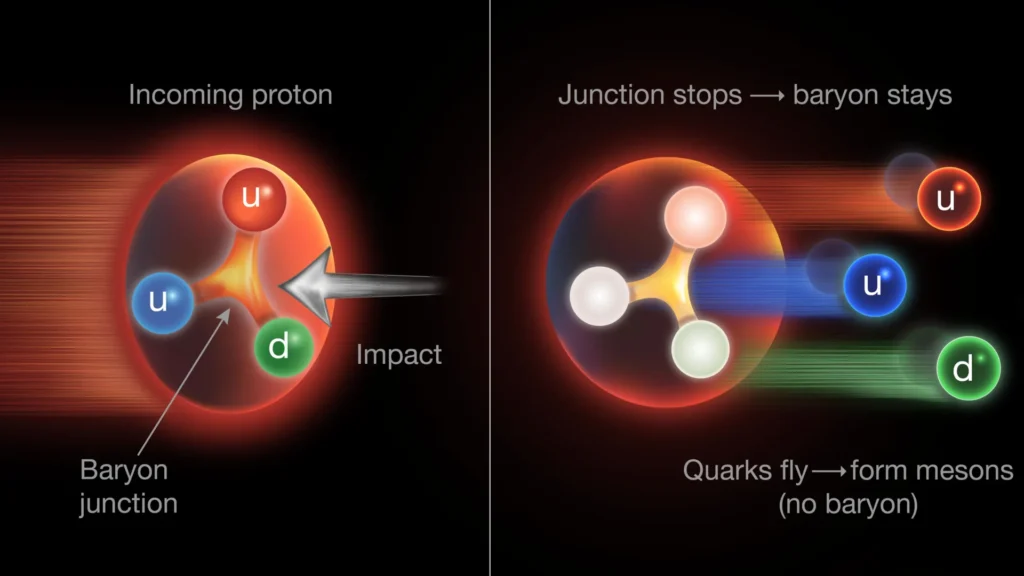
However, as experimental physics progressed, the proton was revealed to be a chaotic "sea" of activity. Beyond the three valence quarks, the interior of a proton is teeming with virtual quarks and antiquarks that pop in and out of existence, along with a swarm of gluons that mediate the strong force. In the 1970s, theorists began to hypothesize the existence of a "baryon junction"—a specific configuration where gluon fields meet in a Y-shape to pull the three valence quarks together.
In 1996, Dmitri Kharzeev, a theoretical physicist at Stony Brook University and Brookhaven Lab, took this idea a step further. He proposed that this gluon junction was not merely a structural connector but was the actual carrier of the baryon number. For nearly thirty years, this remained a provocative but unproven hypothesis. The STAR (Solenoidal Tracker at RHIC) collaboration has now provided the first empirical evidence that Kharzeev’s vision of the proton may be the correct one.
Experimental Methodology: Decoupling Charge from Baryon Number
The research team, led by scientists from institutions including Kent State University, Brookhaven National Laboratory, Rice University, and the University of Science and Technology of China, utilized the unique capabilities of RHIC to test the gluon junction theory. RHIC is an accelerator capable of smashing heavy ions, such as gold nuclei, together at 99.995% of the speed of light. These collisions create a "Quark-Gluon Plasma" (QGP), a state of matter mimicking the conditions of the universe microseconds after the Big Bang.
The experiment hinged on a clever comparison between two different conserved properties: electric charge and baryon number. Valence quarks carry both. If the valence quarks were the sole carriers of the baryon number, then in any collision where the quarks are slowed down or "stopped," the electric charge and the baryon number should be transported together in identical patterns.
The STAR detector measured "midrapidity" particles—those that emerge perpendicular to the direction of the colliding beams. When heavy ions collide, most of the original quarks continue moving forward along the beamline. However, some "stopping" occurs, where the energy of the collision deposits baryon number and electric charge in the central region of the detector.
Upon analyzing the data, the researchers found a striking discrepancy. The number of baryons (protons and neutrons) appearing at midrapidity was significantly higher than the amount of electric charge transported to that same region. In fact, there were roughly twice as many baryons as would be predicted if the quarks (and their associated charges) were the only things carrying the baryon number. This "mismatch" suggested that something other than the valence quarks was responsible for transporting the baryon number into the center of the collision.
The Role of the Gluon Junction in High-Energy Collisions
The STAR team’s findings support a mechanism where the gluon junction acts as the primary vehicle for baryon transport. As protons are accelerated to near-light speeds, the density of gluons within them increases dramatically. According to the theory of "gluon saturation," the momentum of the proton becomes distributed among an ever-growing number of low-energy gluons.
During a high-energy collision, these gluons interact more readily than the high-momentum valence quarks. The Y-shaped gluon junction, which represents a collective topological property of the gluon field, is much easier to "stop" during the impact. While the valence quarks might zip through the collision zone and continue down the beampipe, the gluon junction is left behind in the center of the detector.
"In the collision, the baryon junction gets held behind, and the quarks continue on," explained Prithwish Tribedy, a STAR physicist at Brookhaven Lab. Once the junction is stopped, its immense field energy is converted into new matter through the process of hadronization. The Y-shaped junction effectively "fishes" three quarks out of the vacuum to form a new baryon, such as a proton or a lambda particle. This explains why the STAR detector recorded an excess of baryons at midrapidity without a corresponding increase in the original valence quark charge.
Implications for the Stability of the Universe
The significance of identifying the gluon junction as the carrier of baryon number extends far beyond the confines of subatomic particle maps. It touches upon one of the most fundamental mysteries in physics: the conservation of baryon number and the resulting stability of matter.
Baryon number conservation dictates that the total number of baryons in the universe remains constant (minus antibaryons). This law is the reason protons do not spontaneously decay into lighter particles like electrons or photons. If the proton were to decay, atoms would destabilize, and the complex structures of the universe—stars, planets, and life—would cease to exist.
"It’s believed that the lifetime of a proton is longer than the lifespan of the universe," said Nicole Lewis, a STAR physicist at Rice University. By pinpointing the gluon junction as the source of this property, scientists are gaining a deeper understanding of the topological "knots" in the gluon field that prevent the proton from falling apart.
Furthermore, this research provides clues into the "matter-antimatter asymmetry" problem. The Big Bang should have produced equal amounts of matter and antimatter, which would have annihilated each other, leaving behind a universe of pure radiation. The fact that we live in a matter-dominated universe suggests a slight preference for baryons over antibaryons occurred in the early seconds of time. Understanding how baryon number is carried and transported is essential for theorists working to explain how this asymmetry arose.
Data and Collaboration: A Global Scientific Effort
The results published in Science are the culmination of over two decades of data collection and a massive international collaboration. The STAR detector itself is a house-sized instrument consisting of multiple layers of sensors designed to track thousands of particles simultaneously.
Key data points from the study include:
- Baryon-to-Charge Ratio: The observed ratio of net-baryon number to net-electric charge was consistently higher than the 0.5 value predicted by the valence quark model.
- Energy Dependency: The effect was observed across various collision energies, proving that the gluon junction is a persistent feature of proton structure at high energies.
- Particle Species: The excess was not limited to protons but was also seen in "strange" baryons like Lambda particles, confirming that the junction mechanism is universal for three-quark systems.
The research was supported by a global network of funding and infrastructure, including the U.S. Department of Energy Office of Science, the National Science Foundation, and scientific agencies in China, India, and Europe. Computational heavy lifting was provided by the National Energy Research Scientific Computing Center (NERSC) and the Open Science Grid.
The Future of Nuclear Physics: Toward the EIC
While the STAR results provide compelling evidence for the gluon junction, the scientific community views this as the beginning of a new chapter rather than the final word. The Relativistic Heavy Ion Collider is scheduled to conclude its mission in the coming years, making way for the next generation of discovery: the Electron-Ion Collider (EIC).
The EIC, which will be built at Brookhaven National Laboratory, will act as a high-resolution "microscope" for the interior of the proton. Unlike RHIC, which smashes heavy nuclei together, the EIC will use high-energy electrons to probe the arrangement of quarks and gluons with unprecedented precision.
"Our research challenges the long-held idea that baryon number is simply divided among and carried by the three quarks," said Rongrong Ma, a Brookhaven Lab physicist. "The EIC will allow us to see these gluon junctions in even greater detail, potentially mapping the ‘glue’ that holds our world together in ways we can only currently imagine."
By confirming that gluons—the messengers of the strong force—are also the guardians of the proton’s identity, the STAR collaboration has reshaped the landscape of nuclear physics. This discovery reminds the scientific world that even the most "familiar" particles, like the protons that make up our own bodies, still hold secrets that can redefine our understanding of the cosmos.