Europe is on the cusp of a significant advancement in its space exploration capabilities with the near-completion of its most sophisticated robotic arm, the Sample Transfer Arm (STA). This cutting-edge piece of engineering, currently undergoing final assembly and testing, is designed to be a pivotal tool for future missions to the Moon and Mars, promising to revolutionize how we interact with and understand these celestial bodies.
A New Era of Robotic Dexterity
The Sample Transfer Arm represents a monumental leap in robotic technology, designed to mimic and exceed the dexterity of human limbs. Extending up to a remarkable 2.4 meters, the STA boasts an impressive seven degrees of freedom, granting it an extensive range of motion. This intricate articulation is further augmented by an integrated suite of two advanced cameras and a comprehensive array of sensors, allowing the arm to perceive and interact with its environment with unprecedented precision.
At its core, the STA’s design is elegantly anthropomorphic, featuring a "shoulder," "elbow," and "wrist." However, its capabilities extend far beyond mere physical resemblance. The arm is equipped with a sophisticated "brain" and "eyes" – advanced processing units and optical systems that enable it to "see," "feel," and make autonomous decisions. This self-sufficiency is crucial for operating in the harsh and unpredictable environments of space, where real-time human intervention is often impossible.
The arm’s "hand" is a highly specialized gripper, engineered to handle objects with millimetric accuracy. This level of precision is not only impressive but essential for the demanding tasks it will undertake. The integration of a state-of-the-art force and torque sensor provides the STA with a vital sense of touch. This "haptic feedback" allows the robot to gauge the exact pressure, pull, and twist applied to an object in three-dimensional space, a capability that is paramount for delicate operations such as collecting fragile geological samples or manipulating sensitive equipment. Complementing this tactile sense are internal position sensors embedded within the arm’s joints, which continuously compute the precise location of its tip, ensuring that every movement is executed with pinpoint accuracy.
Origins and Core Mission: Mars Sample Return
The genesis of the Sample Transfer Arm lies in the ambitious joint NASA-ESA Mars Sample Return (MSR) campaign. Originally conceived as a critical component of this groundbreaking endeavor, the STA’s primary role was to facilitate the secure transfer of invaluable Martian soil samples collected by NASA’s Perseverance rover. Its mission was to meticulously retrieve these precious specimens and ensure their safe delivery for eventual transport back to Earth, where they could be subjected to intensive scientific analysis.
The MSR campaign, a multi-mission undertaking, aims to be the first in history to bring Martian rocks and soil back to our home planet, offering scientists an unprecedented opportunity to search for signs of ancient life and unravel the planet’s geological history. The STA’s role in this mission underscores the complexity and delicate nature of such an undertaking, highlighting the need for highly reliable and dexterous robotic systems.
A Legacy of European Robotic Prowess
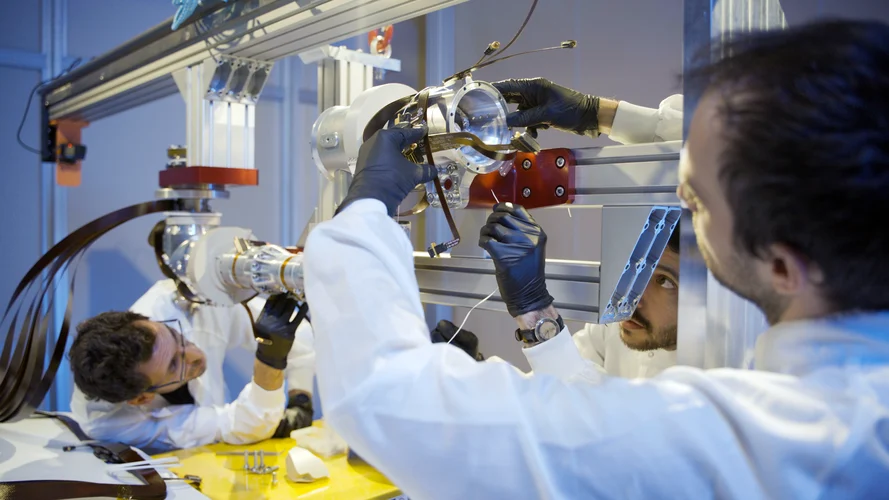
The development of the Sample Transfer Arm is deeply rooted in decades of European expertise and innovation in the field of space robotics. This accumulated knowledge and experience have been instrumental in bringing such a complex and sophisticated system to fruition. The integration of the STA is currently being meticulously undertaken by teams at Leonardo, a prominent Italian aerospace company renowned for its contributions to space technology.
Engineers at Leonardo’s Nerviano plant, located near Milan, are in the final stages of assembling and testing the arm. In the coming weeks, these dedicated professionals will be putting the STA through its paces, subjecting it to rigorous testing in simulated space environments. These simulations are designed to replicate the extreme conditions of vacuum, temperature fluctuations, and radiation that the arm will encounter on its missions, ensuring its robustness and readiness for the rigors of space exploration.
The STA is not a singular effort but a testament to pan-European collaboration. The core industrial consortium, spearheaded by Leonardo, includes key partners such as GMV and AVS from Spain, Maxon from Switzerland, 3DPlus from France, and COMOTI from Romania. This collaborative network extends further, with suppliers contributing from Denmark, Greece, and Germany. This broad international partnership not only showcases Europe’s collective engineering talent but also signifies a strategic drive towards greater autonomy in space exploration.
Broader Applications: Beyond Mars
While its initial mandate was tied to Mars Sample Return, the Sample Transfer Arm’s versatile design and advanced capabilities make it suitable for a multitude of applications beyond its original purpose. The inherent flexibility of its robotic articulation and its precise manipulation skills position it as an invaluable asset for a wide range of future lunar and Martian missions.
On the Moon, for instance, the STA could play a crucial role in establishing lunar bases, assisting astronauts with construction tasks, deploying scientific instruments, and collecting geological samples from challenging terrains. Its ability to operate autonomously or semi-autonomously would significantly reduce the risks to human explorers and enhance the efficiency of lunar operations. For future Mars missions, the STA could be instrumental in deploying scientific payloads, performing in-situ resource utilization (ISRU) tasks, and supporting the development of infrastructure for human settlements.
Accelerating European Autonomy in Space
The development and deployment of advanced space robotic technologies like the Sample Transfer Arm are pivotal in accelerating Europe’s journey towards greater autonomy and strategic independence in space exploration. By mastering the design, manufacturing, and operation of such complex systems, Europe is reducing its reliance on external partners and solidifying its position as a leading spacefaring power.
This strategic independence is crucial for pursuing long-term exploration goals, fostering economic growth through space-related industries, and ensuring Europe’s continued influence in shaping the future of space activities. The STA, with its inherent versatility and adaptability, is a prime example of how European innovation can drive progress across multiple mission architectures, from robotic sample return to the eventual human exploration of distant worlds.
A Glimpse into the Future
The coming weeks will be critical for the Sample Transfer Arm as it undergoes its most demanding tests. The successful completion of these trials will mark a significant milestone, paving the way for its integration into upcoming space missions. The ESA has provided further insights and visual documentation of the arm’s assembly on its Mars blog, offering the public a closer look at this extraordinary piece of engineering.
The journey of the Sample Transfer Arm from concept to reality is a testament to human ingenuity and international cooperation. As it moves closer to deployment, it represents not just a sophisticated tool, but a symbol of Europe’s growing ambition and capability in the ongoing quest to explore the cosmos and expand our understanding of the universe. The potential applications are vast, and the implications for future space endeavors are profound, heralding a new era of robotic assistance in humanity’s grand cosmic journey.
Timeline and Key Milestones
The development and assembly of the Sample Transfer Arm can be understood within a broader context of evolving European space robotics capabilities. While specific project start dates are often proprietary, the STA’s lineage can be traced back through numerous European robotic missions and technology development programs.
- Decades Prior: European expertise in space robotics, including manipulator arms and intelligent control systems, is cultivated through various ESA projects and national space agency initiatives. This foundational knowledge forms the bedrock for complex projects like the STA.
- Early Stages of Mars Sample Return Concept: The conceptualization of the Mars Sample Return campaign begins, highlighting the need for advanced robotic capabilities to handle delicate sample collection and transfer. This phase likely involves initial studies and technology feasibility assessments for a specialized transfer arm.
- Development and Design Phase: The detailed design of the Sample Transfer Arm commences, involving extensive engineering, simulation, and component selection. This is where the anthropomorphic design, seven degrees of freedom, advanced sensing, and precision gripper are finalized. Key industrial partners like Leonardo, GMV, AVS, Maxon, 3DPlus, and COMOTI are brought on board to contribute their specialized expertise.
- Component Manufacturing and Sub-assembly: Individual components of the arm are manufactured by various partners across Europe. These components are then assembled into larger sub-systems, such as the shoulder, elbow, and wrist joints, with their integrated sensors and actuators.
- Current Phase: Final Assembly and Integration: The entire arm is being brought together at Leonardo’s facility in Italy. This is the most critical phase, where all sub-systems are integrated, and the arm begins to take its complete form.
- Upcoming Weeks: Simulated Space Testing: Engineers will conduct rigorous testing of the STA’s functionality in simulated space environments at Leonardo’s Nerviano plant. This will involve verifying its range of motion, precision, autonomous decision-making capabilities, and its ability to handle objects with the specified dexterity.
- Future Deployment: Upon successful completion of testing and qualification, the Sample Transfer Arm will be integrated into a spacecraft destined for a lunar or Martian mission, marking its operational debut in the harsh environment of space. The specific mission timeline will depend on broader mission planning by ESA and its international partners.
Supporting Data and Technological Underpinnings
The sophistication of the Sample Transfer Arm is underpinned by several key technological advancements:
- Degrees of Freedom (DoF): The STA’s seven degrees of freedom are crucial. A typical industrial robot arm might have four to six DoF. The seventh DoF, often associated with wrist-like articulation, allows for more complex orientations and manipulations, enabling the arm to reach awkward angles and perform intricate tasks.
- Force and Torque Sensing: This technology is critical for "gentle manipulation." It allows the arm to detect and react to resistance, preventing damage to delicate samples or equipment. The sensor’s ability to measure forces and torques in three dimensions simultaneously is a significant advancement.
- Advanced Vision Systems: The integration of two cameras provides stereoscopic vision, allowing the arm to perceive depth and distance accurately. This, coupled with sophisticated image processing algorithms, enables the arm to identify objects, navigate its environment, and execute precise movements.
- Onboard Computing and AI: The "built-in brain" signifies the presence of powerful onboard processors capable of running complex algorithms for path planning, obstacle avoidance, and autonomous decision-making. This reduces the reliance on ground control, which is essential given the significant communication delays with Mars.
- Precision Manufacturing: The ability to achieve "millimetric precision" in handling objects requires extremely high-quality manufacturing of all mechanical components and precise calibration of the control systems.
Broader Impact and Implications for Space Exploration
The successful development and deployment of the Sample Transfer Arm have far-reaching implications for the future of space exploration:
- Enhanced Scientific Discovery: By enabling more precise sample collection and manipulation, the STA will significantly enhance the scientific return of future missions, particularly in fields like astrobiology and planetary geology.
- Enabling Human Missions: The STA’s capabilities can be leveraged to support human explorers on the Moon and Mars. It can perform tasks that are too dangerous, repetitive, or require too much precision for astronauts, thereby increasing mission safety and efficiency.
- Foundation for In-Situ Resource Utilization (ISRU): The arm’s dexterity and precision are essential for future ISRU operations, such as extracting water ice or processing regolith to produce building materials or rocket propellant.
- Strengthening European Space Leadership: The STA project underscores Europe’s commitment to developing independent space capabilities, positioning the continent as a key player in the global space arena.
- Inspiration for Future Generations: The visible progress in complex robotic systems like the STA can inspire a new generation of engineers and scientists, fostering continued innovation in the field of space exploration.
The Sample Transfer Arm is more than just a piece of machinery; it is a symbol of human ambition, technological prowess, and the unwavering drive to explore the unknown. As its final assembly progresses, the anticipation grows for its pivotal role in unlocking the secrets of our celestial neighbors.