Everything around us has mass, but its fundamental origin remains one of physics’ most profound unanswered questions. According to modern theories, the mass of particles does not simply arise from the matter itself in isolation. Instead, it is intricately tied to the nature of the quantum vacuum, a concept far removed from empty space. This vacuum is understood as a dynamic, complex environment teeming with virtual particles and fluctuating fields, and its structure plays a crucial role in how particles acquire their mass. Understanding this hidden framework and the mechanisms of mass generation requires probing matter under extreme conditions, and studying special particle systems offers a promising pathway for scientists to achieve this goal.
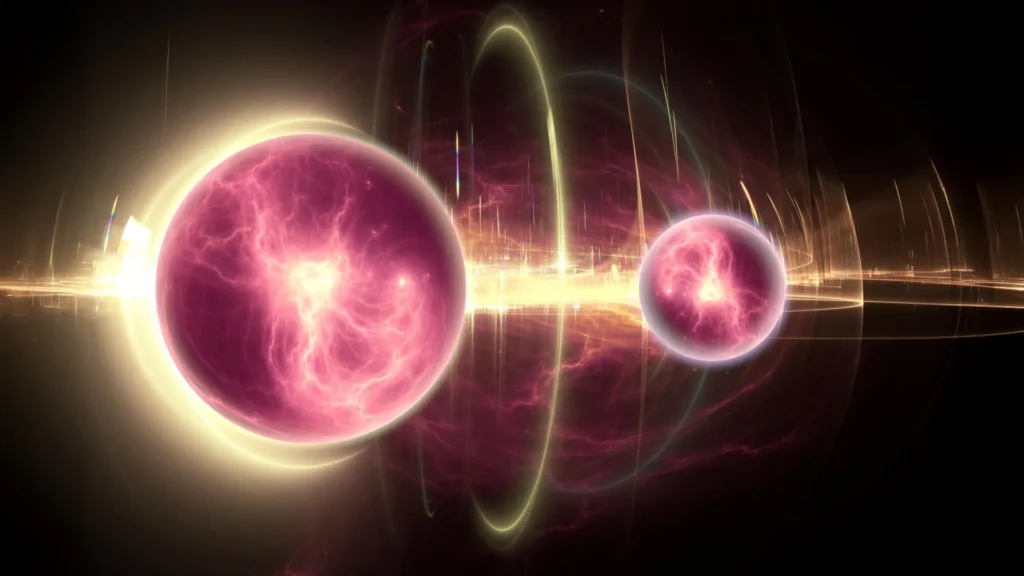
One particularly insightful approach involves the investigation of mesons, which are subatomic particles composed of a quark and an anti-quark bound together by the strong nuclear force. When these mesons are temporarily captured within an atomic nucleus, they form a rare and exotic composite system known as a mesic nucleus. By carefully examining the properties of these mesic nuclei, researchers can gain unprecedented access to the structure of the quantum vacuum within dense nuclear matter and shed light on the elusive mechanisms that endow particles with their intrinsic mass. Recent groundbreaking experimental results have now brought the scientific community significantly closer to this objective, providing compelling evidence for the existence of a completely new type of mesic nucleus, specifically one involving the eta-prime (η’) meson.
The Enigmatic Origin of Mass: Beyond the Higgs Field
The Standard Model of particle physics, our most successful theory describing the fundamental particles and forces, explains the origin of elementary particle mass through the Higgs mechanism. This mechanism posits the existence of a pervasive Higgs field, interacting with particles and imparting mass to them. However, the Higgs mechanism primarily accounts for the intrinsic mass of elementary particles like electrons and quarks. It does not fully explain the vast majority of the mass of composite particles, such as protons and neutrons, which constitute nearly all visible matter in the universe. A proton, for instance, is made of three quarks whose intrinsic masses contribute only a few percent to the proton’s total mass. The remaining 95% or more comes from the kinetic energy of the quarks and the binding energy of the gluons that mediate the strong nuclear force, as described by Quantum Chromodynamics (QCD).
This QCD-driven mass generation is deeply connected to the properties of the quantum vacuum. In the vacuum, quark-antiquark pairs spontaneously appear and disappear, creating a dynamic "condensate." The interaction of quarks with this condensate, which represents a broken symmetry of the vacuum (chiral symmetry), is what primarily gives them their effective mass within hadrons. Studying how this vacuum structure, and particularly chiral symmetry, behaves within the extreme densities found inside atomic nuclei is critical for a complete understanding of mass. Mesons, particularly those sensitive to chiral symmetry breaking, serve as ideal probes for these investigations.
Mesons as Probes of the Quantum Vacuum
Mesons are transient particles, typically existing for fractions of a second before decaying into more stable forms. Their internal structure—a quark and an anti-quark—makes them sensitive to the strong nuclear force and the quantum fluctuations of the vacuum. When a meson is "trapped" within an atomic nucleus, its properties, such as its mass and decay width, can be altered by the dense nuclear environment. This alteration provides a unique window into how the vacuum structure changes under extreme conditions.
The concept of mesic nuclei has been explored for decades, with early research focusing on lighter mesons like pions and kaons. Experiments involving these lighter mesons have offered valuable insights into the strong interaction and the behavior of nuclear matter. However, the search for mesic nuclei involving heavier and more exotic mesons promises to unlock even deeper secrets, particularly regarding the dynamics of chiral symmetry restoration—a phenomenon predicted to occur in extremely dense or hot nuclear matter, where the vacuum condensate might partially melt, causing particles to regain their "bare" masses.
The η’-Meson: A Unique Candidate for Mass Shift
Among the pantheon of mesons, the eta-prime (η’) meson holds particular interest for physicists investigating mass generation. The η’ meson is unusually heavy compared to its related particles, such as the pion (approximately 140 MeV/c²) and the eta (η) meson (approximately 548 MeV/c²). The η’ meson boasts a mass of roughly 958 MeV/c², nearly twice that of the η meson, despite sharing similar quark content. This anomalously high mass is not simply explained by standard quark model considerations but is instead attributed to a quantum phenomenon known as the U(1) axial anomaly. This anomaly plays a crucial role in QCD and significantly influences the η’ meson’s properties.
Theoretical predictions suggest that the η’ meson’s mass should change significantly when it exists inside dense nuclear matter. Specifically, physicists anticipate a reduction in its effective mass due to the partial restoration of chiral symmetry within the nuclear environment. Observing this phenomenon experimentally would provide direct evidence for how the quantum vacuum structure, particularly the chiral condensate, responds to the presence of dense matter, offering invaluable information about how particle masses are generated in the universe. Senior author Kenta Itahashi emphasized this point, stating, "One particle of particular interest is the η’ meson. It is unusually heavy compared with related particles, and physicists expect that its mass changes when it exists inside nuclear matter. Observing this phenomenon would provide valuable information about how particle masses are generated in the universe."
Hunting the Exotic: The GSI Experiment and Its Precision
To embark on this ambitious search for η’-mesic nuclei, an international collaboration of researchers converged on the GSI Helmholtzzentrum für Schwerionenforschung (GSI Helmholtz Centre for Heavy Ion Research) in Darmstadt, Germany. GSI is a world-renowned facility specializing in accelerator-based research with heavy ions, providing the high-energy beams necessary for creating exotic nuclear states. The experiment, a testament to high-precision particle physics, was meticulously designed to detect the subtle signatures of these ephemeral systems.
The core of the experimental methodology involved directing a precisely controlled beam of high-energy protons onto a carbon target. This interaction was designed to excite the carbon nuclei, momentarily creating an environment conducive to the production and capture of η’ mesons. The incident protons, accelerated to energies around 2.5 GeV, were chosen to optimize the cross-section for η’ meson production while minimizing background noise. The carbon target, specifically a ¹²C nucleus, was selected for its relatively simple structure, allowing for clearer interpretation of the reaction products.
Unraveling the Reaction: Proton-Carbon Interactions and Deuteron Analysis
When a high-energy proton strikes a carbon nucleus, a complex nuclear reaction ensues. In certain rare instances, this collision can lead to the creation of an η’ meson, which then becomes temporarily bound within the excited carbon nucleus. The challenge lies in identifying these extremely short-lived η’-mesic nuclei, which exist for less than ten-millionths of a second. The experimental strategy focused on analyzing the particles emitted during the reaction to infer the properties of the transient bound state.
The researchers’ primary method for studying these interactions involved measuring the excitation energy of the carbon nuclei by analyzing the deuterons (a composite nucleus made of one proton and one neutron) that were emitted during the reaction. The kinematics of the emitted deuteron—its energy and angle—carry crucial information about the energy transferred to the residual nucleus, including any energy used to form a mesic state. By precisely measuring these deuterons, the team could reconstruct the excitation spectrum of the carbon nucleus. A specific "peak" or "structure" in this spectrum, corresponding to an energy level below the threshold for free η’ meson emission, would signify the formation of a bound η’-mesic nucleus. These highly precise measurements were carried out using the Fragment Separator (FRS), a sophisticated magnetic spectrometer at GSI. The FRS is capable of separating and identifying reaction products with exceptional resolution, allowing for the isolation of deuterons originating from the specific binding event.
The WASA Detector and FRS: A Synergy for Discovery
Complementing the FRS, the experiment also relied on a specialized detector system known as WASA (Wide Angle Shower Apparatus). Originally developed at Uppsala University in Sweden, the WASA detector is designed to detect and identify high-energy light particles, particularly protons, emitted at large angles from the target. In this experiment, WASA played a critical role in identifying "decay signatures"—signals indicating that an η’ meson had indeed been created and subsequently captured within the nucleus.
Specifically, WASA detected high-momentum protons leaving the target. The coincidence measurement between the deuterons analyzed by the FRS and these high-momentum protons detected by WASA was crucial. This two-pronged detection strategy allowed the researchers to filter out background noise and isolate events where an η’ meson was produced and subsequently bound to the carbon nucleus. Lead author Ryohei Sekiya elaborated on the success of this integrated approach: "With our new experimental setup combining the FRS and the WASA, we can identify structures in the data that match theoretical signatures of η’-mesic nuclei. Our analysis suggests that these bound states were indeed formed." The synergy between the high-resolution FRS for deuteron analysis and the broad acceptance WASA for proton detection provided the necessary sensitivity and selectivity to uncover this rare and exotic particle state.
Evidence Emerges: Signatures of the η’-Mesic Nucleus
The culmination of these intricate measurements and sophisticated data analysis yielded compelling evidence. The excitation spectrum of the carbon nucleus, as measured in the experiment, exhibited distinct patterns that were highly consistent with the theoretical predictions for the formation of η’-mesic nuclei. These patterns, observed as specific energy levels below the free η’ meson production threshold, strongly indicate that the η’ mesons were not merely produced but became genuinely bound to the carbon nuclei.
Furthermore, the characteristics of these observed bound states provided crucial insights into the η’ meson’s behavior within nuclear matter. The results suggested that the effective mass of the η’ meson appears to decrease when it is embedded within the dense nuclear environment. This finding directly supports the long-standing theoretical predictions regarding chiral symmetry restoration and the modification of particle properties under extreme conditions. It marks a rare experimental confirmation of a phenomenon that has primarily existed in theoretical models, offering a tangible glimpse into the complex interplay between mesons and the nuclear vacuum.
Implications for Chiral Symmetry and Vacuum Structure
The discovery of the η’-mesic nucleus and the indication of its mass reduction within nuclear matter carry profound implications for fundamental physics, particularly for our understanding of Quantum Chromodynamics (QCD) and chiral symmetry. Chiral symmetry is a fundamental symmetry of QCD that is spontaneously broken in the vacuum, giving rise to the effective masses of quarks and, consequently, of hadrons like protons, neutrons, and most mesons. Theoretical models predict that this broken symmetry can be partially restored in environments of high temperature or density, such as those found inside atomic nuclei or neutron stars.
The η’ meson, due to its unique connection to the U(1) axial anomaly and chiral symmetry, is an excellent probe for these effects. A reduction in its mass within nuclear matter would be direct evidence of a partial restoration of chiral symmetry in that dense environment. This would not only validate theoretical frameworks but also provide experimental data crucial for refining these models. It offers a unique opportunity to map how the properties of the quantum vacuum, including the quark-antiquark condensate, evolve under varying densities. Kenta Itahashi reiterated the significance, stating, "Our measurements provide important new clues about how mesons behave in nuclear matter. This brings us closer to answering deep, fundamental questions about how matter acquires mass, as well as how the vacuum structure changes inside atomic nuclei."
A Glimpse into the Universe’s Densest Matter
Beyond particle physics, these findings hold relevance for astrophysics and cosmology. Neutron stars, for instance, represent the densest known forms of matter in the universe, where conditions are so extreme that the properties of subatomic particles are expected to be drastically altered. Understanding how mesons behave and how chiral symmetry is restored in dense nuclear matter provides crucial input for theoretical models describing the interior of neutron stars. It can help physicists better understand the equation of state of super-dense matter, which dictates the size, mass, and other characteristics of these enigmatic celestial objects. Similarly, insights into the vacuum structure under extreme conditions can inform models of the early universe, when matter was incredibly dense and hot.
The Road Ahead: Confirmations and New Frontiers
While the current results provide strong evidence for the existence of η’-mesic nuclei and suggest a mass shift, the scientific process demands further confirmation and refinement. The international team is already planning follow-up experiments designed to enhance the accuracy of their measurements. This will involve collecting more data, potentially using different reaction channels or target nuclei, and exploring additional decay signals that could unequivocally confirm the existence and properties of these exotic states. For example, direct observation of the η’ meson’s decay products (e.g., two photons or three pions) while it is still bound within the nucleus would provide even stronger evidence for its modified mass.
The pursuit of these elusive particles is a long-term endeavor, but each new result, like the one presented, incrementally refines our understanding of the fundamental laws that govern matter and the universe. The discovery of the η’-mesic nucleus opens a new frontier in nuclear and particle physics, promising further revelations about the nature of mass, the strong nuclear force, and the intricate, dynamic structure of the quantum vacuum. Future experiments will aim to characterize these systems with even greater precision, potentially revealing details about their binding energies, lifetimes, and how their properties depend on the specific nuclear environment. This ongoing research will undoubtedly continue to push the boundaries of our knowledge, bridging the gap between theoretical predictions and experimental observation in the quest to understand the universe’s most fundamental building blocks.
The article detailing these findings, titled "Excitation Spectra of the ¹²C(p,d) Reaction near the η’-Meson Emission Threshold Measured in Coincidence with High-Momentum Protons," has been published in the prestigious journal Physical Review Letters.