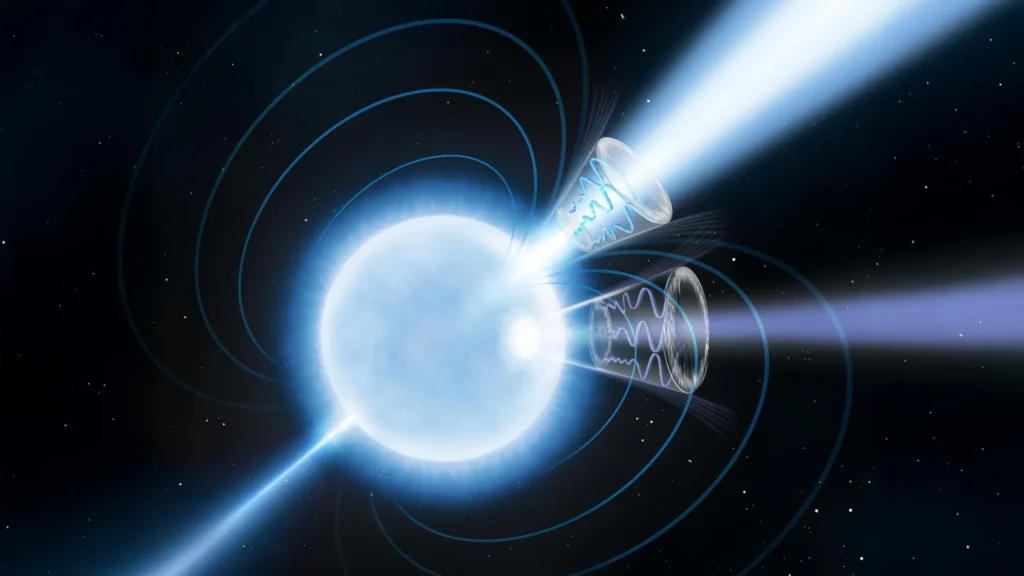
The vacuum of space, long conceptualized as a cold and desolate void, has once again proven to be one of the most complex frontiers in modern physics. In a landmark study published recently in the journal Nature, an international coalition of astronomers has unveiled what may be the most compelling evidence to date for "vacuum birefringence," a quantum mechanical phenomenon first predicted nearly a century ago. By observing the intense environment surrounding a magnetar—a rare and volatile species of neutron star—researchers have demonstrated that even the "emptiness" of space can act as a prism, altering the path and properties of light under the influence of extreme magnetic forces.
This discovery represents a significant milestone in the field of Quantum Electrodynamics (QED), providing a rare bridge between theoretical predictions made in the 1930s and contemporary astrophysical observation. Led by a team including Dr. Marcus Lower from Swinburne University of Technology, the research utilizes data from NASA’s Imaging X-ray Polarimetry Explorer (IXPE) and several of the world’s most powerful radio telescopes to probe the limits of the physical universe.
The Heisenberg Legacy: A 90-Year-Old Prediction
The foundations of this discovery were laid in the mid-1930s by Werner Heisenberg and Hans Heinrich Euler. Heisenberg, a Nobel Prize winner and a central figure in the development of quantum mechanics, proposed that a perfect vacuum is never truly empty. According to the Heisenberg-Euler Lagrangian, the vacuum is populated by "virtual particles"—pairs of electrons and positrons that spontaneously pop in and out of existence.
Under normal circumstances, these virtual particles are undetectable and do not significantly interfere with the passage of light. However, Heisenberg and Euler theorized that in the presence of an unimaginably strong magnetic field, these particles would become polarized. This alignment would cause the vacuum itself to behave like a birefringent crystal, such as calcite, which splits a single beam of light into two. This "vacuum birefringence" would effectively change the refractive index of empty space, causing light waves to travel at different speeds depending on their polarization relative to the magnetic field.
For decades, this theory remained purely mathematical. The magnetic fields required to induce such an effect are far beyond the reach of human technology. To observe vacuum birefringence, scientists needed a laboratory of cosmic proportions.
Magnetars: The Universe’s Most Extreme Laboratories
The search for vacuum birefringence led researchers to the study of magnetars, the remnants of massive stars that have collapsed into incredibly dense spheres. While a typical neutron star possesses a magnetic field billions of times stronger than Earth’s, a magnetar is in a category of its own. Its magnetic field can be 1,000 times stronger than that of a standard neutron star, reaching levels of up to 10^15 Gauss.
"Detecting vacuum birefringence requires a magnetic field that is over 100 million times stronger than any we’ve ever made on Earth," explained Dr. Marcus Lower. "Thankfully, nature has provided us with magnetars, which are the perfect cosmic laboratories to go looking for this effect."
The specific subject of this study was the magnetar 1E 1547.0-5408 (often abbreviated as 1E1547). Located approximately 18,000 light-years away in the constellation Norma, 1E1547 is one of the most active magnetars known to science. It is characterized by its rapid rotation and frequent outbursts of X-rays and radio waves, making it a prime candidate for polarimetric analysis.
Methodology and Cross-Disciplinary Instrumentation
The research team employed a multi-messenger approach, combining X-ray data with radio frequency observations to build a comprehensive map of the magnetar’s environment. The primary instrument used was NASA’s Imaging X-ray Polarimetry Explorer (IXPE). Launched in late 2021, IXPE is the first satellite dedicated to measuring the polarization of X-rays from celestial objects. Unlike traditional X-ray telescopes that measure only the position and energy of photons, IXPE can determine the direction in which the electric field of the light is vibrating.
To complement the X-ray data, the team utilized the NICER (Neutron star Interior Composition Explorer) telescope aboard the International Space Station and Murriyang, the CSIRO’s 64-meter Parkes radio telescope in Australia. The radio observations collected by Murriyang were particularly crucial. Dr. Lower and his colleagues used these signals to track the rotational dynamics of the magnetar with millisecond precision.
The data processing was a massive undertaking, requiring the computational power of Swinburne University’s Ngarrgu Tindebeek supercomputer. By synthesizing the radio and X-ray data, the researchers were able to determine the precise geometry of the magnetar’s rotation and magnetic field alignment.
The Geometry of Discovery
One of the most significant hurdles in detecting vacuum birefringence is the "averaging effect." If a magnetar’s magnetic field is viewed from an unfavorable angle, the different polarization states of light can cancel each other out, masking the quantum signature. However, 1E 1547.0-5408 offered an exceptionally rare viewing geometry.
The team’s analysis revealed that the magnetic and rotational axes of 1E1547 are nearly aligned. Furthermore, the magnetar is oriented in such a way that Earth-based observers view it from a nearly "pole-on" perspective. This alignment means that as the star rotates, the polarization of the emitted light remains relatively stable and tied to the magnetic field lines rather than being scrambled by the star’s rotation.
"By carefully tracking the direction the radio waves and X-rays oscillate as the magnetar rotates, the team found that the alignment of 1E1547’s magnetic and rotational poles were ideal for detecting vacuum birefringence," Dr. Lower stated.
Supporting Data and Evidence
The evidence for vacuum birefringence in 1E1547 rests on two primary findings:
-
High Polarization Degrees: The X-rays detected by IXPE showed an unexpectedly high level of linear polarization. According to classical physics, the polarization should be significantly lower. The high degree of alignment observed suggests that a quantum process—vacuum birefringence—is acting on the photons as they escape the magnetar’s magnetosphere, maintaining their polarization over vast distances.
-
Consistent Polarization Angle: The researchers found that the direction of X-ray polarization was perfectly consistent with the direction of radio wave polarization. Because radio waves and X-rays are produced by different mechanisms at different altitudes above the star’s surface, this consistency implies that a single, overarching phenomenon (the vacuum itself) is dictating how the light is oriented as it travels through the magnetic field.
"Because of the magnetic field’s strength, Heisenberg’s virtual particles become aligned with the direction the field is pointing," Dr. Lower noted. This alignment forces the light to conform to the magnetic "grain" of the vacuum, effectively "locking" the polarization state in place.
Chronology of the Investigation
The journey toward this discovery has spanned nearly a century, moving from the chalkboard to the edges of the galaxy:
- 1936: Werner Heisenberg and Hans Euler publish their theoretical work on the behavior of the vacuum in strong magnetic fields.
- 1990s-2000s: Theoretical astrophysicists suggest that magnetars could provide the necessary conditions to test the Heisenberg-Euler predictions.
- 2016: Early hints of vacuum birefringence are reported using optical observations of a different neutron star, but the results remain controversial due to the lack of high-precision polarimetry.
- 2021: NASA launches IXPE, providing the first tool capable of measuring X-ray polarization with the required sensitivity.
- 2022-2023: The international team conducts a series of coordinated observations of 1E 1547.0-5408 using IXPE, NICER, and Murriyang.
- 2024: After exhaustive data analysis and supercomputer simulations, the findings are published in Nature, marking a definitive step forward in quantum astrophysics.
Broader Impact and Scientific Implications
The potential confirmation of vacuum birefringence has profound implications for our understanding of the fundamental laws of nature. Firstly, it serves as a rigorous test of Quantum Electrodynamics in the "strong-field regime." While QED has been tested with extreme precision in Earth-based laboratories (such as at CERN), those tests occur in relatively weak fields. Magnetars allow physicists to see if these laws hold true when pushed to their breaking point.
Beyond QED, this research opens a new window into "New Physics." Some theories of dark matter, specifically those involving axion-like particles, predict similar effects on light polarization. By establishing a baseline for vacuum birefringence, scientists can better distinguish between known quantum effects and potential signatures of dark matter or other exotic physics.
Furthermore, the study demonstrates the power of multi-wavelength astronomy. The synergy between X-ray polarimetry and radio timing was essential to this discovery. It provides a blueprint for future missions, such as the proposed eXTP (enhanced X-ray Timing and Polarimetry) satellite, which aims to study these phenomena with even greater resolution.
Future Research and Validation
Despite the strength of the current evidence, the scientific community remains cautious. Dr. Lower and his colleagues emphasize that while the signal is highly suggestive of vacuum birefringence, further work is needed to rule out all other possibilities.
"Additional observations and more advanced computer simulations could help establish whether the signal truly comes from vacuum birefringence," Dr. Lower said. Future research will focus on creating more sophisticated models of the magnetar’s surface (the "crust") and its plasma-filled atmosphere. These models will help researchers distinguish the quantum vacuum signature from other physical processes, such as the way light scatters off ions or electrons in the magnetar’s immediate vicinity.
The team is already planning follow-up observations of other magnetars to see if the effect is universal. If similar patterns are found in stars with different geometries, it will solidify the case that the vacuum itself is the culprit.
As the scientific community digests these findings, the legacy of Heisenberg and Euler stands taller than ever. Nearly 90 years after their pens first touched paper, the "empty" space they imagined is finally being seen for what it truly is: a dynamic, vibrating medium that holds the keys to the quantum universe. With future data and updated simulations, humanity may finally be able to complete the quest to understand the invisible architecture of reality.