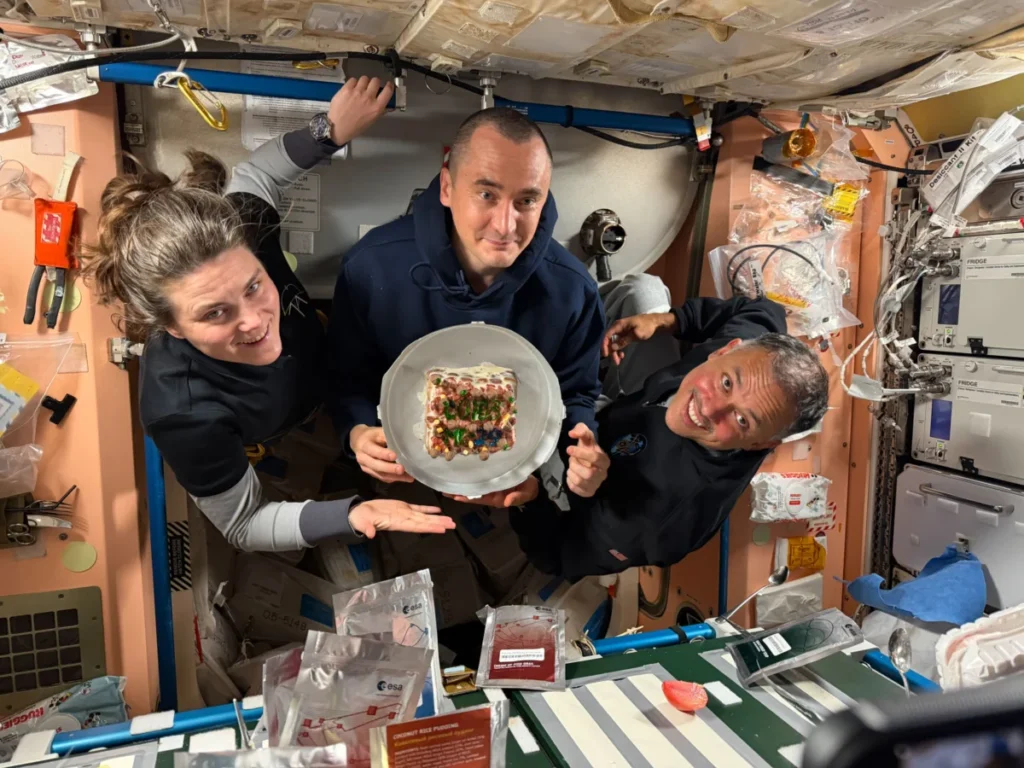
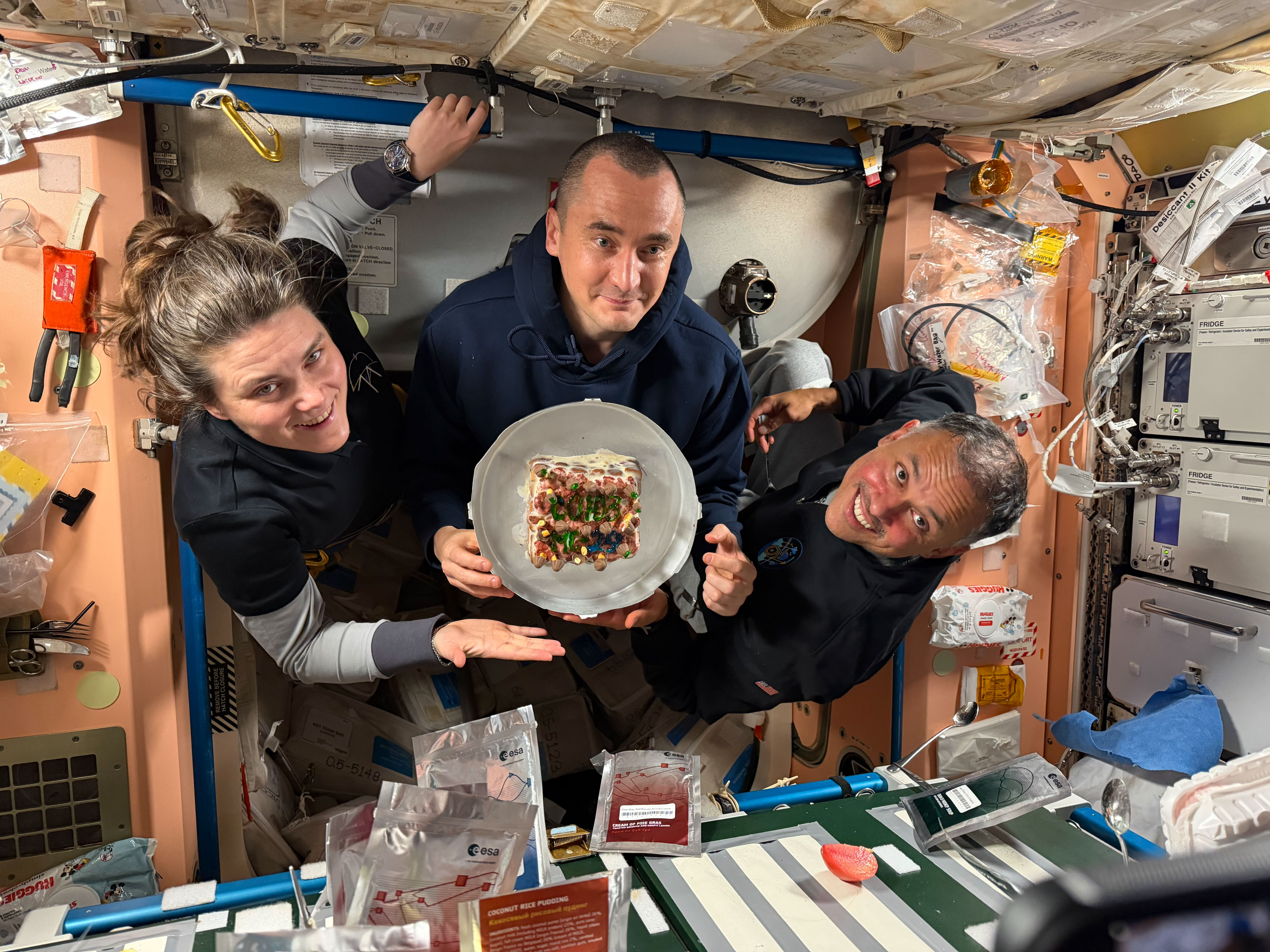
The recent arrival of Expedition 74 astronauts Anna Kikina and Pyotr Dubrov of Roscosmos, alongside NASA astronaut Anil Menon, aboard the International Space Station (ISS) marks another significant milestone in ongoing international collaboration and scientific exploration in orbit. The trio, who successfully docked with the orbiting laboratory on July 14, 2026, following their launch from the Baikonur Cosmodrome in Kazakhstan, have since embarked on the initial stages of their eight-and-a-half-month mission. A moment of shared celebration, captured in a photograph on July 18, 2026, showed the crew holding a cake, symbolizing not only their safe arrival but also the camaraderie and shared purpose that defines human spaceflight. This event underscores the continued dedication of space agencies worldwide to maintaining a continuous human presence in low Earth orbit for research, technological development, and the advancement of our understanding of the cosmos.
A New Chapter in Orbital Research
Expedition 74 represents the latest chapter in the ISS’s illustrious history as a unique platform for scientific inquiry. Anna Kikina, Pyotr Dubrov, and Anil Menon are now in the second week of their extensive mission, a period characterized by both the acquisition of new operational skills essential for living and working in the microgravity environment and the commencement of their demanding research schedules. The ISS, a testament to international cooperation involving NASA, Roscosmos, the European Space Agency (ESA), the Japan Aerospace Exploration Agency (JAXA), and the Canadian Space Agency (CSA), serves as an unparalleled laboratory for experiments that cannot be replicated on Earth. These investigations span a wide range of disciplines, including human physiology, materials science, fundamental physics, and Earth observation, all of which contribute to improving life on our home planet and preparing for future deep-space endeavors.
The presence of astronauts from different nations aboard the ISS is a cornerstone of its operational philosophy. This collaborative spirit is crucial for the complex logistics of maintaining and operating the station, as well as for fostering a global perspective on scientific discovery. The seamless integration of Kikina, Dubrov, and Menon into the existing crew highlights the rigorous training and advanced preparation undertaken by all participating space agencies to ensure mission success and astronaut well-being. Their combined expertise and dedication are vital for the successful execution of the scientific objectives planned for Expedition 74.
Chronology of Arrival and Initial Operations
The journey of Expedition 74 began with a meticulously planned launch from the Baikonur Cosmodrome, a historic spaceport in Kazakhstan that has been instrumental in space exploration since the dawn of the space age. On July 14, 2026, aboard a Soyuz spacecraft, Kikina, Dubrov, and Menon lifted off, commencing their transit to the ISS. The Soyuz spacecraft, a workhorse of human spaceflight for decades, is renowned for its reliability and its critical role in ferrying crews to and from the orbiting laboratory.
The launch itself is a high-stakes operation, involving precise timing and the coordinated efforts of thousands of personnel. The ascent through Earth’s atmosphere subjects the crew to significant G-forces, a test of their physical and mental resilience. Upon reaching orbit, the Soyuz spacecraft initiated its rendezvous sequence with the ISS, a complex orbital dance that requires sophisticated navigation and control systems. Over several hours, the spacecraft meticulously adjusted its trajectory, closing the distance to the station.
The docking maneuver, a critical phase of the mission, was executed with precision. The gentle, controlled connection of the Soyuz to the ISS signifies the successful completion of the transit phase. Following a thorough leak check and the equalization of cabin pressure, the hatch between the Soyuz and the ISS was opened, marking the official welcome of the new crew members. This moment of ingress is always a significant one, symbolizing the transfer of astronauts from their transit vehicle to their home in orbit for the duration of their mission.
The photograph capturing Kikina, Dubrov, and Menon with a celebratory cake was taken on July 18, 2026, just four days after their arrival. This informal yet meaningful gesture highlights the human element of space exploration. In the demanding environment of space, maintaining morale and fostering a sense of community among the crew are paramount for mission success and psychological well-being. The cake, a symbol of celebration and shared accomplishment, serves to acknowledge their safe arrival and the commencement of their demanding work ahead. It also subtly emphasizes the enduring human desire for connection and shared experiences, even in the most extraordinary of settings.
Supporting Data and Mission Context
The International Space Station, a marvel of engineering and international cooperation, has been continuously inhabited since November 2, 2000. It orbits the Earth at an average altitude of approximately 400 kilometers (250 miles) and travels at a speed of about 28,000 kilometers per hour (17,500 miles per hour), completing approximately 16 orbits per day. The station’s modular design, assembled over more than a decade, comprises various pressurized modules, external trusses, and solar arrays, creating a living and working space roughly equivalent to a six-bedroom house.
Expedition 74’s crew members are embarking on a mission that is part of a larger, continuous cycle of crew rotations and scientific operations. The average duration of a mission aboard the ISS has increased over the years, with typical stays now ranging from six months to over a year. This extended duration allows astronauts to adapt to the physiological effects of microgravity and to conduct more in-depth research. The cumulative data gathered from these long-duration missions is invaluable for understanding the long-term impacts of spaceflight on the human body, which is crucial for planning future missions to the Moon, Mars, and beyond.
The scientific payload aboard the ISS is vast and diverse. It includes state-of-the-art laboratories such as the Columbus module (ESA), the Kibo module (JAXA), and the Destiny laboratory (NASA). These facilities are equipped to conduct experiments in microgravity, allowing scientists to observe phenomena that are impossible to replicate on Earth due to gravity’s influence. For example, research into protein crystallization in microgravity can lead to breakthroughs in drug development. Studies on fluid physics and combustion can improve understanding of processes relevant to industrial applications and fire safety. Furthermore, the ISS serves as a crucial platform for Earth observation, providing invaluable data for climate monitoring, disaster response, and environmental research.
Official Responses and International Collaboration
While specific official statements directly addressing the cake-cutting ceremony are unlikely to be publicly disseminated in formal press releases, the very act of sending a mixed-nationality crew to the ISS is a testament to the ongoing commitment of the participating space agencies. NASA, Roscosmos, ESA, JAXA, and CSA consistently emphasize the importance of international partnership in space exploration.
A spokesperson for NASA, in a general statement regarding ISS operations, might typically highlight: "The International Space Station stands as a beacon of international cooperation, enabling groundbreaking scientific research and technological advancements that benefit all of humanity. The continued presence of a diverse and skilled crew, like Expedition 74, underscores our shared commitment to pushing the boundaries of human knowledge and fostering peaceful collaboration in space."
Similarly, a statement from Roscosmos would likely echo these sentiments, emphasizing the vital role of Russian expertise and contributions to the ISS program. The long-standing partnership between NASA and Roscosmos, despite geopolitical complexities on Earth, has been a remarkable success story in maintaining a consistent human presence in space. This symbiotic relationship, forged over decades, is essential for the continued operation and scientific output of the ISS.
The successful launch and docking of Expedition 74 are the culmination of years of planning, training, and technological development by multiple nations. The seamless integration of astronauts from different cultural and operational backgrounds is a testament to the robust inter-agency protocols and the shared vision for space exploration. The presence of a cake, a simple human tradition, serves as a powerful visual reminder of the shared humanity and common goals that unite these international crews as they undertake the extraordinary challenges of living and working in space.
Broader Impact and Implications
The successful arrival of Expedition 74 aboard the International Space Station has several significant implications for the future of space exploration and scientific discovery. Firstly, it reaffirms the operational robustness and continued relevance of the ISS as a critical platform for microgravity research. The station continues to be the premier orbiting laboratory for studying the effects of space on human health, a crucial area of research as humanity sets its sights on longer-duration missions to the Moon and Mars.
Secondly, the collaborative nature of the mission underscores the enduring power of international partnerships in achieving ambitious goals. In an era where global cooperation is increasingly vital, the ISS serves as a powerful example of what can be accomplished when nations work together towards a common objective. The shared expertise, resources, and technological capabilities brought to bear by the participating space agencies ensure the continued success and scientific output of the station.
Thirdly, the mission contributes to the ongoing development of technologies and operational procedures necessary for future deep-space exploration. The lessons learned from managing complex systems, conducting scientific experiments, and ensuring the well-being of astronauts on the ISS will be directly applicable to future endeavors, such as the Artemis program and potential crewed missions to Mars. The cumulative knowledge gained from these long-duration missions is indispensable for mitigating risks and ensuring the safety and success of future human expeditions beyond Earth orbit.
Finally, the presence of astronauts like Kikina, Dubrov, and Menon in space serves as an inspiration for future generations of scientists, engineers, and explorers. Their dedication and achievements highlight the possibilities that arise from scientific curiosity, technological innovation, and international cooperation, encouraging young people worldwide to pursue careers in STEM fields and to dream of contributing to humanity’s ongoing journey into the cosmos. The simple act of sharing a cake in orbit, while seemingly mundane, encapsulates the human spirit of achievement, camaraderie, and the enduring pursuit of knowledge that defines the era of space exploration.