Additive Manufacturing Media, a leading publication in the advanced manufacturing sector, has recently highlighted innovative thermal management components developed by Farsoon Technologies, a prominent player in metal additive manufacturing. The featured components, a 3D printed heat dissipation cold plate and a finned heat sink, underscore the growing sophistication and application breadth of metal 3D printing, particularly within the demanding liquid cooling industry. These advanced parts, produced using Farsoon’s proprietary Fine Laser Spot (FLS) metal additive manufacturing (AM) technology, represent a significant leap forward in achieving intricate geometries and superior thermal performance, often with reduced post-processing requirements.
The showcase, detailed by Additive Manufacturing Media, centers on two key components designed to enhance the efficiency and reliability of liquid cooling systems. These systems are becoming increasingly critical across a wide array of industries, from high-performance computing and data centers to electric vehicles and aerospace, where effective heat dissipation is paramount for operational integrity and longevity. Farsoon’s FLS technology, a sophisticated application of laser powder bed fusion (LPBF), is engineered for applications demanding microscopic precision, enabling the creation of complex, near-net-shape parts that often serve as end-use components with minimal need for extensive finishing. This capability is particularly advantageous for intricate designs like those found in advanced heat exchangers.
The Evolution of Thermal Management in High-Performance Systems
The demand for efficient thermal management has surged in recent decades, driven by the relentless pursuit of higher performance and miniaturization in electronic and mechanical systems. As power densities increase, the ability to effectively remove and dissipate heat becomes a critical bottleneck. Traditional manufacturing methods, while mature, often face limitations in creating the complex internal structures that can maximize surface area for heat exchange or optimize fluid flow paths. This is where additive manufacturing, and specifically Farsoon’s FLS technology, offers a transformative approach.
The development of these 3D printed components is not an isolated event but rather a reflection of a broader trend in the AM industry. Companies are increasingly leveraging the design freedom offered by 3D printing to create parts that are not only lighter and stronger but also possess enhanced functional properties. For thermal management, this translates into components that can dissipate heat more effectively, leading to improved system performance, reduced energy consumption, and increased product lifespan. The ability to print directly from digital designs also facilitates rapid prototyping and customization, allowing engineers to iterate on designs and optimize performance with unprecedented speed.
Farsoon’s Fine Laser Spot Technology: Precision at the Microscopic Level
Farsoon Technologies has positioned its Fine Laser Spot (FLS) technology as a key enabler for high-precision metal AM applications. This advanced LPBF system is designed to achieve extremely fine feature sizes and tight tolerances, making it ideal for producing intricate components like those featured in the recent showcase. The technology’s ability to produce parts with minimal finishing requirements is a significant advantage, reducing manufacturing time and cost.
The FLS solution is characterized by its precise control over the laser beam and powder bed, allowing for the creation of delicate structures and complex internal geometries that are difficult or impossible to achieve with conventional subtractive manufacturing techniques. This precision is crucial for applications such as heat exchangers, microfluidic devices, and other components where small features and intricate designs directly impact performance. By enabling the production of near-net-shape parts, the FLS technology minimizes material waste and the need for extensive post-processing, contributing to a more sustainable and cost-effective manufacturing process.
The 3D Printed Heat Dissipation Cold Plate: Integrated Design for Superior Performance
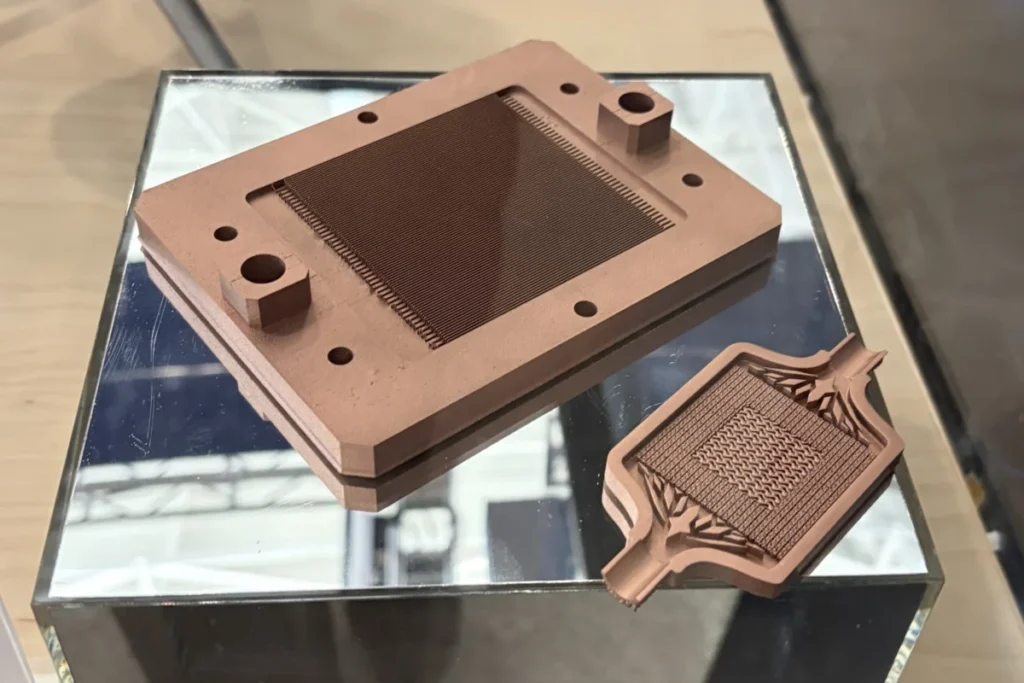
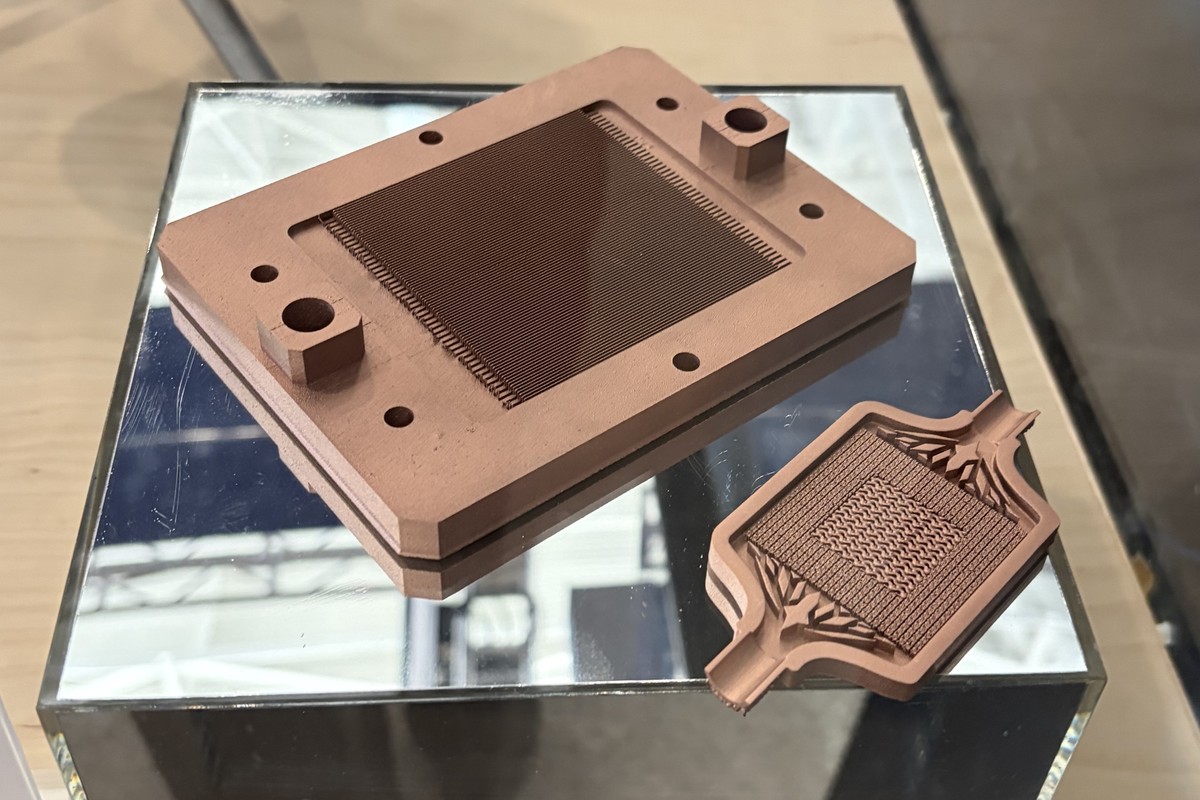
The heat dissipation cold plate, highlighted by Additive Manufacturing Media, exemplifies the innovative potential of Farsoon’s FLS technology. This component was 3D printed as a single, monolithic piece from a CuCrZr alloy. The monolithic construction is a key advantage, as it completely eliminates the risk of leakage, a common concern in liquid cooling systems that rely on multiple assembled parts. This integration not only enhances reliability but also simplifies assembly and reduces the overall system footprint.
A significant design innovation incorporated into this cold plate is the fusion of triply periodic minimal surface (TPMS) structures with traditional cooling channel designs. TPMS structures, such as Gyroids and Schoenflies, are mathematically defined, lattice-like geometries that offer exceptional strength-to-weight ratios and complex internal porosity. By integrating these advanced structures within the cold plate, Farsoon has achieved a design that significantly enhances both its structural integrity and its thermal performance. The internal geometry optimizes the flow of coolant, maximizing the surface area for heat absorption from the base material and promoting efficient heat transfer to the fluid.
The table provided by the source material offers specific technical details about the cold plate:
- Material: CuCrZr alloy, chosen for its excellent thermal conductivity and mechanical properties.
- 3D Printing Solution: Fine Laser Spot, underscoring the need for high precision.
- Layer Thickness: 10 microns, a testament to the fine resolution achievable with the FLS technology. This extremely thin layer thickness allows for the capture of intricate details and smooth surfaces.
- Printing Accuracy: ±0.03 mm, indicating a high degree of dimensional control over the printed part.
- Minimal Wall Thickness of TPMS: 0.2 mm, showcasing the ability to print very thin yet robust lattice structures.
- Minimum Diameter of Cylindrical Structure: 0.1 mm, further emphasizing the capability to produce micro-scale features.
These specifications highlight the advanced capabilities of the FLS technology, enabling the creation of highly optimized and integrated thermal management components. The ability to achieve such fine details and complex geometries in a single print from a high-performance alloy like CuCrZr is a significant advancement for the liquid cooling industry.
The Finned Heat Sink: Maximizing Surface Area for Efficient Heat Dispersion
Complementing the cold plate, the finned heat sink also showcases Farsoon’s additive manufacturing prowess. This component was 3D printed from a copper alloy using Farsoon’s FS273M metal LPBF system. The FS273M is a robust and versatile metal AM system designed for a wide range of industrial applications.
The design of this finned heat sink is optimized for consistent cooling in demanding environments. Its fundamental principle involves absorbing heat through its base, which would be in direct contact with the heat-generating component, and then efficiently dispersing that heat through its fins. The additive manufacturing process allows for the creation of fins with highly optimized geometries and increased surface area compared to traditionally manufactured heat sinks. This expanded surface area facilitates a greater rate of heat transfer to the surrounding air or liquid medium, enabling faster and more reliable cooling.
The technical specifications for the finned heat sink, as presented by the source, are:
- Material: Copper alloy, renowned for its excellent thermal conductivity, making it an ideal material for heat dissipation.
- System: Farsoon FS273M, a capable metal LPBF system suitable for producing such components.
- Process: LPBF, the underlying additive manufacturing technology.
- Average Density: 8.87 g/cm³, which is very close to the theoretical density of copper alloys, indicating a well-sintered and dense part.
- Part Density: > 99.5%, signifying an extremely high degree of material consolidation and minimal porosity. High part density is crucial for thermal conductivity and mechanical integrity.
- Minimum Fin Thickness: 0.25 mm, demonstrating the ability to create thin, efficient fins that maximize surface area without compromising structural stability.
The high density and precisely engineered fin geometry of this 3D printed heat sink are critical for its performance. In applications where airflow or fluid flow is a factor, a larger and more efficient surface area directly translates to superior heat dissipation capabilities, ensuring that sensitive components remain within their optimal operating temperature range.
Implications for the Liquid Cooling Industry and Beyond
The advancements demonstrated by Farsoon Technologies have significant implications for the liquid cooling industry and other sectors reliant on advanced thermal management. The ability to produce highly integrated, complex, and performance-optimized cooling components through additive manufacturing offers several key benefits:
- Enhanced Performance: The intricate designs enabled by AM, such as internal TPMS structures and optimized fin geometries, can lead to substantially improved heat dissipation rates. This allows systems to operate at higher power levels or maintain more stable temperatures, boosting overall performance and reliability.
- Reduced System Complexity and Weight: By integrating multiple functions into a single printed part (e.g., a cold plate with built-in channels and structural support), the number of components in a cooling system can be reduced. This leads to simpler assembly, fewer potential points of failure (like leaks), and a lighter overall system. This is particularly important in applications where weight is a critical factor, such as in aerospace or portable electronics.
- Increased Design Freedom and Customization: AM allows engineers to design cooling solutions tailored to specific applications and geometries. This level of customization was previously unachievable or prohibitively expensive with traditional manufacturing. The ability to print bespoke parts means that cooling can be optimized for unique heat sources or spatial constraints.
- Faster Prototyping and Development Cycles: The digital nature of AM accelerates the design and iteration process. Engineers can quickly produce and test new designs, leading to faster product development and time-to-market.
- Material Innovation: The development of components from specialized alloys like CuCrZr and high-conductivity copper alloys highlights the expanding material palette available for AM. As research and development continue, we can expect even more advanced materials to be utilized for thermal management applications.
Beyond liquid cooling, these advancements have relevance for:
- High-Performance Computing (HPC) and Data Centers: The increasing power density of CPUs and GPUs in servers necessitates more efficient cooling solutions to maintain optimal performance and prevent thermal throttling.
- Electric Vehicles (EVs): Battery packs, power electronics, and motors in EVs generate significant heat. Advanced cooling systems are crucial for battery longevity, charging speed, and overall vehicle performance and safety.
- Aerospace and Defense: Lightweight, high-performance cooling components are vital for avionics, power systems, and specialized equipment in aircraft and spacecraft, where weight and reliability are paramount.
- Industrial Automation: High-power machinery and control systems often require robust thermal management to ensure continuous operation and prevent overheating.
- Medical Devices: Certain advanced medical equipment generates heat that must be managed effectively to ensure patient safety and device functionality.
The Future of Thermal Management with Additive Manufacturing
The showcase of Farsoon Technologies’ 3D printed thermal management components represents a significant milestone in the ongoing integration of additive manufacturing into critical industrial applications. The precision, design freedom, and material capabilities demonstrated are paving the way for a new generation of cooling solutions that are more efficient, reliable, and adaptable than ever before.
As additive manufacturing technologies continue to mature and expand their material offerings, we can anticipate further innovations in thermal management. The ability to create increasingly complex and optimized geometries, coupled with advancements in material science, will drive the development of solutions that push the boundaries of performance in a wide range of industries. Farsoon Technologies, with its focus on precision and advanced LPBF capabilities, is clearly positioned to be a key contributor to this ongoing evolution. The successful application of their FLS technology to these demanding components signals a promising future for additive manufacturing in addressing some of the most pressing thermal challenges across the global technological landscape.