Astronomers have detected what may be the first moon outside our Solar System, an enormous and enigmatic celestial body that defies conventional definitions and could revolutionize our understanding of planetary systems. Observed using the European Southern Observatory’s Very Large Telescope (ESO’s VLT), this potential exosatellite orbits a brown dwarf in the CD-35 2722 star system, a configuration so unusual it prompts a re-evaluation of what constitutes a "moon" and a "planet." If confirmed, this discovery marks a pivotal moment in the ongoing quest to find natural satellites beyond our familiar cosmic neighborhood.
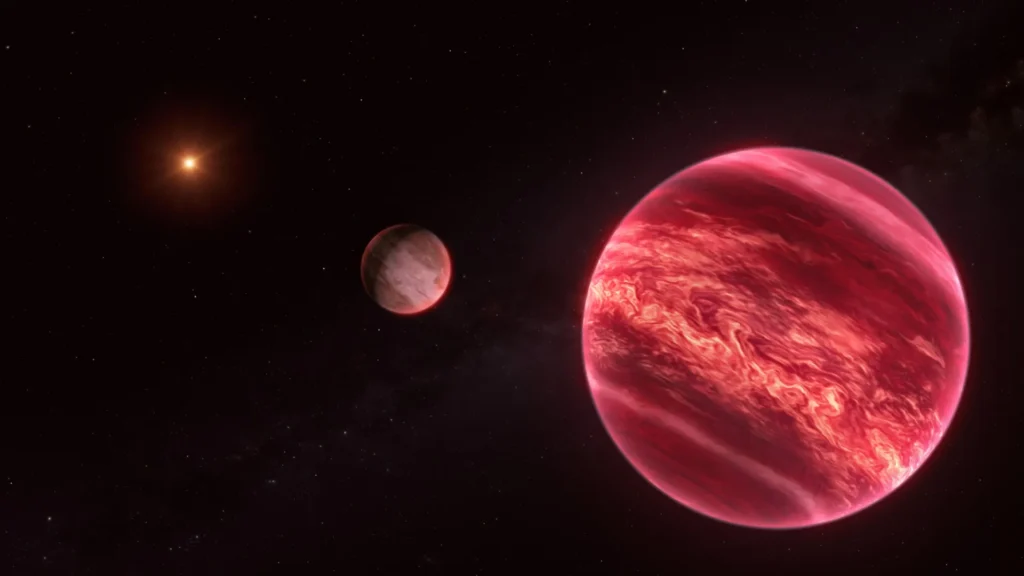
The system at the heart of this groundbreaking observation, CD-35 2722, presents a striking departure from the familiar architecture of our own Solar System. At its core is CD-35 2722, a star roughly half the mass of our Sun. However, instead of planets forming a predictable orbital dance around this star, the system features a brown dwarf in orbit. Brown dwarfs, often described as "failed stars," bridge the gap between planets and stars. They are more massive than any planet but lack the sufficient mass to ignite sustained hydrogen fusion, the process that powers true stars. This brown dwarf, in turn, hosts the newly identified object, creating a complex "third wheel" arrangement where a massive satellite circles an object that itself orbits a star.
This peculiar arrangement has led researchers to label the newly detected object an "exosatellite," a term for a natural satellite located outside our Solar System. The sheer scale of this potential exomoon is staggering. It possesses at least the mass of Jupiter, the largest planet in our Solar System. The brown dwarf it orbits is more than 30 times Jupiter’s mass, making the suspected moon significantly more massive than any known natural satellite within our own cosmic backyard.
"This system is somewhat hard to define using Solar-System-based words like ‘planet’ and ‘moon’," explained Kevin Hoy, an ESO student based in Chile and lead author of the study published in the journal Nature. Hoy, who is also affiliated with the Universidad Diego Portales and the Millennium Nucleus of Young Exoplanets and their Moons (YEMS) in Chile, described the system as "super weird" when compared to our Solar System. He elaborated on the quandary of classification: "The exosatellite is clearly massive enough to be a planet, but it does not orbit a star, though it orbits an object that orbits a star. Being the third wheel in this system makes us want to call it a moon, even if it is nothing like the small, rocky moons we have in our system."
A Bizarre Star System Unlike Our Own
The CD-35 2722 system is a testament to the incredible diversity of cosmic structures that exist beyond our immediate celestial vicinity. The star at its center is relatively young, providing a dynamic environment where such unusual configurations might arise. The brown dwarf, a substantial celestial entity in its own right, orbits the star at a significant distance. The presence of a massive satellite around this brown dwarf adds another layer of complexity, challenging established notions of how planetary systems are organized.
Alice Zurlo, director of YEMS and a collaborator on the study, further emphasized the unique nature of the discovery. "The satellite we report is a giant gaseous body orbiting a highly massive companion, itself several times the mass of Jupiter," Zurlo stated. She pointed out that in our Solar System, the distinction between planets and the Sun is clear, making the definition of moons straightforward. "In the CD-35 2722 system, where we are blurring the lines between stars, planets, and moons, the whole thing becomes more complicated to describe." This blurring of lines is precisely what makes the discovery so significant, as it forces astronomers to confront the limitations of their current terminology.
The Challenge of Defining Exomoons
The discovery of this massive exosatellite candidate highlights a fundamental challenge in exoplanetary science: the difficulty of applying familiar labels to objects found in distant and often alien environments. While the term "exosatellite" broadly refers to any natural satellite outside our Solar System, "exomoon" typically implies a moon orbiting a planet or another celestial body beyond our Solar System. However, a universally accepted definition for an exomoon has yet to be established.
This definitional ambiguity becomes particularly acute in the CD-35 2722 system. The newly detected object, due to its sheer mass, could easily qualify as a planet under some classification schemes. Yet, its orbital path around a brown dwarf, rather than directly around a star, sets it apart from typical exoplanets. This orbital characteristic is what aligns it with the concept of a moon – a natural satellite accompanying a larger body.
A Timeline of the Search for Exomoons
The search for moons beyond our Solar System has been an active area of astronomical research for decades, spurred by the remarkable success in discovering thousands of exoplanets. Despite the vast number of exoplanets identified, the detection of confirmed exomoons has remained elusive. Until now, only a handful of potential exomoon candidates have emerged, with the evidence for each being limited and often debated.
A significant development in this ongoing search occurred earlier in 2026, when a research team led by Quentin Kral reported possible signs of a satellite in the HD 206893 star system. Their observations, utilizing the sophisticated capabilities of ESO’s Very Large Telescope Interferometer, suggested the presence of a moon-like companion. However, these findings did not meet the threshold for a definitive detection.
The CD-35 2722 system now presents a much more compelling opportunity. The evidence for the exosatellite is bolstered by measurements of its gravitational influence on the motion of its larger companion, the brown dwarf. This indirect but robust method of detection provides a stronger basis for concluding its existence.
Unveiling the Alien Moon: The Detection Method
The breakthrough observation of the CD-35 2722 system was made possible by the advanced CRIRES+ instrument mounted on ESO’s Very Large Telescope. Hoy, Zurlo, and their colleagues employed a technique refined over years of exoplanet hunting: the radial velocity method. This method, famously used to discover the first exoplanet orbiting a Sun-like star, relies on detecting minute shifts in the light emitted by a celestial object.
The principle behind the radial velocity method is the gravitational dance between orbiting bodies. When two objects orbit each other, they both revolve around a common center of mass. Even if one object is significantly smaller than the other, its gravitational pull will cause the larger object to exhibit a slight, periodic wobble in its motion. By meticulously analyzing the spectrum of light from the brown dwarf and observing subtle variations in its radial velocity – the speed at which it is moving towards or away from Earth – the researchers were able to infer the presence of an unseen companion.
The measured wobble in the brown dwarf’s motion provided strong evidence that a massive body was indeed in orbit around it. "As exotic as it is, this system is truly unique and represents a breakthrough: the first plausible detection of an exosatellite," Zurlo remarked. This detection method, while indirect, offers a powerful tool for probing the gravitational influence of hidden companions.
A New Era in the Search for Cosmic Companions
The confirmation of moons beyond our Solar System would represent more than just an expansion of astronomical catalogs. Such discoveries hold the potential to unlock crucial insights into the processes of planetary system formation and evolution. Understanding how these complex systems assemble, how their various components interact gravitationally, and why some systems develop such dramatically different architectures could fundamentally alter our models of cosmic evolution.
Furthermore, future observations will be critical in determining whether massive satellites like the one proposed in CD-35 2722 are rare anomalies or representative of a broader, yet-undiscovered population of unusual celestial objects. The sheer scale of this potential exomoon suggests that nature might be more inventive than previously assumed when it comes to forming satellites.
The upcoming Extremely Large Telescope (ELT), currently under construction by ESO, is poised to play a pivotal role in this ongoing search. With its monumental 39-meter mirror and cutting-edge scientific instruments, the ELT will possess the sensitivity required to detect smaller exomoons that are currently beyond the observational capabilities of existing observatories. As astronomers begin to identify a growing number of satellites in distant planetary systems, they may find that the clear-cut distinctions between stars, planets, and moons, which seem so absolute in our Solar System, are far more fluid and varied across the cosmos.
What Constitutes an Exomoon?
The ongoing debate around the definition of an exomoon underscores the complexity of classifying celestial bodies in the universe. At its most basic, a satellite is any object that orbits another, larger object. These can be natural, like Earth’s Moon, or artificial, such as the satellites launched by human space agencies.
An exosatellite, as previously mentioned, is a natural satellite located beyond our Solar System. The term "exomoon" is generally used to describe a natural satellite that orbits a planet or another celestial body outside our Solar System. However, the lack of a universally agreed-upon definition means that astronomers often operate within a gray area.
The potential companion in the CD-35 2722 system exemplifies this definitional challenge. Its mass, comparable to or exceeding that of Jupiter, makes it resemble a planet in terms of its sheer size and likely gaseous composition. Yet, its orbital relationship – circling a brown dwarf that itself orbits a star – positions it as a candidate for a classification that is neither a typical exoplanet nor a familiar exomoon. This situation compels the astronomical community to refine its terminology and conceptual frameworks to encompass the full spectrum of cosmic phenomena. The discovery in CD-35 2722, therefore, is not just a detection of a new object; it is a catalyst for a deeper, more nuanced understanding of the universe’s celestial architecture.