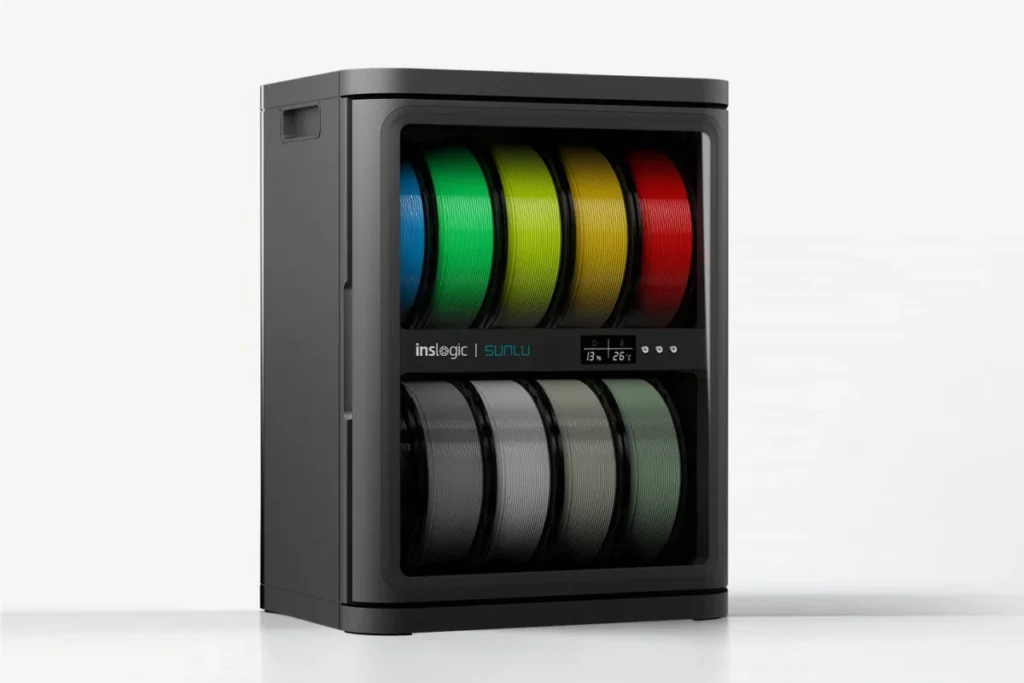
The introduction of the FilaDC i10 filament dehumidifying cabinet, a collaborative effort between technology manufacturers Inslogic and Sunlu, marks a significant shift in the management of 3D printing consumables for both hobbyists and professional makers. Priced at $199, this specialized storage solution addresses one of the most persistent challenges in the additive manufacturing workflow: the hygroscopic nature of 3D printing filaments. Unlike traditional active drying units that rely primarily on high-heat convection, the i10 utilizes a sophisticated dual-effect system combining Positive Temperature Coefficient (PTC) heating with a molecular sieve desiccant. This methodology allows for room-temperature, non-damaging dehumidification, ensuring that sensitive materials maintain their structural integrity and chemical properties over long-term storage.
The Technical Evolution of Filament Maintenance
To understand the significance of the FilaDC i10, one must first examine the environmental vulnerabilities of common 3D printing materials. Most thermoplastic filaments, including Polylactic Acid (PLA), Polyethylene Terephthalate Glycol (PETG), Acrylonitrile Butadiene Styrene (ABS), and particularly Thermoplastic Polyurethane (TPU) and Nylon (PA), are hygroscopic. This means they actively absorb moisture from the surrounding atmosphere.
When moisture-laden filament is fed into a 3D printer’s hot end, the water trapped within the plastic rapidly expands into steam. This process causes several documented print defects, including internal bubbling, excessive stringing (oozing), poor layer adhesion, and a characteristic "popping" sound during extrusion. In professional settings, these defects lead to failed prints, wasted material, and mechanical weaknesses in the final part.
Historically, the 3D printing community has relied on three primary methods for moisture control:
- Passive Storage: Using airtight plastic bins with sacrificial silica gel packets. While cost-effective, this method lacks precision and cannot actively remove moisture already embedded in the filament.
- Active Hot-Air Dryers: Small, single- or dual-spool devices that use heating elements and fans to bake moisture out of the filament. These are effective but often consume significant power and can accidentally deform filament if the temperature is set too high.
- Industrial Dry Cabinets: High-end laboratory equipment designed for electronics storage, often costing upwards of $500 to $1,500, which is prohibitively expensive for most individual users.
The FilaDC i10 positions itself as a specialized hybrid, bringing industrial-grade molecular sieve technology to the consumer market at a mid-range price point.
Core Technology: PTC and Molecular Sieve Dual-Effect
The "dual-effect" dehumidification technology touted by Inslogic and Sunlu is the centerpiece of the i10’s design. The system utilizes a molecular sieve—a material containing tiny pores of precise and uniform size—which acts as a highly efficient adsorbent for water molecules. Unlike silica gel, which can become saturated and lose effectiveness relatively quickly in high-humidity environments, the molecular sieve used in the i10 is designed for industrial-level performance.
The inclusion of a PTC (Positive Temperature Coefficient) heating element serves a specific role in the regeneration of the desiccant. PTC heaters are self-regulating; as they heat up, their electrical resistance increases, which prevents overheating and ensures energy efficiency. In the i10, this system operates "in the background," maintaining a set humidity level without subjecting the plastic spools to the constant, direct heat of a traditional dryer. This "non-damaging" approach is particularly beneficial for materials with low glass transition temperatures, which can soften or fuse together if exposed to the 60°C–70°C temperatures common in active hot-air dryers.
Design, Capacity, and User Interface
The FilaDC i10 is engineered for high-capacity storage, capable of housing up to 10 standard 1kg spools of filament. This capacity addresses a common pain point for makers who manage multiple colors or material types simultaneously. The cabinet’s physical footprint is optimized for a workshop environment, providing a centralized "dry zone" that replaces a scattered collection of individual dry boxes.
The setup process is notably streamlined, reflecting a "plug-and-play" philosophy. The unit features a single power cord and an intuitive control interface. Users can set a target humidity percentage, and the cabinet’s internal sensors monitor the environment in real-time. According to manufacturer specifications and early performance reports, the unit is capable of reaching low-humidity setpoints rapidly. Once the target level is achieved, the system enters a maintenance mode, turning off the active components and only restarting when the sensors detect a rise in internal humidity.

The operational noise level of the i10 is significantly lower than that of fan-based hot-air dryers. Because the dehumidification process is largely passive once the internal atmosphere is stabilized, the unit can operate in office or residential environments without causing acoustic disruption.
Impact on Print Quality and Material Longevity
Empirical testing of the FilaDC i10 has demonstrated a direct correlation between the cabinet’s humidity control and improved print outcomes. In a series of test prints using PETG filament—a material notoriously prone to stringing when damp—the use of the i10 resulted in a visible reduction in surface artifacts.
Data suggests that maintaining filament at a relative humidity (RH) of below 20% is critical for high-performance materials. The i10 allows users to dial in specific RH levels tailored to their inventory. For instance, while PLA may remain stable at 30% RH, Nylon often requires levels below 10% for optimal results. The inclusion of a comprehensive humidity guide in the i10’s documentation provides users with the necessary data to manage these various requirements effectively.
Beyond immediate print quality, the i10 contributes to the long-term longevity of the filament. Prolonged exposure to moisture can lead to "hydrolysis," a chemical reaction where water molecules break the polymer chains in the plastic, leading to permanent degradation that cannot be reversed by drying. By providing a stable, low-humidity environment, the i10 prevents this chemical breakdown from occurring.
Market Context and Strategic Collaboration
The partnership between Inslogic and Sunlu is a strategic move within the 3D printing industry. Sunlu is a globally recognized leader in filament manufacturing and entry-level drying hardware, while Inslogic brings specialized engineering focus to the collaboration. By co-branding the FilaDC i10, the companies are targeting a growing segment of "prosumers"—users who have moved beyond basic hobbyist printing and require more reliable, industrial-style infrastructure.
The $199 price point is particularly competitive. Comparative products in the "dry cabinet" category often feature smaller capacities or lack the specialized PTC-regeneration technology. By offering a 10-spool solution at this price, Inslogic and Sunlu are effectively lowering the barrier to professional-grade material management.
Chronology of Development and Release
The development of the FilaDC series follows a timeline of increasing sophistication in the 3D printing peripheral market:
- 2020–2021: The surge in home 3D printing leads to a proliferation of "cereal box" DIY dry solutions and the first generation of single-spool active dryers.
- 2022: Sunlu and other manufacturers refine active drying technology, introducing timed cycles and digital displays (e.g., the Sunlu S2).
- 2023: Market feedback identifies a need for bulk storage that does not require the constant energy consumption of multiple active dryers.
- 2024: The FilaDC i10 is launched, bridging the gap between active drying and long-term climate-controlled storage.
Broader Implications for the 3D Printing Ecosystem
The release of the FilaDC i10 reflects a broader trend toward the "professionalization" of the desktop 3D printing workspace. As 3D printers become faster and more reliable (with the advent of high-speed Klipper-based machines and enclosed systems), the bottleneck for quality has shifted from the machine itself to the preparation of the materials.
Furthermore, the energy-efficient nature of the i10 aligns with increasing consumer interest in sustainable maker practices. Traditional dryers that run 40W to 100W heaters for 12 to 24 hours at a time represent a significant cumulative energy cost. The i10’s ability to cycle off and maintain humidity passively offers a more sustainable alternative for users managing large inventories.
In conclusion, the FilaDC i10 filament dehumidifying cabinet represents a mature solution to a foundational problem in additive manufacturing. By combining high capacity, specialized molecular sieve technology, and an accessible price point, Inslogic and Sunlu have provided a tool that enhances both the reliability of the 3D printing process and the lifespan of the materials used within it. As the industry continues to evolve, the integration of such climate-controlled storage is likely to become a standard component of the modern 3D printing workflow.