The global water crisis remains one of the most pressing humanitarian challenges of the 21st century, with the United Nations reporting that approximately 2.2 billion people—nearly one-third of the world’s population—still lack access to safely managed drinking water. As climate change accelerates and traditional freshwater sources like aquifers and glacial runoff deplete, regions ranging from the arid Middle East to the drought-prone coastlines of California have turned to the ocean as a primary resource. However, conventional desalination technology, while life-saving, remains hindered by high energy costs, chemical dependencies, and the production of toxic waste. A breakthrough from researchers at the University of Rochester’s Institute of Optics now offers a potential paradigm shift: a solar-powered desalination system that uses laser-treated metal surfaces to purify water without producing liquid brine, while simultaneously mining valuable minerals like lithium from the sea.
The research, led by Chunlei Guo, a professor of optics and physics and a senior scientist at the University of Rochester’s Laboratory for Laser Energetics (LLE), addresses the "brine problem" that has long plagued the desalination industry. Traditional methods, such as reverse osmosis and thermal distillation, are effective but environmentally taxing. Reverse osmosis requires massive amounts of electricity to force seawater through semi-permeable membranes at high pressure. Thermal distillation, on the other hand, mimics the natural water cycle by boiling water and capturing steam, but it consumes immense thermal energy. Both methods produce a byproduct known as brine—a hypersaline slurry often laced with anti-scaling chemicals and heavy metals. When pumped back into the ocean, this brine sinks to the seafloor, depleting oxygen and devastating local marine ecosystems.
The Science of Femtosecond Laser Surface Processing
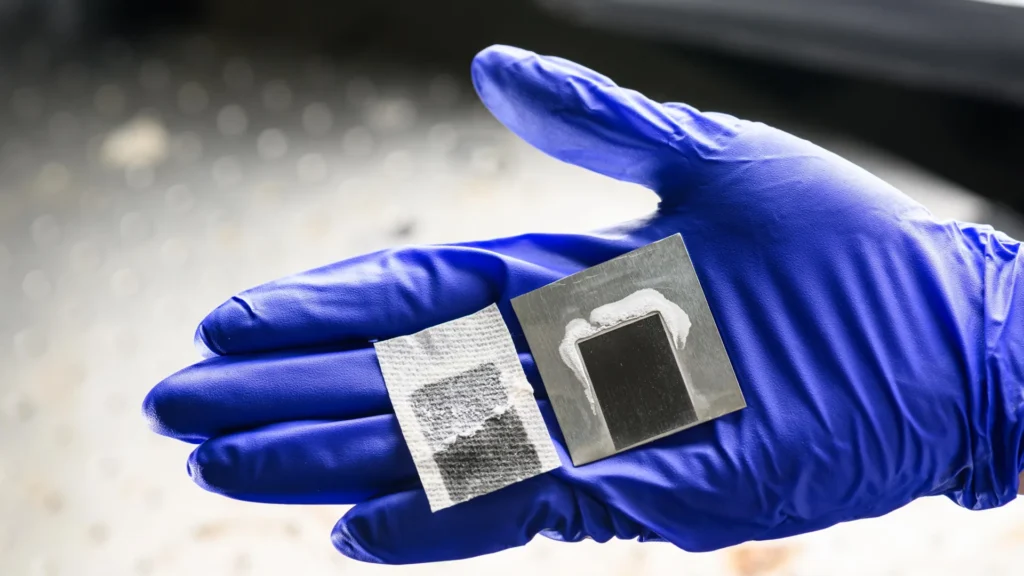
At the core of the University of Rochester’s innovation is a specialized solar panel made of black metal. This is not a traditional photovoltaic panel that generates electricity, but rather a solar thermal harvester. The metal’s surface is transformed using femtosecond lasers—ultrafast lasers that emit pulses lasting only one quadrillionth of a second. These pulses are so brief and intense that they do not simply melt the metal; they ablate it, creating complex, hierarchical micro- and nano-structures on the surface.
This laser treatment accomplishes two critical physical changes. First, it renders the metal "pitch black," allowing it to absorb nearly 100 percent of the solar radiation that hits it, maximizing the heat available for evaporation. Second, it creates a "superwicking" effect. In its natural state, water might bead up on a metal surface, but the laser-etched nanostructures create capillary forces so strong that they pull a thin film of water across the entire surface of the panel, regardless of gravity. This thin film allows for rapid, efficient evaporation at lower temperatures than those required by industrial boilers.
Solving the Salt Accumulation Challenge
One of the primary hurdles for solar-thermal evaporation has always been salt accumulation. In most experimental solar stills, as water evaporates, the salt left behind forms a hard crust, known as "scaling," on the heating element. This crust acts as an insulator, blocking heat and preventing water from reaching the surface, eventually rendering the device useless.
To solve this, Guo’s team utilized a phenomenon known as the "coffee ring effect." When a drop of coffee dries on a table, the suspended particles are pushed to the edges, leaving a dark ring. The Rochester team engineered microscopic grooves in the metal that guide the evaporating water in a specific direction. As the water turns to vapor in the "active region" of the panel—the part directly under the sun—the remaining salt is naturally pushed toward the "passive region" at the edges of the panel.
By separating the evaporation zone from the salt deposition zone, the system becomes self-cleaning. During their testing, which utilized real seawater samples from the Atlantic, Pacific, and Indian Oceans, the researchers found that the panels could operate continuously without a drop in efficiency. The salt does not form a destructive crust; instead, it accumulates as solid crystals on the periphery, where it can be easily collected.
A Comparative Analysis: Lab Seawater vs. The Real World
A significant portion of the team’s research, published in Light: Science & Applications, highlights the discrepancy between laboratory success and real-world application. Many previous desalination studies used "simulated seawater"—essentially a simple mixture of distilled water and sodium chloride (table salt). Sodium chloride tends to crystallize in porous, grainy structures that are relatively easy to wash away.
However, real ocean water is a complex chemical soup containing magnesium, calcium, potassium, and sulfates. These elements form much harder, denser mineral scales. The Rochester team’s ability to handle actual seawater is what sets this technology apart. By demonstrating that their laser-treated surfaces can manage the complex mineralogy of the world’s oceans, they have moved the technology from a theoretical curiosity to a viable engineering solution.
The Economic Incentive: Turning Waste into "White Gold"
Perhaps the most significant enrichment of this research is the integration of mineral recovery. In a secondary study published in the Journal of Materials Chemistry A, Guo and his colleagues demonstrated that their system could do more than just provide water; it could function as a sustainable mine.
The team embedded nanoparticles made from hydrogen titanate into the laser-etched grooves of the metal. These nanoparticles act as selective "magnets" for lithium ions. Lithium, often called "white gold," is the cornerstone of the modern green energy transition, essential for the batteries in electric vehicles (EVs), smartphones, and grid-scale energy storage.
Currently, lithium mining is an environmentally destructive process. In the "Lithium Triangle" of South America (Chile, Argentina, and Bolivia), millions of gallons of water are pumped into evaporation ponds, often depleting local water tables in some of the driest places on Earth. Hard-rock mining in other regions is energy-intensive and produces significant tailings.
The Rochester system offers a "circular" alternative. Using samples from the Great Salt Lake, the team was able to recover approximately 50 percent of the lithium present in the water. By extracting lithium and other minerals in solid form during the desalination process, the system transforms a waste management problem (brine disposal) into a high-value revenue stream.
Supporting Data and Technical Specifications
The efficiency of the system is backed by rigorous testing and funding from major global institutions. The research was supported by the National Science Foundation (NSF), the Bill & Melinda Gates Foundation, and the Worldwide Universities Network.
Key technical milestones include:
- Solar Absorption: The femtosecond laser-treated metal achieves nearly 100% absorption across the solar spectrum.
- Water Production: The system demonstrates a high evaporation rate that exceeds the limits of traditional untreated surfaces.
- Solid Salt Extraction: Unlike reverse osmosis, which produces a liquid waste that is roughly 50-70% as voluminous as the intake water, this system extracts nearly 100% of dissolved solids as dry material.
- Scalability: Because the laser treatment can be applied to large sheets of common metals, the researchers believe the technology can be scaled for industrial or community-level use.
Chronology of Development
The path to this breakthrough has been a multi-year journey at the Institute of Optics:
- 2015-2019: Professor Chunlei Guo’s lab perfects the use of femtosecond lasers to create superhydrophilic (water-attracting) and superhydrophobic (water-repelling) metals.
- 2020: The team publishes initial findings on using black metal for solar-thermal water evaporation, focusing on basic efficiency.
- 2022: Research shifts toward solving the "scaling" problem, leading to the discovery of the directed coffee ring effect for salt management.
- 2023-2024: The team successfully tests the system with real-world ocean samples and integrates the hydrogen titanate nanoparticles for lithium extraction, culminating in the recent dual publications.
Broader Implications and Future Outlook
The implications of this technology extend far beyond the laboratory. For developing nations and remote coastal communities, this system offers a decentralized solution to water scarcity. Because it relies on solar energy rather than a high-voltage power grid, it could be deployed in areas where infrastructure is minimal.
Furthermore, the environmental impact of traditional desalination cannot be overstated. There are currently over 20,000 desalination plants worldwide, producing enough brine every day to cover the entire state of Florida in a foot of salty sludge every year. Transitioning to a "zero-liquid discharge" (ZLD) model, like the one proposed by the University of Rochester, would represent a massive victory for marine conservation.
From an industrial standpoint, the ability to harvest lithium, magnesium, and other minerals could subsidize the cost of water production. In many regions, the cost of desalinated water is prohibitively high for agriculture. If a plant can pay for its operations by selling battery-grade lithium, the price of the resulting fresh water could drop significantly, making it accessible for irrigation and food security.
Professor Guo and his team, including senior scientist Subash Singh and several PhD students, are now looking toward the next phase: commercialization and scaling. While the proof-of-concept devices are small, the physics of the system are inherently scalable. If successfully implemented, this laser-etched technology could redefine our relationship with the ocean, turning it into a sustainable source of both the water that sustains life and the minerals that power the future.