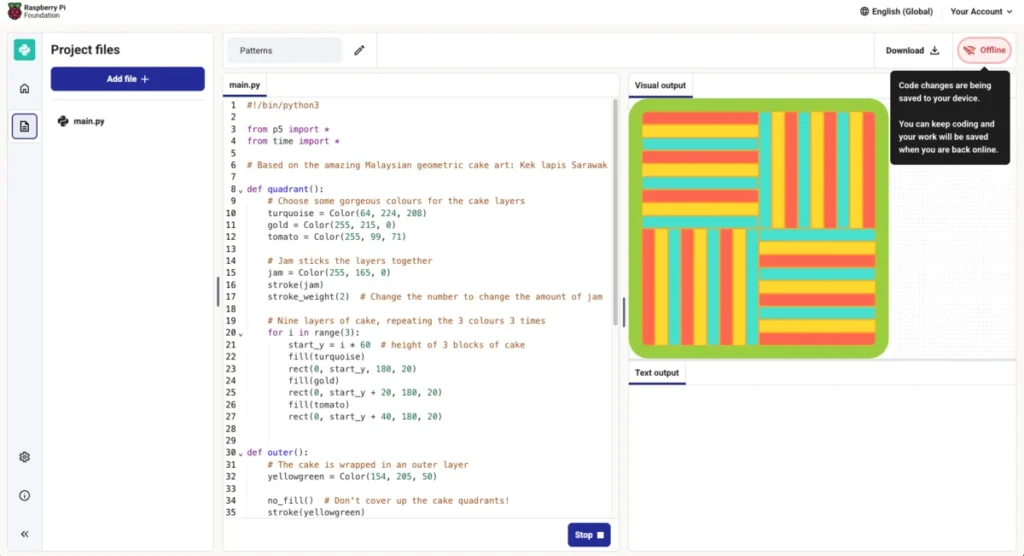
The Raspberry Pi Foundation has officially announced a significant update to its free, browser-based Code Editor, introducing robust offline capabilities designed to safeguard the progress of learners in environments with unstable internet connectivity. This development ensures that the editor remains functional even when a user’s internet connection is severed, allowing for the continuous writing and execution of code without the risk of data loss or session disruption. In a move that highlights the Foundation’s commitment to inclusive educational technology, the update utilizes advanced web technologies to ensure that even a page reload during a connectivity outage will not result in the loss of a student’s work.
This transition toward a more resilient, "offline-first" architecture addresses a critical barrier in global computer science education. For many years, the primary hurdle for digital literacy programs in developing regions has not just been the availability of hardware, but the reliability of the infrastructure required to support modern, cloud-based learning tools. By enabling the Code Editor to persist through network interruptions, the Raspberry Pi Foundation is directly tackling the "digital divide" that often leaves students in rural or underserved metropolitan areas at a disadvantage.
Technical Implementation and the Role of Service Workers
The core of this update lies in the implementation of a "service worker," a sophisticated script that operates independently of the main browser thread. Service workers act as a programmable network proxy, allowing the Code Editor to intercept network requests and manage a local cache of essential files. When a user first navigates to the Code Editor website, the service worker identifies and stores the necessary assets—including the user interface components, the code execution engine, and the underlying libraries—within the browser’s internal storage.
If the internet connection subsequently fails, the service worker detects the outage and automatically serves the required files from the local cache. This allows the editor to remain fully interactive. Users can continue to type Python or HTML/CSS code and, crucially, run that code to see the results. Because the Code Editor is designed to execute code client-side—utilizing the user’s local hardware rather than a remote server—the absence of an internet connection does not hinder the computational process. Once the connection is restored, the service worker silently updates the cache in the background, ensuring the user always has access to the latest version of the tool without requiring manual intervention.

Grounded in Global Field Research
The decision to prioritize offline resilience was not an arbitrary technical choice but the result of extensive field research conducted by the Raspberry Pi Foundation. The organization engaged with educators and learners in several key regions, including India, Kenya, and South Africa, to understand the day-to-day realities of computer science instruction.
The findings revealed a complex landscape of connectivity challenges. While slow or expensive internet in rural areas was an expected finding, the research also highlighted significant infrastructure issues in major metropolitan centers. In South Africa, for instance, the practice of "load-shedding"—scheduled rolling blackouts to manage the national power grid—frequently disrupts both electricity and the local cellular and broadband towers that depend on it. Similarly, "brownouts" and unpredictable power surges in parts of India and Kenya often lead to sudden router reboots, which previously would have caused a student to lose their place in a coding lesson.
Beyond national infrastructure, the Foundation identified "micro-connectivity" issues common in high-density environments. In a typical school computing lab, 30 or more students often attempt to connect to a single consumer-grade Wi-Fi access point simultaneously. This congestion frequently leads to "packet loss" and temporary disconnections. By making the Code Editor resilient to these drops, the Foundation ensures that the rhythm of a classroom lesson is not broken by the limitations of local networking hardware.
Strategic Alignment with EdTech Principles
This update serves as a practical application of the Raspberry Pi Foundation’s recently published "Draft Principles for Safe and Responsible Education Technology." A cornerstone of these principles is the commitment to "design for diverse needs, abilities, and contexts." This involves a conscious effort to avoid the assumption of "always-on" high-speed internet, which is a luxury not afforded to a significant portion of the global population.
According to data from the International Telecommunication Union (ITU), while approximately 67% of the world’s population is now online, the quality and stability of that access vary wildly. In many Least Developed Countries (LDCs), internet penetration remains below 40%, and even those with access often rely on expensive, capped mobile data. By optimizing the Code Editor to function with minimal data overhead and high resilience, the Foundation is moving toward a model of "frugal innovation," where software is designed to be as efficient and accessible as possible.

Impact on the Learning Experience
For the student, the most immediate impact of this update is the elimination of "connection anxiety." Previously, a "Page Not Found" error or a spinning loading icon could mean that 20 or 30 minutes of creative effort had vanished. This was particularly discouraging for novice programmers who were already navigating the frustrations of learning syntax and logic.
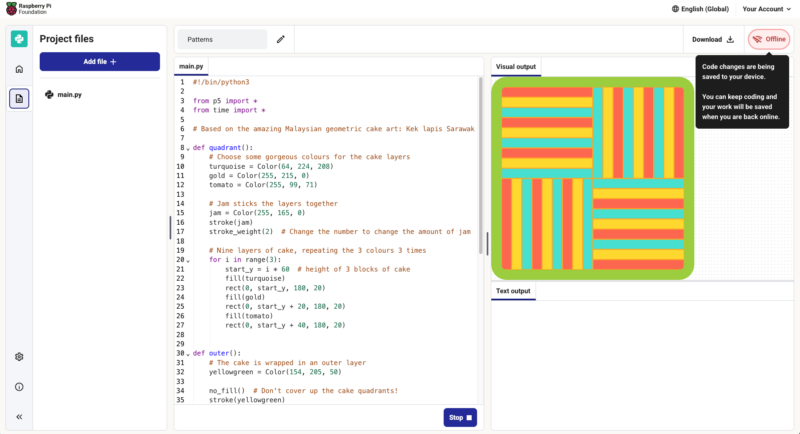
Under the new system, the transition between online and offline states is designed to be seamless. If the connection drops, a subtle notification informs the user that they are working offline, but the editor remains fully responsive. This allows students to:
- Continue writing and editing their code scripts.
- Execute programs to test logic and debug errors.
- Reload the page if the browser hangs, without losing the current code state.
- Save their work locally to the browser’s persistent storage.
For teachers, the update reduces the "technical support" burden during class time. Instead of troubleshooting individual connection issues for dozens of students, educators can focus on the pedagogical aspects of the lesson, confident that the software will remain stable even if the school’s Wi-Fi fluctuates.
Current Limitations and Future Development
While the update represents a major leap forward, the Foundation has been transparent about its current limitations. The Code Editor is not yet a "full" offline application in the sense of a standalone executable that can be installed without any internet access. The initial load of the editor still requires a connection to fetch the service worker and the primary asset package.
Furthermore, certain cloud-integrated features remain unavailable in offline mode. For example, users cannot sign in or out of their Raspberry Pi accounts, nor can they sync new projects to the cloud until a connection is re-established. However, the Foundation has indicated that it will continue to iterate on these features, exploring ways to further extend the offline capabilities, such as local project management and deferred cloud syncing.
The Role of Corporate Philanthropy
The development of these offline features was made possible through funding from Cisco. This partnership underscores the growing recognition within the technology sector that hardware alone is not enough to solve the global education crisis. Strategic investment in software infrastructure—specifically tools that are platform-agnostic and resilient to poor conditions—is essential for creating a sustainable pipeline of global tech talent.
Cisco’s involvement highlights a broader trend of corporate social responsibility focusing on "digital inclusion." By supporting the creation of tools that do not require the latest hardware or the fastest internet, these partnerships help ensure that the benefits of the digital economy are distributed more equitably.
Broader Implications for the EdTech Industry
The Raspberry Pi Foundation’s move toward offline resilience may signal a shift in the broader educational technology industry. For the past decade, the trend has been toward "Software as a Service" (SaaS) and heavy cloud dependency. However, as organizations look to scale their impact in the Global South, the limitations of this "cloud-only" approach are becoming apparent.
This update demonstrates that the web browser is becoming a powerful platform for "Edge Computing" in education. By leveraging modern APIs like Service Workers and WebAssembly, developers can create tools that offer the ease of access of a website with the reliability of a desktop application. This "hybrid" approach—accessible via a URL but functional without a signal—is likely to become the standard for any educational tool aiming for a truly global reach.
As coding literacy becomes increasingly recognized as a fundamental skill—on par with reading and writing—the tools used to teach it must be as reliable as a pencil and paper. The Raspberry Pi Foundation’s latest update to its Code Editor is a significant step toward that reality, ensuring that a student’s location or socioeconomic status does not dictate their ability to participate in the digital future. The Foundation continues to invite feedback from educators globally to further refine the tool, maintaining its status as a leading resource in the mission to put the power of computing and digital making into the hands of people all over the world.