The Historic Milestone in Incheon
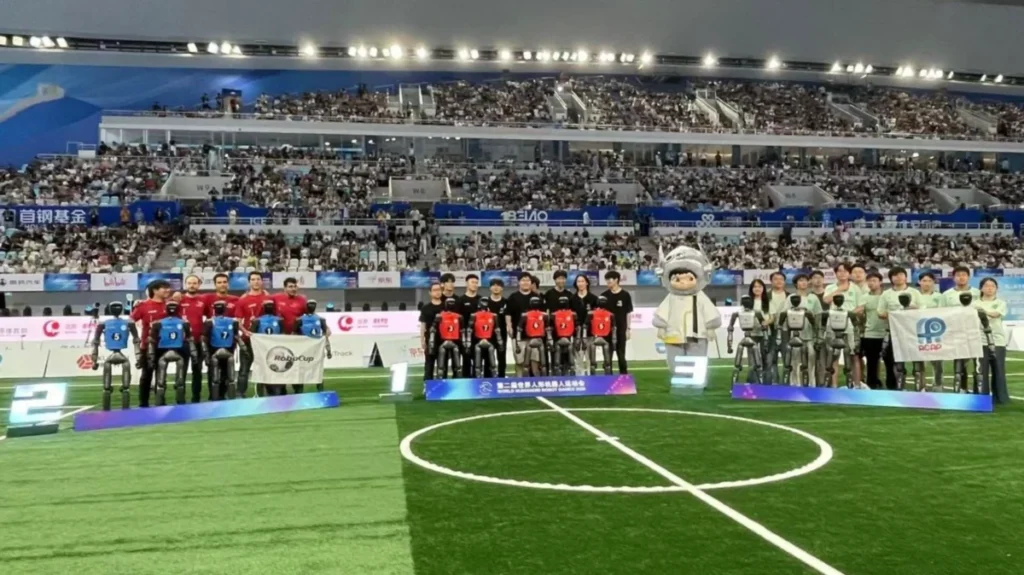
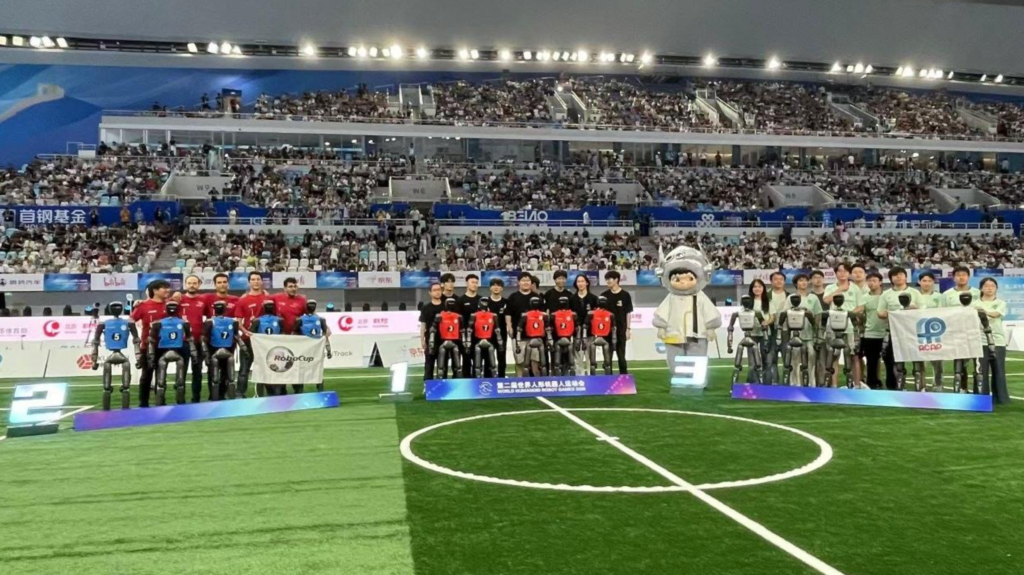
The match in South Korea was more than a mere sporting event; it was a stress test for decades of research in computer vision, bipedal locomotion, and multi-agent coordination. For the first time, the "Middle Division" humanoid robots moved beyond the small-scale pitches of previous years to occupy a space that mirrors the dimensions used by human athletes. The robots, primarily based on the Booster Robotics K1 humanoid platform, had to solve complex kinematic equations in real-time to maintain balance while tracking a moving ball and avoiding collisions.
B-Human’s victory followed their success in the official RoboCup 2026 Middle Division final, where they defeated HTWK Robots 6–0. However, the 11-a-side exhibition presented unique challenges that the standard tournament format does not encounter. In a 3-v-3 or 5-v-5 match, the computational overhead for localization—knowing where the robot is on the field—is manageable. In an 11-a-side environment, the "noise" created by twenty-one other moving entities makes visual processing and path planning exponentially more difficult. The success of this match serves as the primary backdrop for the upcoming Italian Open RoboCup Humanoid Soccer Tournament at Maker Faire Rome.
A Chronology of Autonomous Ambition
To understand the significance of the 2026 season, one must look back at the trajectory of the RoboCup Federation. Founded in 1997 in Nagoya, Japan, the organization established a "North Star" goal that remains one of the most ambitious in science: by the year 2050, a team of fully autonomous humanoid robots shall play a game of football against the reigning human World Cup champions and win, complying with the official rules of FIFA.
- 1997: The first RoboCup is held, featuring wheeled robots. The primary focus is on basic multi-agent cooperation and ball handling.
- 2002: Humanoid robots are introduced at the Fukuoka event. At this stage, the "players" struggle to walk in a straight line, and matches consist largely of robots attempting to stand up after falling.
- 2010s: The Standard Platform League (SPL) matures, using the Aldebaran (now SoftBank) Nao robot. This allows researchers to focus on software rather than hardware design.
- 2020-2025: Significant breakthroughs in Deep Reinforcement Learning (DRL) allow robots to learn gait and striking behaviors in simulation before deploying them to physical hardware.
- 2026: The merger of the Standard Platform League and the Humanoid League into the Humanoid Soccer League, culminating in the first 11-a-side match.
This timeline demonstrates a shift from mechanical stability to cognitive complexity. The robots are no longer just "walking machines"; they are becoming "thinking athletes."
Technical Hurdles: Why Football?
The choice of football as a benchmark for Artificial Intelligence and robotics is deliberate. Unlike chess or Go, which are played in a static, turn-based environment, football is a "dynamic, adversarial, multi-agent task in a continuous space." A robot must solve several problems simultaneously:
Bipedal Locomotion and Balance
Maintaining balance on two legs is an ongoing challenge. The robot must constantly calculate its center of mass while accounting for the friction of the turf, the momentum of its own limbs, and the impact of external forces. The 2026 season saw teams like B-Human move away from traditional pre-programmed walking routines in favor of motion systems trained via deep reinforcement learning. This allows the K1 platform to execute more fluid, "human-like" running and shooting motions.
Computer Vision and Localization
The robot’s "eyes"—typically high-speed cameras—must identify the ball, the goals, the field lines, and other players. Because the robots are autonomous, they cannot rely on external GPS or overhead cameras. They must use "SLAM" (Simultaneous Localization and Mapping) techniques to determine their coordinates on the pitch based on the white lines and goalposts they see.

Multi-Agent Coordination
In an 11-a-side match, robots must communicate over a local wireless network to decide who "challenges" the ball and who stays back in defense. If the network lags or fails, the robots must rely on their visual sensors to infer the intentions of their teammates, a task that requires sophisticated social modeling algorithms.
Maker Faire Rome: The European Stage
From October 23 to 25, 2026, the focus of the robotics world shifts to Italy. Maker Faire Rome – The European Edition will host the first Italian Open RoboCup Humanoid Soccer Tournament at the Gazometro Ostiense. This event is not merely a repeat of the South Korean matches but an official RoboCup Regional Event designed to bring these high-level academic challenges to a public audience.
The Rome tournament will feature matches in the Middle and Large Divisions, with formats ranging from 3-v-3 to 5-v-5. The choice of the Gazometro Ostiense—an iconic industrial heritage site—provides a symbolic contrast between the heavy iron works of the past and the silicon-based intelligence of the future.
Beyond the matches, the event will include technical testing and a dedicated RoboCup Humanoid Soccer workshop. This "open-pit" approach is central to the Maker Faire philosophy. Visitors will see the "debugging" process in real-time. When a robot fails to recognize the ball due to the changing shadows of the afternoon sun, the audience will see engineers frantically adjusting code and recalibrating sensors. This transparency highlights the "Sim2Real" gap—the notorious difficulty of making software that works in a computer simulation function correctly in the messy, physical world.

The Role of Standardized Hardware
A key factor in the rapid advancement seen in 2026 is the adoption of standardized humanoid platforms like the Booster Robotics K1. In the early years of RoboCup, teams spent 90% of their time fixing broken gears and burnt-out motors. By using a reliable, off-the-shelf humanoid platform, researchers can redirect their energy toward the "brain" of the robot.
However, as the B-Human team demonstrated, having the same hardware does not result in the same performance. The Bremen-based team developed a proprietary motion engine for the K1 that allows it to get back on its feet faster than its competitors and strike the ball with greater precision. This highlights the growing importance of "software-defined robotics," where the competitive edge is found in neural networks and control algorithms rather than the strength of the metal.
Official Perspectives and Industry Impact
While the primary goal of RoboCup is sporting excellence, the implications for the broader robotics industry are profound. Researchers involved in the Incheon match have noted that the technologies developed for robot soccer—specifically robust bipedal walking and rapid visual object recognition—are directly transferable to "social robotics" and disaster recovery.
"Football forces us to deal with the unexpected," says one lead researcher from the HTWK Robots team. "If a robot can navigate a chaotic football pitch and coordinate with teammates to achieve a goal, it can eventually navigate a hospital corridor or a collapsed building. The pitch is our laboratory."

The data gathered from the 11-a-side match in Incheon is already being analyzed to update the 2027 rulebook. Future iterations of the competition are expected to introduce even more challenging conditions, such as varying turf textures and "natural" lighting, to further push the limits of autonomous perception.
Broader Implications: The Path to 2050
The 11-a-side match in Incheon and the upcoming tournament in Rome represent a "proof of concept" for the 2050 goal. We are currently in the "adolescent" phase of humanoid robotics. The machines are capable of the basic mechanics of the sport, but they lack the tactical fluidity and physical grace of a professional human athlete.
However, the progress made between 2002 and 2026 suggests that the 2050 target, while still daunting, is not impossible. The integration of generative AI and large-scale physical simulations is accelerating the learning curve. In the coming years, we can expect to see robots that not only play football but also learn from their mistakes during the match, adjusting their strategy in real-time without human intervention.
Conclusion: Why Rome Matters
Maker Faire Rome serves as a vital bridge between the elite world of academic research and the global maker community. By hosting the Italian Open RoboCup Humanoid Soccer Tournament, the event demystifies the complexity of Artificial Intelligence. It shows that "serious" robotics is a process of trial, error, and persistent iteration.

As the robots take to the field at the Gazometro Ostiense this October, the scoreline will be secondary to the technical progress on display. Each successful pass, each saved goal, and even each clumsy fall is a data point on the long road to 2050. For the engineers, makers, and spectators in Rome, the message is clear: robot football is no longer a futuristic novelty; it is a serious, rapidly evolving field of science that is beginning to master the beautiful game.
Maker Faire Rome – The European Edition
October 23–25, 2026
Gazometro Ostiense, Rome