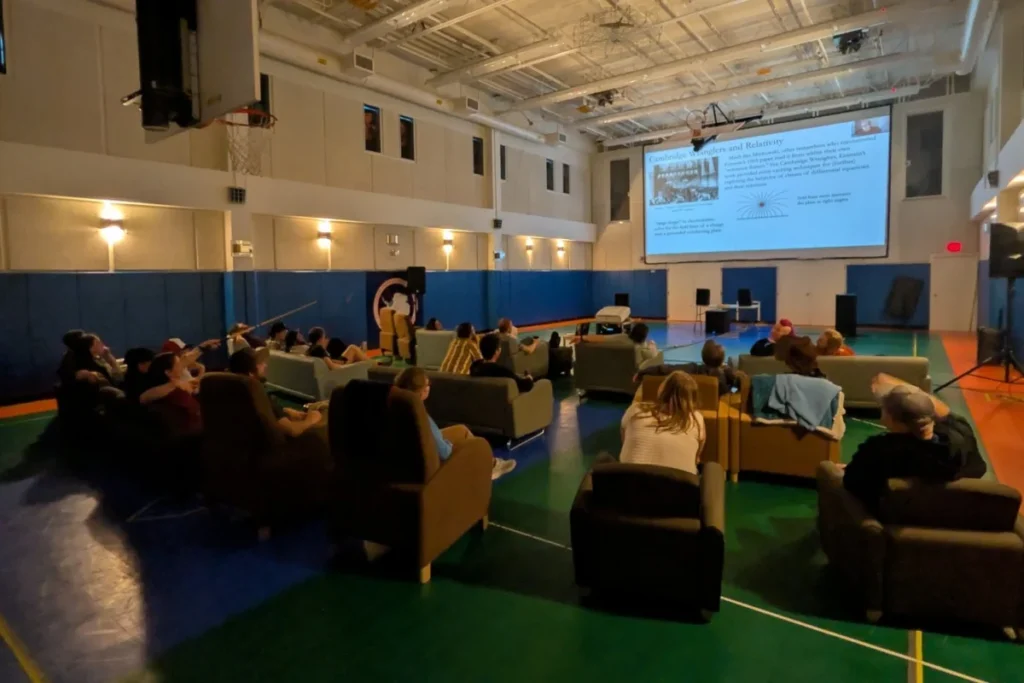
Amidst the desolate, frozen landscape of the Antarctic plateau, where temperatures regularly plummet below minus 80 degrees Fahrenheit and the sun vanishes for six months of the year, a small group of researchers is bridging the gap between cutting-edge astrophysics and open-access education. John Della Costa, a researcher dedicated to the Background Imaging of Cosmic Extragalactic Polarization (BICEP) project, has transformed the isolation of the Amundsen-Scott South Pole Station into a classroom. Alongside his colleagues, Della Costa is engaging with STS.042/8.225 (Einstein, Oppenheimer, Feynman: Physics in the 20th Century), a free online course offered through MIT Open Learning’s OpenCourseWare (OCW) platform. This initiative, dubbed “Fysics Fridays,” represents a unique intersection of high-level scientific research and the democratization of global education.
The BICEP project, which operates some of the most sensitive radio telescopes on Earth, is currently tasked with answering some of the most fundamental questions regarding the origin of the universe. By studying the Cosmic Microwave Background (CMB)—the residual heat from the Big Bang emitted roughly 380,000 years after the universe began—the team seeks evidence of primordial gravitational waves. These ripples in spacetime are the "smoking gun" for the theory of cosmic inflation, a concept pioneered by MIT Professor Alan Guth. To maintain intellectual rigor and community morale during the grueling "winter-over" period, Della Costa’s team has turned to the very institution that produced the theories they are testing.
The BICEP Collaboration and the Quest for Cosmic Inflation
The BICEP (Background Imaging of Cosmic Extragalactic Polarization) collaboration is a multi-institutional effort aimed at measuring the polarization of the CMB. The South Pole is an ideal location for this research due to its extreme altitude (approximately 9,300 feet), its ultra-dry atmosphere, and the stability of the air, which minimizes interference with sensitive radio signals.
The primary objective of the current BICEP experiments is to detect "B-mode" polarization patterns in the CMB. These patterns are theorized to have been caused by gravitational waves generated during cosmic inflation—a period of exponential expansion in the first fraction of a second after the Big Bang. If detected, these waves would provide definitive proof of Alan Guth’s inflationary model, which explains why the universe appears so uniform and flat on a large scale.
Della Costa emphasizes the gravity of this work: “Inflation is really important in making sense of our observations of our universe. We have yet to discover the evidence for inflation that definitively proves that it did happen, and BICEP’s main role here at the South Pole is to discover gravitational waves from the very early universe.” The research requires immense dedication, as the telescopes must run continuously, and the data must be meticulously filtered to remove "noise" from galactic dust.
Survival and Scholarship in Total Isolation
Life at the Amundsen-Scott South Pole Station is defined by the "winter-over," a period of total physical isolation that lasts from mid-February to early November. During these months, the cold is so intense that aircraft fuel would freeze upon landing, making it impossible for planes to reach the station. The crew of approximately 45 people—comprising scientists, engineers, and support staff—must be entirely self-sufficient.
Della Costa, who is scheduled for a full-year deployment from late 2025 through late 2026, recognized early on that the combination of 24-hour darkness and extreme confinement could take a toll on mental health. To combat "winter-over syndrome"—a condition characterized by irritability, depression, and cognitive decline—he sought a way to foster community and intellectual engagement.
The solution was "Fysics Fridays," a weekly gathering where the team watches physics lectures and documentaries. Because the station’s internet access is limited to a few hours a day via aging satellites, high-bandwidth streaming is impossible. To circumvent this, Della Costa downloaded several entire MIT OpenCourseWare modules before the station "closed" for the season. These included not only the history-heavy STS.042/8.225 but also more technical tracks such as Physics II: Electricity and Magnetism (8.02), Physics III: Vibrations and Waves (8.03), and Alan Guth’s own course, The Early Universe (8.286).
The Pedagogical Bridge: MIT’s OpenCourseWare
MIT OpenCourseWare was launched in 2001 with the radical mission of making the materials for all MIT undergraduate and graduate courses available to the world for free. Over two decades later, it has become a cornerstone of global self-directed learning. The course currently favored by the BICEP team, STS.042/8.225, was developed by Professor David Kaiser, a renowned physicist and historian of science.
The course itself has a history rooted in crisis. Originally taught in person, Kaiser adapted the curriculum for a fully remote format during the COVID-19 pandemic in 2020. This adaptation involved creating comprehensive digital slides and recorded lectures for a global student body of over 100 people. The refined version was officially added to the OCW platform in August 2022.
Unlike standard physics courses that focus purely on mathematical derivations, Kaiser’s curriculum integrates the social, political, and philosophical contexts of scientific discovery. Students learn about the Manhattan Project, the development of quantum mechanics, and the cold war’s influence on particle physics. This interdisciplinary approach makes the material accessible to the diverse staff at the South Pole, many of whom are engineers or technicians rather than theoretical physicists.
“In this course, we get to talk about some really amazing ideas from modern physics,” says Kaiser. “We start in the middle of the 19th century… and we rapidly go through things like relativity, quantum theory, nuclear physics, and particle physics. We end up with some of my favorite material about cosmology and the Big Bang—the kinds of things that John and his team are actively working on right now.”
Building Community Through Experimental Learning
The "Fysics Fridays" series has evolved beyond simple video screenings. To deepen their understanding, the South Pole team has begun conducting hands-on experiments corresponding to the lecture topics. They have already performed the famous double-slit experiment, which demonstrates the wave-particle duality of light and matter—a foundational concept in quantum mechanics.
Looking forward, the group plans to construct a cloud chamber. This device allows observers to see the tracks of ionizing radiation, such as cosmic rays, as they pass through a supersaturated vapor. For a team living at the bottom of the world, where cosmic radiation is a constant presence, such experiments provide a tangible connection between the abstract theories in the lectures and the physical reality of their environment.
Della Costa notes that the inclusive nature of the course is vital for the station’s social fabric. “Not everyone here is a physicist, actually. It’s widely accessible, but still meaty, and worth people’s time to watch.” By engaging in shared intellectual pursuits, the team fosters a sense of purpose that transcends the daily grind of station maintenance and data collection.
Official Responses and Global Impact
The connection between the South Pole researchers and the MIT faculty has sparked a rare dialogue between the "field" and the "classroom." Professor David Kaiser, who co-directs a research group on early-universe cosmology with Alan Guth, expressed profound admiration for the team’s initiative. Having had colleagues who served as Antarctica winter-overs, Kaiser is well-aware of the psychological and physical rigors of the post.
“Hearing that John and his team are spending a part of their time with this course was just the best message to receive,” Kaiser said. “It’s very exciting to see this important research flourishing. It takes enormous effort and dedication.”
In a gesture of academic solidarity, Kaiser has arranged to provide a special Zoom colloquium for the South Pole community once satellite windows permit. This direct interaction between one of the world’s leading physicists and the researchers on the front lines of experimental cosmology underscores the power of open learning to dissolve geographical and institutional barriers.
Broader Implications for Open Learning
The use of MIT OCW at the South Pole serves as a powerful case study for the future of education. It highlights several key trends:
- Asynchronous Resilience: In environments with limited connectivity—be it the South Pole, remote rural areas, or developing nations—the ability to download and use high-quality educational content offline is critical.
- Professional Development: Open learning is not just for students; it is a tool for active professionals to stay connected to the theoretical foundations of their work.
- Mental Health and Community: In isolated or high-stress environments, structured learning can serve as a vital tool for community building and psychological resilience.
As the BICEP team continues to scan the heavens for the echoes of the Big Bang, they do so with a deeper appreciation for the history of the tools they use and the theories they test. The "Fysics Fridays" at the South Pole prove that no matter how remote the location, the human drive to understand the universe remains unquenchable, fueled by the open exchange of knowledge across the globe. Through the efforts of researchers like Della Costa and the resources provided by MIT OpenCourseWare, the most isolated place on Earth has become a vibrant hub of 20th and 21st-century scientific thought.