Researchers at the Harvard John A. Paulson School of Engineering and Applied Sciences (SEAS) have successfully demonstrated a groundbreaking methodology for safeguarding delicate quantum information through the utilization of mechanical vibrations. By employing microscopic sound waves, known as phonons, the team has introduced a paradigm shift in how quantum bits, or qubits, are protected from environmental interference. This advancement, developed within the laboratory of Marko Lončar, the Tiantsai Lin Professor of Electrical Engineering at SEAS, represents a significant step toward the realization of compact, chip-integrated quantum networks and the development of hybrid quantum systems that integrate diverse qubit architectures.
The research, which was recently published in the prestigious journal Nature Physics, marks a culmination of years of inquiry into the intersection of nanophotonics, quantum optics, and acoustics. The experimental efforts were spearheaded by Eliza Cornell, a recent Ph.D. graduate from the Lončar lab and currently a postdoctoral researcher at Boston University, alongside Zhujing Xu, a former postdoctoral scholar in the same research group. Their findings suggest that mechanical vibrations, far from being a source of disruptive noise, can be engineered to serve as a robust shield for quantum memory.
The Role of Phonons in Quantum Information Science
In the rapidly evolving landscape of quantum computing, the search for efficient information carriers is paramount. While photons—particles of light—have long been the primary candidates for transporting quantum data due to their high speed and minimal interaction with the environment over long distances, they present challenges when integrated into dense, chip-scale architectures. At the frequencies required for quantum communication, photons possess relatively long wavelengths, which imposes physical limits on how small optical components can be manufactured and how closely they can be packed on a semiconductor chip.
Phonons, the quantized units of mechanical vibration, offer a compelling alternative. At the same operational frequencies as light, phonons have wavelengths that are several orders of magnitude shorter. This characteristic allows for the construction of significantly smaller components, facilitating the creation of highly miniaturized quantum circuits. Furthermore, phonons exhibit a unique versatility: they interact readily with both solid-state spins—such as those found in diamond impurities—and electromagnetic fields. This makes them ideal "transducers" or intermediaries in hybrid quantum technologies, where different types of qubits must communicate within a single, unified system.
The Lončar lab has been a pioneer in exploring these mechanical systems. A central component of their research involves the "phononic cavity," a specialized structure designed to trap and localize mechanical vibrations. By confining phonons within these cavities, researchers can enhance the interaction between the vibrations and the electron spin of a qubit, effectively creating a high-efficiency interface for information exchange.
The Challenge of Maintaining Quantum Coherence
Despite the advantages of phononic systems, a persistent obstacle has hindered their widespread adoption: the fragility of quantum memory. Qubits operate on the principle of superposition, where information is stored in a state that is simultaneously "0" and "1." This state is extraordinarily sensitive to external perturbations, such as thermal fluctuations, magnetic field variations, or mechanical jitters. The duration for which a qubit can maintain this state is known as its "coherence time."
In traditional quantum systems, researchers protect coherence through a technique known as dynamical decoupling. This involves the application of rapid microwave pulses to the qubit, which serves to "flip" the spin state in a way that cancels out the cumulative effect of environmental noise. While effective in bulk materials, these microwave-based techniques face significant hurdles when applied to qubits embedded within phononic cavities. The physical constraints of the cavities and the specific electromagnetic requirements of the qubits often result in a trade-off: one can achieve either strong interaction with phonons or a long coherence time, but rarely both simultaneously.
Engineering the "Dressed" Qubit State
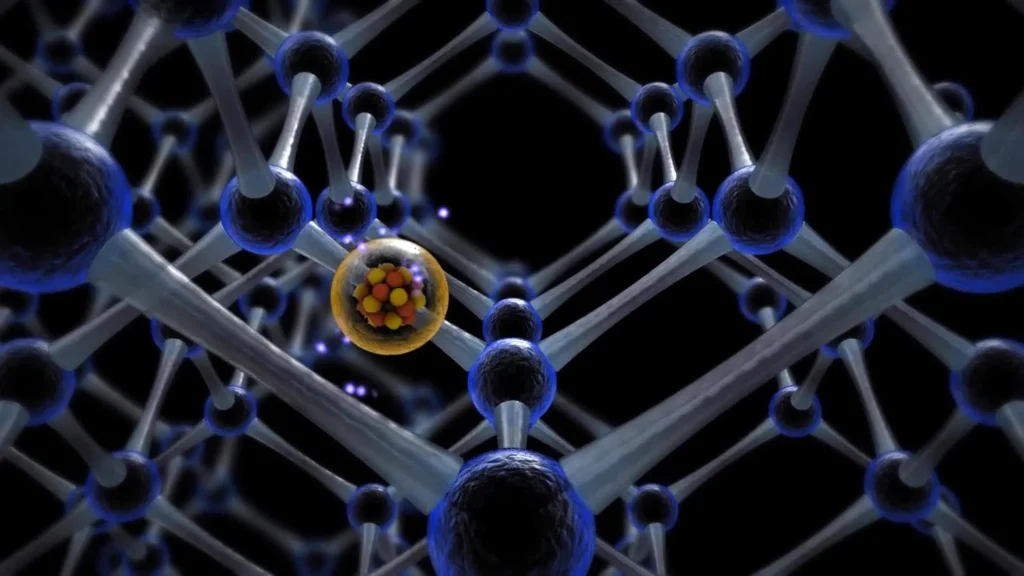
To overcome this limitation, the SEAS team moved away from conventional microwave-driven protection and toward an "all-mechanical" approach. The researchers focused their experiments on the silicon-vacancy (SiV) center in diamond. The SiV center is a type of point defect where two carbon atoms in the diamond lattice are replaced by a single silicon atom, creating a stable platform for an electron spin that can act as a qubit.
Instead of using intermittent microwave pulses to decouple the spin from its environment, the team applied a continuous mechanical driving field consisting of phonons. This continuous interaction essentially "dresses" the qubit in a field of sound. In quantum mechanics, a "dressed state" occurs when a quantum system is so strongly coupled to an external oscillating field that the two can no longer be considered separately. The resulting hybrid state possesses new energy levels that are inherently more resilient to the low-frequency noise typically found in solid-state environments.
By "wearing" this acoustic field, the silicon-vacancy spin becomes shielded. The continuous nature of the mechanical drive ensures that the protection is always active, providing a steady barrier against the decoherence-inducing fluctuations of the surrounding diamond lattice.
Experimental Results and Quantitative Improvements
The experimental validation of this "all-mechanical coherence protection" yielded impressive results. By applying the continuous-wave mechanical driving field, the researchers observed that the coherence time of the silicon-vacancy spin qubit increased by approximately a factor of three.
This three-fold improvement is particularly significant because it was achieved within the context of a functional phononic device. It demonstrates that the very same mechanical vibrations used to transport information can be repurposed to preserve it. This dual functionality simplifies the architecture of quantum chips, as it removes the need for complex, integrated microwave delivery systems that would otherwise occupy valuable space and introduce additional heat.
"We are solving two problems," Eliza Cornell explained regarding the team’s objectives. "We want the spin to have strong interaction with phonons, and we want the spin to have a long coherence time. Our paper demonstrates a method of extending the coherence time that is compatible with the silicon-vacancy center being in a cavity."
The ability to maintain coherence while the qubit is coupled to a cavity is a critical milestone. It suggests that researchers can now design systems where qubits are "plugged in" to a mechanical bus for high-speed data transfer without immediately losing their quantum information to environmental noise.
Implications for the Future of Quantum Networking
The success of the SEAS experiment has broad implications for the development of the "Quantum Internet." As researchers look toward connecting individual quantum computers into a global network, the need for efficient, small-scale nodes becomes apparent. Phononic-based systems, with their compact footprint and high compatibility with solid-state qubits, are leading candidates for these nodes.
The "dressed" qubit approach also paves the way for more effective hybrid quantum systems. In the future, a single quantum device might use superconducting qubits for ultra-fast processing, spin qubits in diamond for long-term storage, and phonons to translate and move information between them. The ability to protect these spins mechanically ensures that the "translation" process does not become a bottleneck for the system’s overall performance.
Furthermore, the research highlights the potential of diamond-based quantum technologies. Diamond is an exceptional material for quantum applications due to its high thermal conductivity and wide bandgap, which allows for stable qubit operations even at temperatures slightly higher than the absolute zero required by other systems. The integration of phononic control into diamond nanostructures further solidifies diamond’s role as a cornerstone of quantum hardware.
Collaborative Effort and Institutional Support
The study, titled "All-mechanical coherence protection and fast control of a spin qubit," featured a diverse group of contributors. In addition to Cornell, Xu, and Lončar, the paper was co-authored by Zhaoyou Wang, Hana K. Warner, Eliana Mann, Michael Haas, Smarak Maity, Graham Joe, Liang Jiang, Peter Rabl, and Benjamin Pingault. The collaboration spanned multiple disciplines, reflecting the interdisciplinary nature of quantum engineering.
The research was supported by several high-level federal and institutional grants, underscoring the strategic importance of quantum information science in the United States. Funding sources included:
- The National Science Foundation (NSF) under grant number EEC-1941583.
- The Air Force Office of Scientific Research (AFOSR) under award numbers FA9550-23-1-0333 and FA9550-23-1-0338.
- Q-NEXT, a U.S. Department of Energy Office of Science National Quantum Information Science Research Center.
- The Harvard Center for Nanoscale Systems (CNS), which provided the specialized fabrication and characterization facilities necessary for the diamond nanostructures.
The Harvard Office of Technology Development (OTD) has recognized the commercial potential of these findings and is actively pursuing patent protection. The OTD is also exploring opportunities for commercialization, which could lead to the licensing of this technology to startups or established aerospace and computing firms looking to build the next generation of quantum sensors and communicators.
Conclusion and Analysis
The demonstration of all-mechanical coherence protection by the Lončar lab represents a shift in the philosophy of quantum control. Traditionally, mechanical vibrations were viewed as the "enemy" of quantum states—a source of heat and disorder that needed to be frozen out or filtered away. By demonstrating that sound can instead be a protector, Harvard researchers have opened a new avenue for quantum architecture design.
While a three-fold increase in coherence is a significant achievement, the researchers view this as just the beginning. Future iterations of the "dressed" qubit technique may involve more complex acoustic waveforms or the use of topological phononic structures to provide even greater levels of isolation. As the field moves from laboratory demonstrations to scalable technology, the integration of mechanical protection will likely be a defining feature of reliable, chip-scale quantum processors. The era of "quantum acoustics" is no longer a theoretical curiosity; it is a burgeoning reality that promises to make the quantum world a little less fragile and a lot more connected.