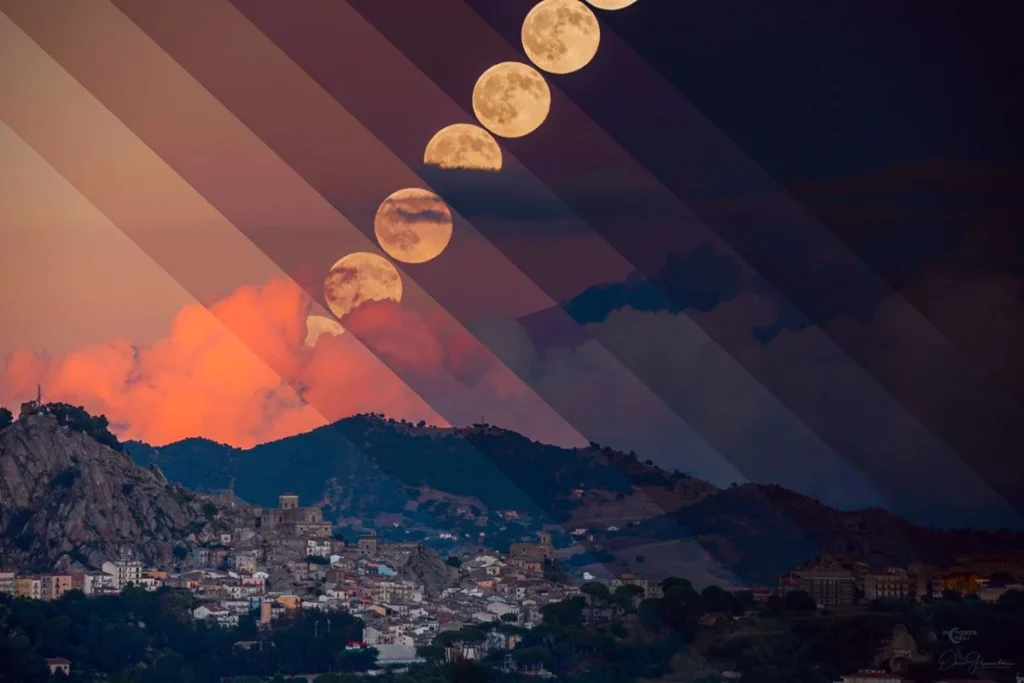
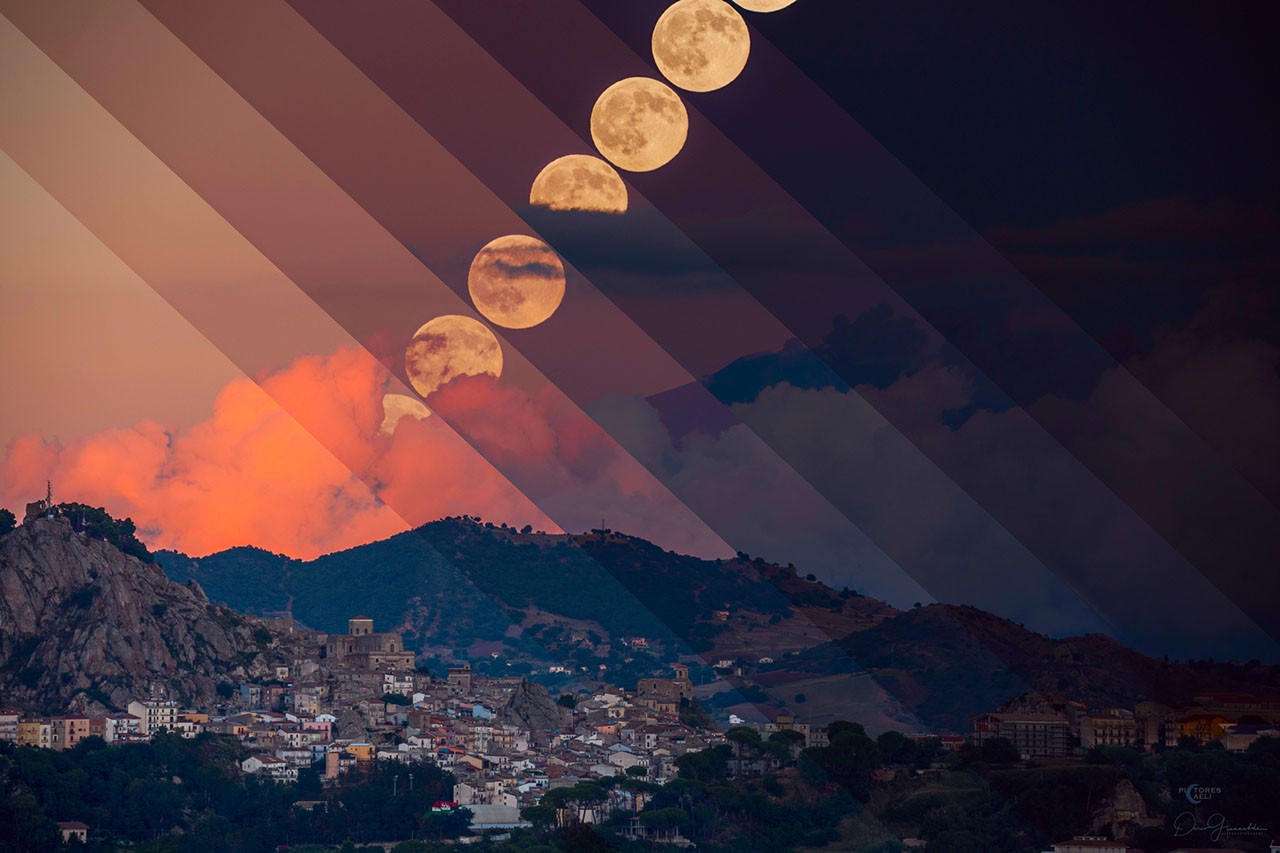
The spectacle of a full moon rising, often referred to as the Harvest Moon in many Northern Hemisphere cultures, was dramatically captured over Sicily last weekend, offering a breathtaking tableau of celestial and terrestrial phenomena. The composite photograph, taken near Nicosia, Italy, showcases the moon’s ascent against a deepening twilight sky, further enhanced by the fiery glow of Mount Etna’s eruption and the ethereal pink band of the Belt of Venus. This multi-layered celestial event provides a unique opportunity to explore the interconnectedness of astronomical cycles, atmospheric optics, and geological activity.
A Celestial Symphony Over Sicily
The image meticulously captures the moon’s journey as it emerges on the horizon, its brilliance gradually intensifying as the surrounding sky transitions from the lingering hues of sunset to the deep indigo of night. This transition is not merely a darkening of the sky but a complex interplay of light and atmospheric conditions. The lower clouds in the photograph are illuminated by antitwilight, a phenomenon that occurs after sunset when sunlight, scattered by particles in the upper atmosphere, creates a distinct band of color, often reddish or pinkish, opposite the setting sun.
Adding to this celestial artistry is the distinct pink band arching across the sky, identified as the Belt of Venus. This atmospheric optical phenomenon is essentially the anticrepuscular rays of the rising or setting sun seen in the antisolar direction. It appears as a pinkish or reddish band on the horizon opposite the sun. Its visibility is dependent on atmospheric clarity and the presence of fine dust or aerosols, which scatter sunlight. In this particular photograph, the Belt of Venus creates a striking contrast with the darker sky and the ascending moon, adding depth and an otherworldly quality to the scene.
The Volcanic Heartbeat of Mount Etna
Further enriching the visual narrative is the undeniable presence of Mount Etna, one of the world’s most active volcanoes, which was actively erupting at the time of the photograph. The image clearly depicts ash and gas plumes rising from the volcano, situated higher in the background. This geological event, while a dramatic backdrop, also plays a role in the atmospheric conditions that contribute to the visual splendor. Volcanic ash and gases, when injected into the atmosphere, can enhance the scattering of sunlight, potentially intensifying phenomena like the Belt of Venus and creating more vibrant twilight colors. The eruption, a constant reminder of Earth’s dynamic geological processes, adds a terrestrial element of awe and power to the otherwise celestial display.
Mount Etna, located on the east coast of Sicily, is a stratovolcano and the highest active volcano in Europe. Its eruptions are frequent, ranging from effusive lava flows to explosive events. The current eruption, while not explicitly detailed in terms of its specific intensity or duration within the provided context, clearly had a significant visual impact on the sky above Sicily, contributing to the dramatic colors and atmospheric effects observed.
Understanding the Lunar Cycle and the Harvest Moon
The photograph prominently features a full moon, a phase that holds cultural significance for many. A full moon occurs when the Earth is positioned directly between the Sun and the Moon, with the lunar surface fully illuminated by the Sun’s rays as seen from Earth. This alignment means that during a full moon, the moon rises as the sun sets, and sets as the sun rises. The lunar cycle, the period it takes for the Moon to complete one orbit around the Earth and return to the same phase, is approximately 29.5 days. This is known as the synodic period. It’s important to distinguish this from the sidereal period, which is the time it takes for the Moon to orbit the Earth with respect to the fixed stars, approximately 27 days.
The full moon that occurs in September is traditionally known as the Harvest Moon in many cultures of the Northern Hemisphere. This name is derived from the fact that this full moon rises at a particularly early hour in the evening, allowing farmers to continue harvesting their crops by the moonlight late into the night. The moonrise times around the autumnal equinox (which falls in September) are unusually close to sunset, making this full moon particularly beneficial for agricultural activities. While the specific date of the photograph is indicated as "last weekend" and the year is implied as 2026 through the image file name, the cultural designation of the Harvest Moon is a timeless aspect of lunar observation.
The Science Behind the Colors: Atmospheric Optics
The captivating colors visible in the photograph are a testament to the intricate workings of atmospheric optics. The Belt of Venus, as previously mentioned, is a prime example. Its visibility is enhanced by the scattering of sunlight by aerosols – tiny particles suspended in the atmosphere. These aerosols can originate from various sources, including natural processes like volcanic eruptions and anthropogenic activities. In this case, the ash and gas from Mount Etna likely contributed to the clarity and intensity of the Belt of Venus.
The antitwilight colors, appearing as a band of pink or red near the horizon, are also a result of light scattering. As the sun dips below the horizon, its rays travel through a longer path of the Earth’s atmosphere. Shorter wavelengths of light (blues and violets) are scattered away more effectively, allowing the longer wavelengths (reds and oranges) to dominate, creating the warm hues of sunset and twilight. The presence of fine particles in the atmosphere can further enhance these colors by scattering sunlight in specific directions.
Data and Context: Mount Etna’s Activity and Lunar Cycles
To provide a more comprehensive understanding, it’s beneficial to consider the typical activity patterns of Mount Etna and the astronomical context of a full moon. Mount Etna averages an eruption every few months, with varied intensities. The eruption captured in the photograph, though visually striking, might not have been a catastrophic event, but rather a significant Strombolian or Vulcanian eruption that produced noticeable ash plumes. Scientific monitoring of Mount Etna is continuous, with agencies like the National Institute of Geophysics and Volcanology (INGV) in Italy providing real-time data on seismic activity, gas emissions, and lava flow.
The timing of the Harvest Moon is also predictable. While its exact date shifts annually, it consistently occurs in September, either as the full moon closest to the autumnal equinox or, in some definitions, the full moon of September itself. For instance, in 2026, the autumnal equinox will occur around September 22nd, and the full moon preceding or closely following this date would be considered the Harvest Moon. The photograph’s timing aligns with this lunar event, amplifying its significance.
Inferred Reactions and Broader Implications
While no direct statements or reactions from involved parties are provided in the source material, one can infer the immense appreciation and awe such a photograph would elicit from astronomers, photographers, and the general public. The photographer, through their skill in capturing and compositing this image, has provided a unique window into a moment where Earth’s geological power and the vastness of the cosmos converged.
The implications of such an image extend beyond its aesthetic appeal. It serves as a powerful educational tool, illustrating complex astronomical and atmospheric phenomena in a visually compelling manner. It underscores the interconnectedness of our planet’s systems – the moon’s predictable orbit, the Earth’s dynamic atmosphere, and the volatile nature of its geology. For the scientific community, images like these can offer valuable data points, particularly when combined with meteorological and geological records, to better understand atmospheric scattering, volcanic plume behavior, and their impact on visual phenomena.
Furthermore, the image prompts reflection on humanity’s place within the universe. The simultaneous presence of a familiar celestial body like the Moon, a dramatic geological event, and subtle atmospheric optics creates a profound sense of wonder and perspective. It reminds us that while we are grounded on Earth, our skies are a constant canvas of dynamic and often spectacular events.
The APOD’s Evolving Platform
The provided information also includes administrative details regarding the Astronomy Picture of the Day (APOD) program. The mention of a change in APOD’s email for image submissions and the relocation of its main NASA site from apod.nasa.gov to science.nasa.gov/apod indicates the ongoing evolution of digital platforms and communication channels for disseminating scientific imagery and information. APOD, established in 1995, has been a cornerstone of public outreach in astronomy, providing daily access to stunning astronomical images and expert explanations. The shift to a new domain and updated submission protocols reflects the dynamic nature of online content management and accessibility. The mention of "Tomorrow’s picture: sharpless" is a typical APOD teaser, hinting at the subject of the next day’s featured image, in this case, likely related to the work of astronomer Carlton Sharpless.
In conclusion, the "Harvest Moon Trail With Venus Belt and Erupting Mount Etna" photograph is more than just a beautiful image; it is a confluence of celestial mechanics, atmospheric science, and geological power, captured at a moment of rare visual harmony. It stands as a testament to the wonders that unfold above and around us, reminding us to look up and appreciate the intricate beauty of our universe.