Astronomers have long considered brief, intense gamma-ray bursts as the primary electromagnetic signature of colliding neutron stars. These fleeting events, often vanishing in less than two seconds, provided a crucial but ephemeral beacon for identifying these cataclysmic cosmic encounters. However, groundbreaking new research suggests that some neutron star mergers may also unleash X-ray flashes that persist for several minutes, offering a significantly longer window for observation and analysis. This discovery, detailed in a recent publication in the esteemed journal Science Bulletin, has profound implications for understanding the universe’s most energetic phenomena and could finally illuminate the origins of previously inexplicable cosmic flashes.
The recent surge in detections by the Einstein Probe satellite, launched in January 2024, has presented astronomers with a deluge of hundreds of bright X-ray flashes originating from distant galaxies. These transient events, categorized as fast X-ray transients, have proven to be enigmatic, with potential origins ranging from the explosive deaths of massive stars to more obscure cosmic processes. The challenge in pinpointing their exact source has historically stemmed from the difficulty in determining their distance and the immense energies they release, often leaving astronomers grasping for conclusive evidence.
The Birth of a Magnetar: A New Clue from an Extended X-ray Transient
A pivotal study, spearheaded by researchers within Professor Eleonora Troja’s esteemed group at the University of Rome Tor Vergata and supported by a prestigious European Research Council (ERC) Consolidator grant, has provided compelling evidence for a direct link between these extended X-ray flashes and neutron star mergers. Following an alert from the Einstein Probe, the team swiftly mobilized a comprehensive follow-up observation campaign utilizing a suite of powerful instruments, including the European Southern Observatory’s Very Large Telescope (VLT) and the Very Large Array. By meticulously analyzing the aftermath of a particularly luminous X-ray event, the researchers have posited that they may have directly witnessed the formation of a magnetar, a highly magnetized neutron star, born from the violent collision of two neutron stars.
Neutron stars themselves are the incredibly dense remnants of massive stars that have exhausted their nuclear fuel and undergone a supernova explosion. These stellar corpses are so compact that a mere teaspoonful of neutron star material would weigh billions of tons on Earth. When two such behemoths collide, they unleash an extraordinary torrent of energy, producing not only gravitational waves that ripple through spacetime but also electromagnetic radiation across the spectrum. Traditionally, the short gamma-ray bursts (sGRBs) have been the primary electromagnetic tracer of these mergers, offering a brief but intense glimpse into the heart of the collision.
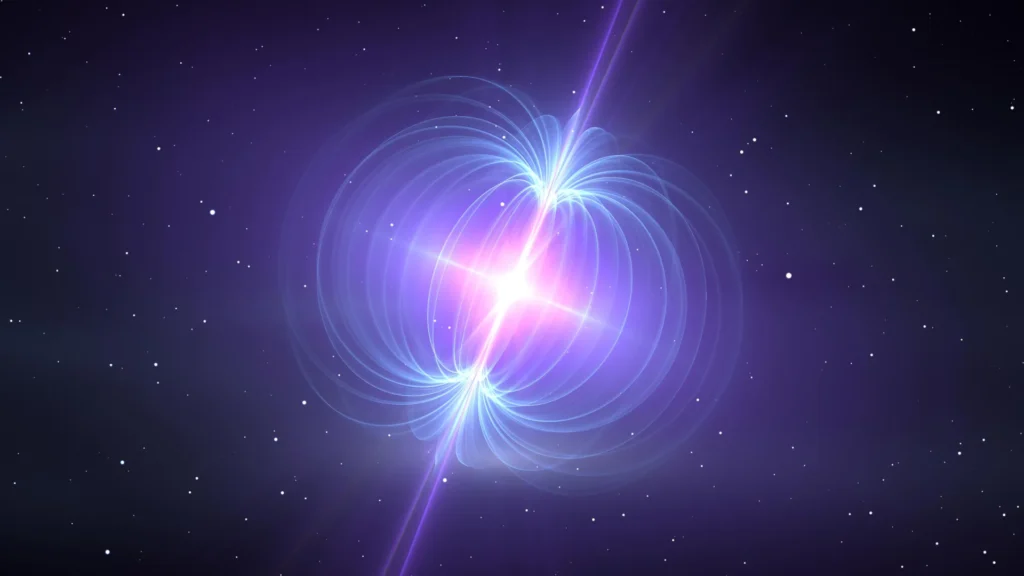
"However, if the remnant of the collision is a magnetar, it could keep bursting for longer," explained Professor Troja, a key member of the Einstein Probe European collaboration and co-corresponding author of the Science Bulletin paper. "Magnetars are rapidly spinning neutron stars with colossal magnetic fields. When they dissipate their magnetic energy into their surroundings, they can amplify any subsequent explosion, making it brighter and more sustained. When I first examined the X-ray data from this new event, I immediately sensed that we were observing something extraordinary and potentially unprecedented."
EP250704a/GRB 250704B: A Record-Breaking X-ray Flash
The specific event that has ignited this scientific excitement is designated EP250704a/GRB 250704B. It was first detected on July 4, 2025, by a coordinated network of space-based observatories, including the SVOM, Insight-HXMT, and the Einstein Probe satellites. While the associated gamma-ray burst was remarkably short, lasting for approximately half a second – consistent with typical sGRBs – the Einstein Probe continued to record bright X-ray emissions for an astonishing duration of nearly ten minutes.
"This is the longest lasting prompt X-ray flash ever observed from a neutron star merger," stated Niccolò Passaleva, a graduate student at the University of Rome Tor Vergata who spearheaded the critical follow-up observations using the VLT in Chile. "It represents an unparalleled opportunity to gain a front-row seat to the most extreme forces in the universe and to unlock more of its profound secrets."
Passaleva and his colleagues had dedicated several years to establishing a definitive connection between fast X-ray transients and neutron star mergers. Previous candidate events had unfortunately faded too rapidly, rendering them insufficient for thorough investigation. In the case of EP250704a/GRB 250704B, Passaleva’s swift response was crucial. He received the alert while traveling home and, with remarkable agility, managed to secure observation time on one of the world’s largest telescopes remotely. "I was traveling home by train," Passaleva recalled, "and all of a sudden I was rushing against time to commandeer one of the largest telescopes in the world from my laptop. It was an exhilarating race against the fading light."
Pinpointing a Cosmic Colossus: Distance, Redshift, and the Absence of a Supernova
The crucial follow-up observations were performed using the VLT’s X-Shooter instrument, a powerful spectrograph capable of dissecting light into its constituent wavelengths. By analyzing these spectral components, Passaleva and his team identified distinct absorption patterns. These patterns served as a cosmic fingerprint, allowing them to accurately measure the event’s redshift. Redshift, a fundamental concept in cosmology, quantifies how much the light from a distant object has been stretched by the expansion of the universe, thereby revealing its distance.
The measured redshift for EP250704a/GRB 250704B was z=0.6610. This value indicates that the light from this cataclysmic event began its journey towards Earth over six billion years ago, a time when our own solar system was still in its nascent stages of formation. This immense distance underscores the power and scale of the merger.
The researchers then sought further evidence to rule out alternative explanations for the prolonged X-ray emission. A common scenario for long-lasting X-ray flares in the universe involves the core-collapse of massive stars, which typically result in a bright supernova explosion. To investigate this, the team utilized deep observations from the VLT’s FORS2 instrument, specifically searching for the tell-tale signature of a supernova. Crucially, no such supernova signal was detected.
The confluence of these key pieces of evidence – the measured redshift indicating immense distance, the prolonged X-ray emission, and the conspicuous absence of a supernova – provided robust support for the hypothesis that the event originated from the merger of two neutron stars. The extended X-ray glow, therefore, is not the result of a dying massive star, but rather a consequence of the extreme conditions following the collision of two neutron stars.
Implications for Magnetar Formation and the Future of Cosmic Discovery
This discovery opens up a new avenue for understanding the frequency with which neutron star mergers give rise to magnetars. Magnetars, with their extraordinarily powerful magnetic fields, are thought to play a significant role in various astrophysical phenomena, but their formation mechanisms are still a subject of intense research. If extended X-ray flashes are a common byproduct of magnetar birth in neutron star mergers, then astronomers now possess a powerful new tool to identify these events and study the properties of these nascent magnetars.
"Finding more of these X-ray flashes could help reveal how often neutron star mergers create magnetars," Passaleva elaborated. "I am particularly excited for the upcoming runs of gravitational wave observations. The ability to finally pair one of these extended X-ray flashes with a corresponding burst of gravitational waves from the same source would be a monumental step forward in our understanding of these cosmic collisions."
The implications extend beyond magnetar studies. The ability to detect neutron star mergers through their extended X-ray signatures, rather than solely relying on the fleeting gamma-ray bursts, could significantly increase the number of identified mergers. This, in turn, will allow for more robust statistical analyses of their occurrence rates, their distribution throughout the universe, and their contribution to the cosmic elemental abundance, particularly the creation of heavy elements through processes like the r-process.
A Collaborative Endeavor and a Glimpse into the Extreme Universe
The research involved a significant international collaboration of astronomers from various institutions, highlighting the global nature of modern scientific inquiry. The lead authors of the study include An Li from Beijing Normal University, Chen-Wei Wang and Jie An from the Chinese Academy of Sciences, and Niccolò Passaleva from the University of Rome Tor Vergata. Corresponding authors who guided the research efforts are Binbin Zhang from Nanjing University, Eleonora Troja from the University of Rome Tor Vergata, Yi-Han Iris Yin from The University of Hong Kong, Jing-Wei Hu and Hua-Li Li from the Chinese Academy of Sciences.
The VLT observations central to this study were conducted as part of a large program titled "QUEENB: a QUEst for Elusive Neutron star and Black hole mergers" (program ID: 114.27LW), with Professor Eleonora Troja serving as the Principal Investigator. This ambitious program underscores the ongoing commitment of astronomers to unraveling the mysteries of the most extreme objects and events in the cosmos. The successful identification of EP250704a/GRB 250704B through this extended X-ray emission marks a significant milestone, promising a richer and more detailed understanding of neutron star mergers and the violent birth of magnetars. As observational capabilities continue to advance, the universe’s most profound secrets, once hidden within fleeting flashes, may now be revealed in sustained bursts of light.