Scientists at the Helmholtz-Zentrum Dresden-Rossendorf (HZDR) are currently spearheading a critical research initiative to address one of the most persistent environmental challenges of the 21st century: the contamination of water systems by per- and polyfluoroalkyl substances (PFAS). This group of more than 10,000 synthetic chemicals, widely used in industrial and consumer products since the 1940s, has earned the moniker "forever chemicals" due to their near-total resistance to natural degradation. The HZDR team, in collaboration with specialists from the Helmholtz Centre for Environmental Research (UFZ), is testing two innovative technological approaches—hydrodynamic cavitation and cold atmospheric plasma—designed not merely to filter these chemicals, but to systematically dismantle their molecular structure.
The urgency of this research is underscored by the increasing detection of PFAS in global water supplies, including high concentrations recently identified in the Elbe River. Unlike traditional water treatment methods that often only relocate contaminants—such as activated carbon filtration which traps PFAS in a medium that then requires hazardous waste disposal—the HZDR methods aim for "mineralization." This process involves breaking the incredibly stable carbon-fluorine bonds to convert organic pollutants into harmless fluoride salts and other manageable byproducts. If successful, these technologies could provide a scalable solution for industrial wastewater treatment, preventing these hazardous compounds from entering the broader ecological cycle.
The Molecular Resilience of PFAS: A Global Environmental Crisis
To understand the significance of the HZDR research, one must first consider the unique chemical architecture of PFAS. These substances are defined by the carbon-fluorine bond, which is recognized as the strongest single bond in organic chemistry. This bond provides PFAS with exceptional thermal stability and water- and oil-repellent properties, making them invaluable for products such as non-stick cookware, stain-resistant fabrics, specialized firefighting foams, and semiconductor manufacturing.
However, this same stability ensures that once PFAS enter the environment, they do not break down through sunlight, microbial action, or standard chemical oxidation. Over decades, these chemicals have leached from industrial sites and landfills into groundwater, eventually reaching rivers and oceans. Because they are mobile and bioaccumulative, they have been detected in the blood of humans and wildlife globally, even in remote Arctic regions.
The health implications are a primary driver for the HZDR’s efforts. While the biological effects of many of the 10,000-plus compounds remain under study, well-documented PFAS variants like perfluorooctane sulfonate (PFOS) are linked to serious health risks. These include developmental delays in children, hormonal disruption, interference with the immune system, and an increased risk of several types of cancer. As regulatory bodies like the European Chemicals Agency (ECHA) and the U.S. Environmental Protection Agency (EPA) move toward stricter limits and potential bans, the demand for effective destruction technologies has reached a critical peak.
Chronology of the HZDR Research Initiative
The current experimental phase is a cornerstone of Germany’s "National Water Strategy," a federal framework adopted to secure long-term drinking water quality and protect aquatic ecosystems. The HZDR’s involvement intensified in 2022 with the launch of a preliminary study led by postdoctoral researcher Dr. Ysabel Huaccallo-Aguilar.
Under the umbrella of the Clean Water Technology Lab (CLEWATEC), a Helmholtz Innovation Lab, the team began investigating whether extreme physical and chemical conditions could force the cleavage of the carbon-fluorine bond. The research was structured into two primary pathways: one focusing on the mechanical energy of collapsing bubbles (cavitation) and the other on the high-energy reactive environment of ionized gas (plasma).
By 2023, the team had established proof-of-concept for both methods, demonstrating that PFOS molecules could indeed be degraded in a controlled laboratory setting. The project is currently transitioning into a scaling phase, where researchers are moving from milliliter-scale experiments to five-liter reactors, with the ultimate goal of developing a modular system suitable for industrial integration.
Technology One: The Mechanics of Hydrodynamic Cavitation
The first approach investigated by Dr. Huaccallo-Aguilar’s team utilizes the power of hydrodynamic cavitation. This process involves pumping PFAS-contaminated water through a specialized constriction in a pipe. As the water passes through this narrow point, its velocity increases and the local pressure drops below the vapor pressure of the liquid, causing the formation of millions of microscopic vapor bubbles.
"In hydrodynamic cavitation, we pass PFAS-enriched water through a constriction, generating small vapor bubbles," explains Dr. Sebastian Reinecke, head of the Department of Water and Environmental Technologies at HZDR. The effectiveness of this method relies on the surfactant-like properties of long-chain PFAS. These molecules possess a "water-loving" (hydrophilic) head and a "water-fearing" (hydrophobic) tail, which causes them to naturally migrate to and collect on the surface of the vapor bubbles.
The destruction occurs when the bubbles move past the constriction into a zone of higher pressure. At this point, the bubbles collapse violently—an event known as implosion. This collapse generates localized "hotspots" where temperatures can spike to several thousand degrees Celsius and pressures reach hundreds of bars. Under these extreme conditions, the PFAS molecules attached to the bubble interface are thermally decomposed.
Furthermore, the process generates highly reactive hydroxyl radicals (·OH). These radicals are aggressive oxidants that attack the intermediate products formed during the initial breakdown of PFAS. Dr. Reinecke’s team hypothesized that these radicals significantly boost the degradation rate by preventing the formation of smaller, still-persistent fluorinated fragments. In initial tests using tap water enriched with PFOS, the cavitation process successfully degraded 37 percent of the molecules. Analysis by the UFZ confirmed the release of fluoride ions, proving that the carbon-fluorine bonds were being broken.
Technology Two: Cold Atmospheric Plasma and Gas Dispersion
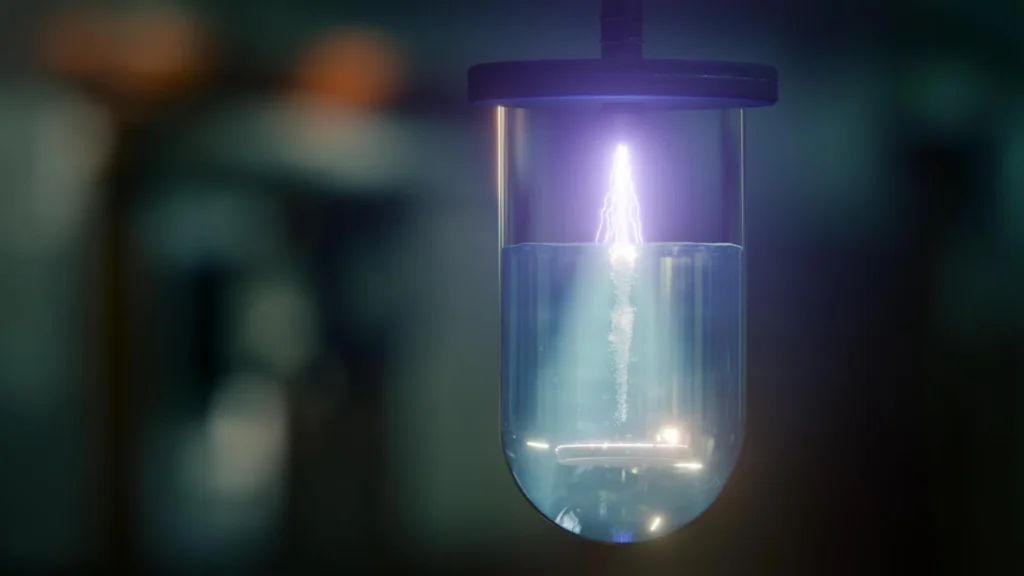
While cavitation relies on mechanical forces, the second method, developed by environmental engineer Dr. Amit Kumar, employs cold atmospheric plasma. Plasma, often called the fourth state of matter, is an ionized gas containing a rich mixture of electrons, ions, and reactive species such as ozone and hydrogen peroxide.
In Dr. Kumar’s experimental setup, plasma is generated at the surface of the contaminated water while a gas dispersion system introduces bubbles from below. As the bubbles rise through the water column, they act as transport vehicles, carrying the PFAS molecules to the surface. "The PFAS attach to the surface of the gas bubbles," Dr. Reinecke notes. "As they rise, the water is constantly circulated. This brings the PFAS to the surface, where they are broken down in the plasma."
The results from the plasma treatment have been particularly striking. The method demonstrated the ability to degrade both long-chain and short-chain PFAS—the latter being notoriously difficult to remove via traditional filtration. The plasma treatment achieved faster reaction kinetics than cavitation and successfully mineralized approximately 35 percent of the fluorine atoms into fluoride salts.
However, the plasma method presents unique challenges. It is significantly more energy-intensive than cavitation, which could impact its cost-effectiveness at a large scale. Additionally, the researchers identified the formation of gaseous transformation products. A current priority for the HZDR team is to identify these gases to ensure that the process does not simply convert a water pollutant into an air pollutant.
Data-Driven Analysis and Future Integration
The data gathered thus far suggests that neither technology is a "silver bullet" on its own, but rather that they offer complementary strengths. Cavitation is energy-efficient and effective at handling large volumes of water, while plasma offers superior speed and the ability to tackle a wider range of PFAS variants.
The HZDR researchers are now working to combine these two technologies into a single, hybrid system. By integrating plasma electrodes into a cavitation reactor, they hope to create a synergistic effect where the cavitation provides the initial breakdown and the plasma-generated species finalize the mineralization of the more resistant fragments.
"I believe we’ll achieve high degradation rates by combining the highly reactive species from the plasma with the effects of cavitation," says Dr. Reinecke. The team has set ambitious targets for the next phase of development: a degradation rate of over 80 percent for the targeted PFAS compounds and a mineralization rate of more than 50 percent of the bound fluorine.
Broader Implications for Industry and Environmental Policy
The successful development of these technologies would have profound implications for industrial wastewater management. Currently, industries that use PFAS—ranging from textile manufacturers to chemical plants—face mounting pressure to eliminate PFAS discharge. A "point-of-source" treatment system using HZDR’s combined technology could allow these facilities to destroy PFAS on-site before their wastewater ever reaches municipal sewers or natural water bodies.
From a regulatory perspective, the HZDR research aligns with the European Union’s "Zero Pollution" ambition. As the EU debates a comprehensive restriction on the manufacture and use of PFAS, the availability of viable destruction technologies will be a key factor in determining the feasibility of such regulations.
Furthermore, the detection of PFAS in the Elbe River serves as a stark reminder of the local stakes. For regions downstream of industrial hubs, the ability to treat river water or industrial effluent effectively is not just an environmental goal but a public health necessity. The fluoride salts produced by the HZDR process are far easier to manage and less toxic than the parent PFAS compounds, representing a significant step forward in environmental safety.
Funding and Institutional Support
The research is supported by a robust network of funding and institutional cooperation. It is financed by the Helmholtz Association’s Impulse and Networking Fund through the CLEWATEC lab. Additionally, the specific projects "HyKaPro" and "Plasma4PFAS" receive co-financing from the European Union and the Saxon Parliament, reflecting the high level of political and social interest in solving the PFAS crisis.
As Dr. Reinecke and his team move toward larger-scale testing, the focus remains on optimizing energy consumption and ensuring the safety of all byproducts. The transition from a 50-milliliter lab test to a 5-liter pilot reactor marks the beginning of the journey toward a commercially viable system that could finally end the era of "forever chemicals" in our water. Through the intersection of fluid mechanics, plasma physics, and environmental chemistry, the HZDR is providing a roadmap for turning a persistent industrial legacy into a manageable environmental solution.