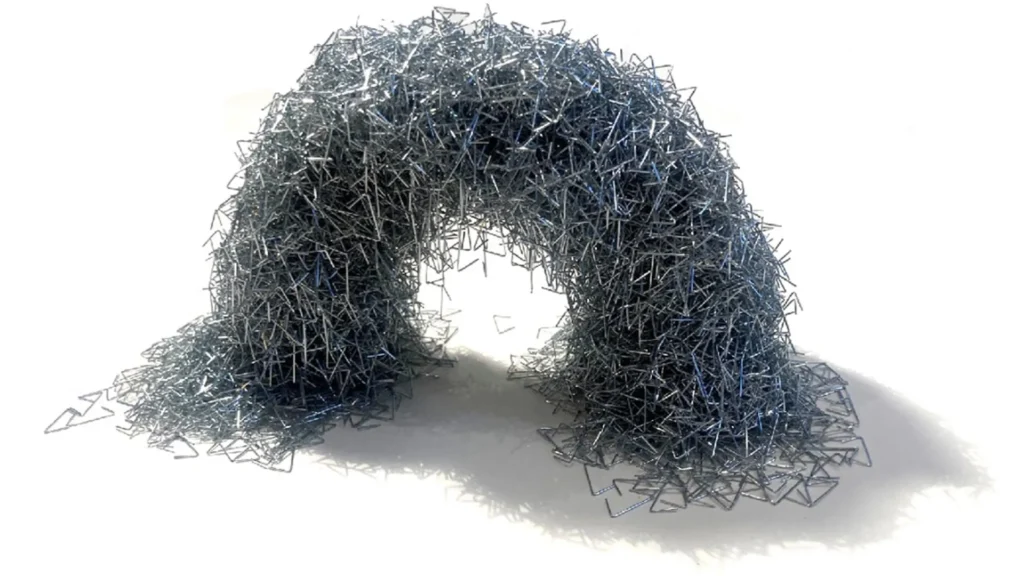
A tightly compressed bundle of office staples can behave in a surprising way. Even though it is made of many separate pieces, the tangled mass can be difficult to pull apart and can act almost like a single solid object. Yet that same bundle can quickly come undone. With the right vibration or movement, the staples can separate and return to a loose collection of individual pieces. This seemingly mundane observation, a paradox of transient solidity and rapid disaggregation, has captivated researchers at the Paul M. Rady Department of Mechanical Engineering at CU Boulder, who believe this unusual combination of strength and reversibility could help inspire a new generation of engineered materials. By designing particles that interlock in a similar way to staples, they hope to create materials that are strong, adaptable, and potentially recyclable, addressing some of the most pressing challenges in sustainable engineering and advanced manufacturing.
The Quest for Adaptive Materials: A Modern Imperative
For decades, material scientists have strived to create substances that can adapt to changing conditions, offering properties that extend beyond the static capabilities of conventional materials. The concept of "smart materials" capable of responding to external stimuli—be it temperature, light, or electric fields—has been a significant area of research. However, the true holy grail lies in materials that can not only adapt but also fully reverse their structural state, transforming from a robust, load-bearing entity into a collection of easily separable, reusable components. This reversibility is crucial for addressing the global challenge of waste, particularly in industries like construction, where demolition generates enormous volumes of non-recyclable debris. The CU Boulder team’s work, recently published in the Journal of Applied Physics, marks a significant stride toward achieving this ambitious goal, pushing the boundaries of what is possible in material design by focusing on the fundamental mechanics of particle interaction.
Unlocking Nature’s Secrets: The Principle of Entanglement
The research centers on a phenomenon known as entanglement, which occurs when particles become intertwined and form connections with one another. This principle is not new; it is pervasive throughout nature, forming the basis of many resilient biological structures. Bird nests, for example, rely on an intricate network of interwoven twigs and fibers to maintain their structure against wind and weather, demonstrating remarkable strength despite being composed of relatively weak individual elements. Bones, too, derive their exceptional strength and toughness from a complex hierarchical structure where hard mineral components (hydroxyapatite) are intricately intertwined with softer, flexible protein fibers (collagen). Even the seemingly fragile spider web, with its interwoven silk strands, exemplifies entanglement’s power to create robust, energy-absorbing structures.
The CU Boulder team, led by Professor Francois Barthelat, head of the Laboratory for Advanced Materials & Bioinspiration, wanted to understand how similar principles could be harnessed to create manufactured materials with unprecedented properties. Their exploration into interlocking, entangled particles represents a natural evolution of Barthelat’s long-standing interest in "building blocks" and geometry. "We’ve been playing around with the idea of building blocks and geometry for many years, but we started looking at interlocking, entangled particles only recently," Barthelat stated, highlighting the progressive nature of their research trajectory. This shift in focus from mere assembly to active entanglement proved to be the crucial insight.
The Critical Role of Particle Geometry: Beyond Simple Aggregation
The team’s work quickly pointed to one crucial factor: the shape of the particles themselves. Traditional granular materials, such as sand, while exhibiting interesting collective behaviors, fundamentally lack the ability to interlock. "Let’s take sand as an example. Sand is smooth and convex-shaped, meaning it cannot interlock from grain to grain," explained PhD student Youhan Sohn, a key contributor to the research. This inherent limitation means that sand, despite its prevalence, relies primarily on friction and compaction for any structural integrity, which can be easily disrupted.
The CU Boulder researchers hypothesized that by altering the fundamental geometry of individual particles, they could dramatically enhance their collective mechanical properties. "However, we found that if we change the shape of a grain of sand, we can drastically affect its behavior and mechanical properties, including the particle’s ability to link with other particles," Sohn elaborated. This realization underscored the potential for design-driven material innovation.
To investigate further, the researchers employed sophisticated computational techniques, specifically Monte Carlo simulations. This probabilistic modeling approach allowed them to explore a vast parameter space of particle shapes and their potential interactions. By simulating millions of particle configurations and movements, they could efficiently identify geometries that would maximize entanglement, predict their collective behavior under various stresses, and screen for promising designs without the need for extensive physical prototyping in the initial stages. These simulations are computationally intensive, often requiring high-performance computing clusters, but they provide an invaluable tool for accelerating discovery in materials science.
The "Staple" Particle: A Dual-Function Marvel Emerges
After identifying several promising designs through simulation, the team moved to experimental validation, conducting a series of "pickup tests" to observe how the particles behaved in real-world conditions. These physical experiments were crucial to bridge the gap between theoretical predictions and practical application, allowing the researchers to confirm the simulated behaviors and uncover unexpected phenomena.
The results were striking: a "two-legged" particle, remarkably resembling a common office staple, consistently produced the highest degree of entanglement. This staple-like shape, simple yet profoundly effective, offered several unexpected benefits that set it apart from other designs. One of the most notable was its ability to combine tensile strength and toughness, two properties that are often difficult to achieve simultaneously in conventional materials. Tensile strength refers to a material’s ability to resist breaking when stretched, while toughness describes its capacity to absorb energy and deform plastically without fracturing. Typically, materials that are very strong tend to be brittle, and those that are tough are often less rigid. The entangled granular material, leveraging the unique geometry of the staple-like particle, defied this conventional trade-off. "Our entangled granular material using the staple-like particle demonstrates both high strength and toughness at the same time," affirmed PhD student Saeed Pezeshki, another vital member of the research team. This combination opens up possibilities for materials that are not only robust but also resistant to sudden, catastrophic failure.
Beyond this impressive mechanical duality, the staple-like particles displayed another unusual characteristic: their rapid and reversible assembly. They could quickly come together into a stronger, entangled structure and then, just as rapidly, separate again. The researchers discovered that by applying different vibration patterns, they could precisely control the degree of entanglement. Gentle, low-frequency vibrations encouraged the particles to interlock and strengthen the material, effectively "solidifying" the aggregate. Conversely, stronger, higher-frequency vibrations caused the intricate network to unravel, returning the material to a loose collection of individual pieces. This dynamic control over material properties is what makes this discovery truly revolutionary. "It’s a strange material because it’s obviously not a liquid. However, it’s also not quite solid. This opens new and intriguing engineering possibilities," Barthelat noted, describing the material’s exotic feel and behavior.
Revolutionizing Industries: From Sustainable Construction to Adaptive Robotics
The implications of this research are far-reaching, with potential applications across numerous sectors, particularly in areas demanding adaptability and sustainability.
Sustainable Infrastructure: The researchers believe the technology could eventually support more sustainable approaches to construction, a sector notorious for its environmental footprint. Traditional construction methods often result in vast amounts of waste generated during demolition, with concrete and steel structures being notoriously difficult and energy-intensive to recycle or reuse. In the future, bridges, buildings, and other large structures might be built using entangled materials that can later be deconstructed rather than demolished. Imagine a building whose components, made from these staple-like particles, could be vibrated apart at the end of its service life, allowing the individual particles to be collected, transported, and then re-entangled to form new structures. Such a system would represent a paradigm shift towards a truly circular economy in construction, drastically reducing landfill waste, conserving raw materials, and lowering the energy consumption associated with manufacturing new building components. Industry experts recognize the immense economic and environmental benefits of such a system, potentially leading to lower material costs over a structure’s lifecycle and compliance with increasingly stringent environmental regulations.
Adaptive Robotics and Beyond: The concept of dynamically reconfigurable materials also holds immense promise for the field of robotics. PhD student Saeed Pezeshki highlighted a fascinating application: "I was talking with other students who believe this technology can be used in swarm robotics – where small robots can entangle, do a task and then disentangle when they are done." In swarm robotics, numerous small, simple robots work collaboratively to achieve complex tasks. The ability for these robots to physically interlock and form larger, more robust structures on demand could enable them to perform tasks requiring greater strength or stability, then disaggregate to navigate confined spaces or perform individual actions. This offers a level of adaptability currently unseen in robotic systems.
Professor Barthelat drew a captivating analogy, albeit with a healthy dose of scientific caution: "Yes, kind of like that liquid metal T-1000 in Terminator 2 who can change shape to slide under a door and then transform back to a human’s size on the other side." While the science fiction vision of a shapeshifting robot remains in the distant future, the underlying principle of reconfigurable matter is precisely what the CU Boulder team is exploring. This could lead to advancements in soft robotics, where robots can change their morphology to interact safely with humans or navigate unstructured environments, and even in adaptive tools that can adjust their shape and rigidity to suit different tasks. Beyond robotics, potential applications might include temporary medical implants that can be easily removed, self-healing materials, or adaptive protective gear that stiffens upon impact.
Challenges and the Road Ahead: From Lab to Market
Despite the groundbreaking nature of these findings, the path from laboratory discovery to widespread commercial application is often fraught with challenges. Professor Barthelat candidly acknowledged some of these hurdles: "It’s expensive and scaling up is a challenge, but it’s something that’s on everybody’s mind."
Manufacturing Complexity and Cost: Producing billions or trillions of precisely shaped, staple-like particles with high fidelity and at a low cost will require advanced manufacturing techniques. Current methods for creating such intricate geometries might be expensive and slow, making large-scale production economically unfeasible for many applications. Innovations in additive manufacturing (3D printing) or advanced molding techniques will be crucial.
Material Durability and Lifecycle: For applications like construction, materials must withstand years, if not decades, of environmental exposure and repeated stress cycles. The long-term durability of these entangled systems, particularly their ability to maintain strength and reversibility over many entanglement/disentanglement cycles, will need rigorous testing. Factors like wear, fatigue, and environmental degradation of the particle surfaces could impact performance.
Scalability and Performance: While laboratory demonstrations are promising, scaling the technology from small bundles to massive structures, like bridges or buildings, presents significant engineering challenges. Ensuring uniform entanglement across vast volumes and developing robust mechanisms for controlled vibration on such scales will require substantial research and development.
Regulatory and Standardization Hurdles: As a novel class of materials, entangled granular systems would likely face extensive regulatory scrutiny and require new standardization protocols before they could be widely adopted in critical applications like infrastructure.
The CU Boulder team is already moving into the next stage of their research, directly addressing some of these challenges by pushing the boundaries of particle design. Their latest experiments focus on a new particle design that includes additional protruding "legs," moving beyond the simple two-legged staple. The researchers compare the shape to the spiky burrs that cling stubbornly to shoes and clothing outdoors—a natural example of highly effective entanglement. They believe these added features could create even stronger entanglement effects, enhancing both the strength and the control over the material’s state, thereby unlocking new possibilities for future materials. This continuous innovation underscores the dynamic nature of materials science and the long-term vision for reconfigurable matter.
Reshaping the Future of Materials Science
The work from the Paul M. Rady Department of Mechanical Engineering at CU Boulder represents a significant leap forward in our understanding and control of granular materials. By drawing inspiration from the humble office staple and the intricate designs of nature, researchers are pioneering a new class of materials that challenge the conventional dichotomy between solid and fluid, strong and reversible. The ability to create materials that can dynamically switch between a robust, load-bearing state and a loose, reconfigurable one holds the potential to revolutionize industries from sustainable construction to adaptive robotics. While significant engineering and economic hurdles remain, the foundational science is firmly in place, paving the way for a future where materials are not just strong or flexible, but intelligently adaptive, reusable, and integral to a more sustainable world.