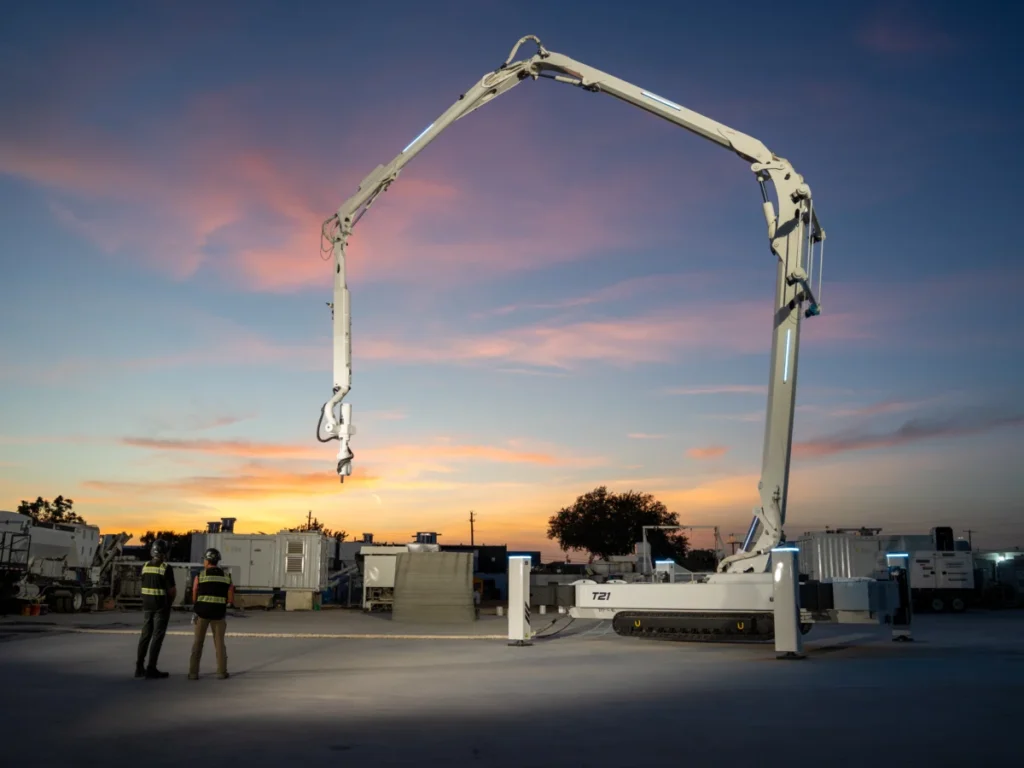
Austin, TX – ICON, the pioneering additive construction (AC) firm, has significantly bolstered its position as a leader in the 3D printed construction market with the announcement of a $200 million Series D funding round. This substantial investment propels the company’s cumulative funding to approximately $700 million, underscoring robust investor confidence in its technology and market strategy. The latest funding round was co-led by prominent global investment firms Baillie Gifford and BlackRock, alongside continued participation from major investor Tiger Global Management. This infusion of capital not only highlights the scale of financial backing but also the caliber of institutions recognizing ICON’s potential.
The significance of this Series D round extends beyond its monetary value, reflecting a critical juncture for the nascent additive construction industry. While other companies in the 3D printed construction space have faced financial headwinds or ceased operations, ICON has consistently demonstrated a path to scalability and market penetration. This latest funding validates its approach and suggests a strategic consolidation of leadership within the sector. The participation of heavyweight financial institutions like Baillie Gifford, known for its long-term investment horizons in innovative companies, and BlackRock, the world’s largest asset manager, signals a maturing investment landscape for advanced construction technologies.
A History of Strategic Investment and Growth
ICON’s journey to this point has been marked by a series of strategic funding rounds and significant operational milestones. Founded in 2017, the company quickly established itself with its proprietary Vulcan 3D printing technology, designed to construct homes and structures from proprietary cementitious materials. Early funding rounds, including a $165 million Series C in 2021, set the stage for accelerated growth.
The company’s strategic vision has consistently focused on addressing critical housing needs, from affordable housing initiatives to disaster relief shelters and even potential extraterrestrial habitats. This broad application of its technology has attracted a diverse investor base, including venture capital firms, strategic corporate partners, and government entities.
The Series D round builds upon a foundation of substantial financial support:
- Early-Stage Funding: Initial seed and Series A rounds provided the foundational capital to develop and refine its core technology.
- Series B and C Rounds: These rounds, totaling over $300 million, were crucial for scaling manufacturing, expanding project pipelines, and initiating larger-scale developments.
- Series D Round: The most recent $200 million injection further solidifies ICON’s financial stability and capacity for ambitious future projects.
This consistent access to capital is a testament to ICON’s ability to translate technological innovation into tangible market success, a rarity in the often volatile startup ecosystem.

Strategic Partnerships and Government Support
Beyond venture capital, ICON has cultivated strong relationships with strategic partners and government bodies, further cementing its market standing. The company has secured substantial government contracts, reportedly totaling $370 million to date. This level of public sector support indicates a recognition of additive construction’s potential to address national infrastructure and housing challenges.
A notable collaboration is with Wells Fargo, announced earlier this year. This partnership aims to streamline the homebuying process for 3D printed homes, offering homebuyers a 0.5 percent credit on mortgages for homes constructed by ICON. Such initiatives are vital for normalizing the adoption of 3D printed housing and integrating it into the traditional real estate market. The involvement of a major financial institution like Wells Fargo signals a significant step towards mainstream acceptance and accessibility.
These strategic alliances are not merely financial; they represent endorsements of ICON’s technology and its potential to revolutionize the construction industry. By partnering with established players in finance and government, ICON is effectively building bridges between cutting-edge technology and established market infrastructures.
Growth Trajectory and Market Validation
ICON’s operational performance further validates its market leadership. The company reported that it is on pace for a four-fold increase in revenue this year. This aggressive growth trajectory is supported by an expanding portfolio of completed projects, with nearly 300 buildings constructed to date. These projects range from single-family homes in developments like the Wolf Ranch neighborhood in Georgetown, Texas, to larger-scale initiatives in partnership with organizations like New Story for affordable housing.
The company’s technology, including the Titan 3D printer, a larger-scale system designed for rapid construction, has been instrumental in achieving these production volumes. The ability to consistently deliver completed structures at an increasing pace is a critical differentiator in a sector that has historically struggled with scalability.
The Competitive Landscape and Future Outlook
The question of whether any other company can genuinely compete with ICON’s current market position is a pertinent one. While the additive construction sector remains niche, ICON’s sustained success, substantial funding, and strategic partnerships create a formidable barrier to entry for new competitors. The company’s comprehensive ecosystem, encompassing proprietary printing technology, specialized materials, and integrated design and construction processes, presents a significant advantage.
However, the author’s provocative framing – "I’m wondering if anyone else can truly compete with ICON" – highlights a crucial aspect of innovation: the need for competition to drive further advancement. ICON itself benefits from having strong challengers that can push the boundaries of technology and market application. The existence of a dominant player like ICON, while potentially daunting for rivals, also serves as a powerful validation of the additive construction concept. It demonstrates that 3D printed buildings are not just theoretical prototypes but viable, scalable solutions with significant economic and social potential.

The author draws an analogy to SpaceX in the commercial space sector. SpaceX has established a near-monopoly in certain aspects of satellite launches and space exploration, spurring immense innovation and investment from companies seeking to capture market share. Similarly, ICON’s leadership in additive construction may inspire a wave of new ventures or existing construction firms to develop competing technologies and business models. The development of a "horizontal network" of AC companies, as suggested by the author, could collectively challenge ICON’s dominance in a manner analogous to how various European space initiatives are aiming to create a unified front against established players.
The Next Frontier: Space Exploration and Beyond
ICON’s ambition extends beyond terrestrial construction, with significant involvement in projects related to space exploration. The company has been a key partner in NASA’s Artemis program, contributing to the development of technologies for building habitats on the Moon and Mars. This dual focus on Earth-based housing solutions and extraterrestrial infrastructure underscores ICON’s long-term vision and its commitment to pushing the boundaries of additive manufacturing.
The company’s participation in space-related projects, such as the development of potential lunar habitats, not only showcases its technological prowess but also aligns with a broader global interest in space exploration. These initiatives often attract significant government funding and private investment, further bolstering ICON’s resources and reputation.
Industry Implications and Expert Insights
The implications of ICON’s continued success for the broader construction industry are profound. Additive construction offers potential solutions to pressing challenges such as labor shortages, rising material costs, and the urgent need for more sustainable building practices. By automating significant portions of the construction process, 3D printing can lead to faster build times, reduced waste, and improved safety.
Experts in the field anticipate that ICON’s achievements will accelerate the adoption of AC technologies across the globe. Jonathan Ladouceur, VP of Technology & Products at ICON, is scheduled to speak on an Additive Construction panel at the upcoming Additive Manufacturing Strategies (AMS) event on February 24, 2027. This platform will likely provide further insights into the company’s technological advancements and its vision for the future of construction. His participation alongside industry leaders such as Stephan Mansour will undoubtedly generate further discussion and interest in the sector.
The $200 million Series D funding round for ICON is more than just a financial transaction; it represents a significant milestone in the evolution of the additive construction industry. It solidifies ICON’s leadership position, validates the market’s potential, and sets a high bar for any aspiring competitors. As the company continues to innovate and expand its operations, its impact on how we build and inhabit our world is poised to grow exponentially. The future of construction is increasingly being shaped by the precision and scalability of 3D printing, with ICON at the forefront of this transformative movement.