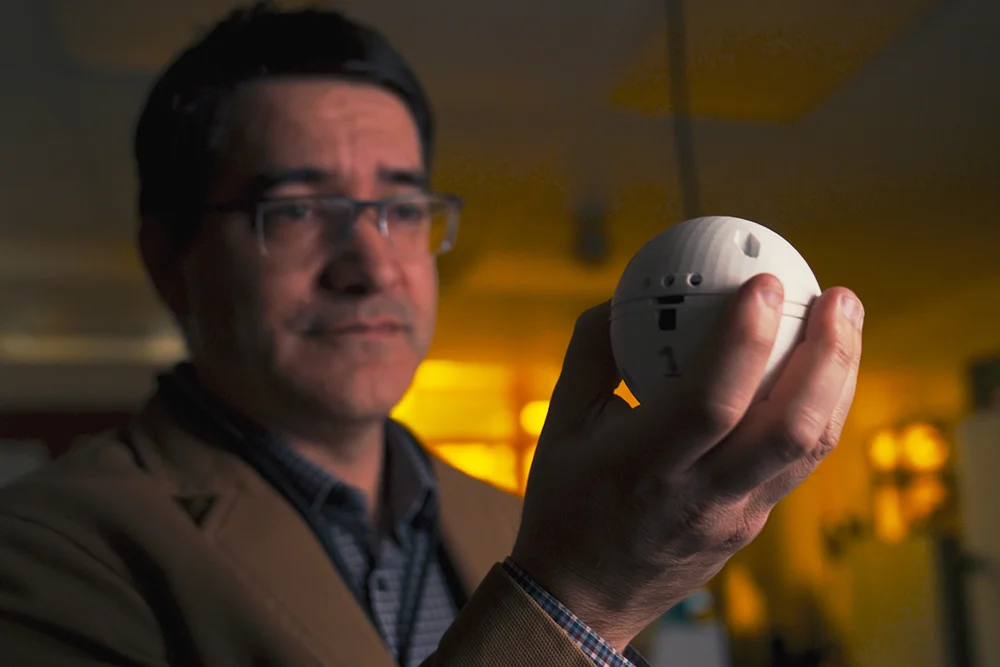
Researchers at MIT Lincoln Laboratory have developed a groundbreaking portable sensor technology, codenamed TOSSIT, designed to provide early and remote detection of hazardous airborne agents. This innovative device, roughly the size of a baseball, promises to significantly enhance the safety and situational awareness of military personnel, first responders, and law enforcement in environments potentially contaminated with chemical threats. The development addresses a critical gap in current detection capabilities, particularly for threats that are otherwise difficult to identify with existing small-scale sensor systems.
A New Era of Chemical Threat Detection
The Tactical Optical Spherical Sensor for Interrogating Threats, or TOSSIT, represents a significant leap forward in personal protective and early warning systems. Its primary function is to sample ambient air and alert users to the presence of dangerous vapors and aerosols. This capability is crucial in a wide array of scenarios, from identifying chemical warfare agents like nerve or blister agents on the battlefield to detecting accidental releases of industrial chemicals in civilian settings, or even the presence of potent substances like fentanyl dust in illicit drug operations.
The operational concept of TOSSIT is elegantly simple yet highly effective. The device can be deployed by various means, including being manually tossed into a suspect area, dropped from a drone, or even launched via specialized equipment. Once deployed, TOSSIT begins its air sampling process. At its core, the sensor utilizes an internal camera to observe color changes on a removable dye card. These specialized dye cards are engineered to react specifically with certain chemical compounds, producing a distinct visual alteration when exposed to them. This colorimetric detection method, combined with sophisticated image analysis, allows TOSSIT to identify the presence of targeted hazardous substances.
Upon successful detection of a threat, TOSSIT communicates its findings to users through multiple channels. Alerts can be received via a dedicated mobile application, providing real-time data and notifications to personnel operating within or near the affected zone. Additionally, the sensor itself can be equipped with integrated alarms, offering immediate auditory or visual cues to those in its vicinity. This dual alert system ensures that critical information is disseminated rapidly and effectively, allowing for timely evacuation, containment, or mitigation efforts.
Addressing an Unmet Need in Threat Identification
The impetus behind the development of TOSSIT stems from a recognized deficiency in existing sensor technology, particularly concerning the detection of certain types of chemical threats. As highlighted by principal investigator Richard Kingsborough, "TOSSIT fills an unmet need, providing a low-cost sensing option for vapors and solid aerosol threats—think toxic dust particles—that would otherwise not be detectable by small deployed sensor systems." This statement underscores the device’s unique value proposition. Many existing portable sensors are optimized for specific vapor-phase chemicals, but struggle to effectively identify or quantify airborne particulate matter carrying toxic agents.
The implications of this gap are significant. For instance, the dispersal of nerve agents in aerosolized form or the airborne spread of fine dust particles contaminated with lethal substances present complex detection challenges. TOSSIT’s ability to address these specific threats, alongside more conventional vapor detection, broadens the spectrum of risks that can be proactively identified. This is particularly relevant for military operations where the nature of potential chemical attacks can be varied and sophisticated, and for first responders dealing with industrial accidents or hazardous material incidents where the precise nature of the released substance may be initially unknown.
The development process involved extensive testing and refinement. While specific details of the testing protocols are not fully elaborated in the initial release, the mention of "extensive testing in the field" suggests a rigorous evaluation phase under realistic operational conditions. This practical validation is crucial for ensuring the reliability and effectiveness of such a critical safety device. The successful completion of these field trials has paved the way for the technology’s transition to operational use, with a clear pathway for transfer to the U.S. military. This marks a significant milestone, indicating that TOSSIT is moving from the research and development phase into practical application, where it can directly contribute to the safety and security of personnel.
Technological Foundation and Future Potential
The core of TOSSIT’s functionality lies in its combination of advanced optics, material science, and digital processing. The removable dye card is a key component, acting as a passive chemical collector and indicator. The selection and formulation of these dyes are critical, requiring them to be sensitive to specific chemical agents while remaining stable and inert under normal environmental conditions. The internal camera and image processing algorithms are responsible for accurately interpreting the color changes, distinguishing between false positives and genuine threat indicators. The integration of these elements into a compact, durable, and user-friendly device is a testament to the engineering prowess at MIT Lincoln Laboratory.
The "baseball-sized" descriptor implies a device that is easily transportable, deployable, and potentially carried by individual service members or integrated into various unmanned systems. Its spherical design may also offer advantages in terms of omnidirectional sensing and durability, allowing it to withstand the rigors of deployment in challenging environments.
The implications of TOSSIT extend beyond its immediate application in chemical threat detection. The underlying technology could potentially be adapted for other sensing applications, such as environmental monitoring, industrial safety, or even medical diagnostics, depending on the development of appropriate sensing materials. The modular nature of the dye card system suggests that TOSSIT could be reconfigured to detect a wider range of substances with relative ease, making it a versatile platform for future innovation.
Broader Context and Impact
The development of TOSSIT arrives at a time when concerns over chemical warfare and the potential for hazardous material incidents remain high. International tensions, coupled with the increasing complexity of industrial processes, necessitate robust and adaptable detection capabilities. For military forces, the ability to rapidly identify chemical agents on the battlefield can mean the difference between life and death, allowing for immediate protective measures and strategic responses. For civilian first responders, such as firefighters and HAZMAT teams, TOSSIT could provide crucial early warnings during chemical spills, industrial accidents, or even in situations involving the illicit production of dangerous substances.
The "low-cost" aspect mentioned by Dr. Kingsborough is particularly noteworthy. While advanced sensor technology can often be prohibitively expensive, a cost-effective solution like TOSSIT could enable wider deployment, equipping more personnel and units with essential detection capabilities. This democratization of advanced safety technology is vital for enhancing overall preparedness and resilience.
The transfer of this technology to the U.S. military signifies a strong endorsement of its efficacy and potential impact. It suggests that TOSSIT has met stringent military requirements for performance, reliability, and usability. As the technology is integrated into military protocols, it is likely to be accompanied by comprehensive training programs to ensure that service members can effectively utilize its capabilities.
Future Outlook and Related Developments
While the current announcement focuses on the detection of chemical warfare agents and industrial chemicals, the future evolution of TOSSIT could see it adapted to detect biological agents, radiological materials, or even specific environmental pollutants. The adaptability of the dye card system and the potential for software updates to enhance detection algorithms suggest a long developmental runway for this technology.
The development of TOSSIT by MIT Lincoln Laboratory is a significant achievement in the field of defense and public safety technology. It highlights the ongoing efforts to equip individuals on the front lines with the tools they need to stay safe and respond effectively to a wide range of threats. As the technology matures and finds its place in operational environments, its impact on safeguarding lives and mitigating risks associated with hazardous airborne agents is expected to be substantial. The ability to remotely and reliably detect these threats, even in the form of challenging aerosols and dust particles, represents a critical advancement in our collective ability to confront and manage emergent dangers.