The rapid expansion of data centers across the United States is placing an unprecedented strain on the nation’s aging electricity infrastructure, prompting a search for decentralized energy solutions that can keep pace with the digital age. These massive facilities, which serve as the backbone of the global internet and the burgeoning artificial intelligence sector, require enormous amounts of power not only to operate high-density computing equipment but also to maintain the sophisticated cooling systems necessary to prevent hardware failure. According to recent estimates from the Electric Power Research Institute (EPRI), data centers could account for as much as 9% of annual U.S. electricity generation by 2030. This represents a staggering increase from 2023, when these facilities consumed approximately 4% of the nation’s total electricity demand. As the grid nears its capacity in key hubs like Northern Virginia and Silicon Valley, the need for on-site, sustainable power generation has moved from a secondary concern to a critical priority for the tech industry.
Researchers are now exploring advanced materials science to reduce this strain by making fuel cells a viable alternative for primary power. A multi-institutional team led by Gang Wu, the Elvera and William R. Stuckenberg Professor in the McKelvey School of Engineering at Washington University in St. Louis, has developed a breakthrough approach that could significantly improve the performance and longevity of low-temperature fuel cells. By engineering a novel carbon support structure for catalysts, the team has addressed a decades-old trade-off between efficiency and durability, potentially clearing the path for fuel cells to serve as a reliable, off-grid power source for energy-intensive infrastructure.
The Growing Pressure on the American Power Grid
The surge in data center construction is driven by the global transition to cloud-based services and the massive computational requirements of generative AI models. Modern data centers are no longer just warehouses of servers; they are industrial-scale energy consumers. A single large-scale data center can require upwards of 100 megawatts of power—enough to support a mid-sized city. When clustered together, these facilities can overwhelm local utilities, leading to delays in connection times and increased reliance on fossil-fuel-based peaking plants to maintain grid stability.
"If a data center is able to supply its electricity itself by using a fuel cell, it would directly convert hydrogen and other fuels into electricity, reducing the burden on the energy grid," Professor Gang Wu explained. This decentralized model, often referred to as "behind-the-meter" generation, allows facilities to operate independently of the fluctuations and limitations of the public utility system. Furthermore, because fuel cells produce electricity through an electrochemical reaction rather than combustion, they offer a pathway to zero-emission power if supplied with green hydrogen.
The Platinum Challenge in Fuel Cell Engineering
At the heart of the most efficient fuel cells—specifically Proton Exchange Membrane Fuel Cells (PEMFCs)—lies a catalyst that facilitates the reaction between hydrogen and oxygen. While several materials can act as catalysts, platinum is widely regarded as the most effective due to its high catalytic activity and ability to withstand the acidic environment inside a fuel cell. However, platinum is a precious metal with a high market price and limited global supply. For fuel cells to be commercially competitive with traditional internal combustion engines or grid-scale lithium-ion batteries, the amount of platinum used must be drastically reduced without compromising the cell’s output.
To maximize the utility of platinum, researchers typically break the metal down into nanoparticles. By reducing the metal to a scale of just a few nanometers, the surface-area-to-volume ratio increases exponentially, allowing a tiny amount of platinum—often less than 0.25 milligrams per square centimeter—to facilitate a high volume of chemical reactions.
The primary obstacle, however, is durability. During the rigorous operation of a fuel cell, these platinum nanoparticles are prone to degradation. They can dissolve into the electrolyte, migrate across the support surface, or clump together in a process known as sintering. As the particles grow larger or disappear, the total surface area available for the reaction shrinks, leading to a steady decline in power output. In the context of a data center that requires 24/7 uptime, such degradation is a deal-breaker.
Breakthrough in Carbon Nanostructure Design
The research team, which included experts from Brookhaven National Laboratory, Lawrence Berkeley National Laboratory, Northeastern University, and the University of Pittsburgh, focused on creating a "host" environment that could protect these tiny particles. Their findings, published on August 6, 2026, in the journal Nature Nanotechnology, detail the creation of a sophisticated carbon nanostructure designed to anchor and stabilize platinum-cobalt (Pt-Co) intermetallic nanoparticles.
Intermetallic catalysts are a specialized class of materials where platinum is alloyed with another metal, such as cobalt, in a highly ordered atomic arrangement. These structures are known to be more active and stable than random alloys. However, creating this "ordered" state requires heating the materials to high temperatures, a process called annealing. Traditionally, if researchers heated the catalyst above 700°C to achieve the desired atomic order, the nanoparticles would melt and fuse together, destroying the high surface area needed for efficiency.
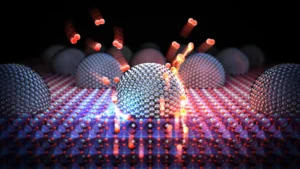
Wu and his colleagues solved this by developing a new carbon structure: porous, hollow carbon spheres featuring orderly radial nanochannels. This architecture acts like a high-tech honeycomb, providing substantial internal surface area and pore space.
"Our strategy is using this new carbon nanostructure to synthesize platinum cobalt intermetallic nanoparticles that can reduce precious metal content and enhance activity and stability," Wu said. "Traditionally, there would be a tradeoff between size and stability, but with the ordered carbon nanochannel host, platinum cobalt nanoparticles can be confined and remain stable at very small particle size even at high temperatures."
Testing and Performance Metrics
The effectiveness of the new carbon support was demonstrated through rigorous testing that simulated real-world operating conditions. Because the carbon spheres contain radial nanochannels, the researchers were able to heat the Pt-Co catalyst to 1000°C. This high temperature was sufficient to trigger the transition to a highly ordered intermetallic structure, yet the physical constraints of the nanochannels prevented the particles from clumping together. The resulting nanoparticles remained smaller than five nanometers and were evenly distributed throughout the support.
In durability tests, the material showed remarkable resilience. After 150,000 severe voltage cycles—tests designed to mimic the stress of a fuel cell being repeatedly turned on and off or fluctuating in load—the catalyst retained 85% of its initial performance. For comparison, many existing catalysts show significant degradation after just 30,000 cycles. The researchers estimate that this level of stability could translate to approximately 25,000 hours of operational life, a milestone that brings hydrogen fuel cells much closer to the requirements for heavy-duty industrial use and long-term power generation.
The architecture of the carbon support offers secondary benefits as well. The "open channel" design allows for the uniform distribution of ionomers (polymers that conduct ions) and creates clear pathways for protons, oxygen, and water to move through the electrode. This reduces "mass transport" resistance, ensuring that the fuel cell can maintain high power density even under heavy loads.
Chronology of the Research and Institutional Collaboration
The development of this technology was the result of a multi-year effort involving several of the nation’s leading research facilities:
- Conceptualization (2023-2024): The team at Washington University in St. Louis identified the limitations of current carbon supports and began designing the hollow sphere geometry.
- Synthesis and Material Characterization (2024-2025): Collaborators at Northeastern University and the University of Pittsburgh assisted in the atomic-level modeling of the Pt-Co intermetallic phases.
- Advanced Imaging (2025): Researchers utilized the high-resolution electron microscopy and X-ray absorption spectroscopy facilities at Brookhaven National Laboratory and Lawrence Berkeley National Laboratory to verify the ordered atomic structure of the nanoparticles within the carbon channels.
- Performance Validation (Early 2026): Extensive stress testing was conducted to confirm the 150,000-cycle durability.
- Publication and Patenting (August 2026): The findings were published in Nature Nanotechnology, and Professor Wu filed a patent for the carbon nanostructure through the WashU Office of Technology Management.
Analysis of Implications for the Energy Landscape
The implications of this research extend far beyond the server racks of big tech companies. While the data center crisis provides an immediate and lucrative use case, the advancement of durable, low-platinum catalysts is a linchpin for the broader hydrogen economy.
Heavy-Duty Transportation: Long-haul trucking and maritime shipping are difficult to electrify with batteries due to the weight and charging time required. Durable fuel cells could provide the range and refueling speed necessary to decarbonize these sectors. The 25,000-hour lifespan estimated by Wu’s team is particularly relevant here, as it aligns with the expected service life of commercial freight vehicles.
Grid Resilience and Microgrids: As extreme weather events increasingly threaten the centralized power grid, hospitals, emergency services, and military bases are looking toward microgrids. A fuel cell system that can run reliably for years with minimal maintenance offers a compelling solution for energy security.
Economic Viability: By reducing the platinum loading while increasing the lifespan of the catalyst, the "cost per kilowatt" of fuel cell power drops. This makes the technology more attractive to private investors and reduces the reliance on government subsidies for hydrogen adoption.
Future Outlook and Industry Integration
While the laboratory results are promising, the next hurdle is scaling the production of these hollow carbon spheres for industrial application. Professor Wu has indicated that the team is looking toward further development and collaboration with industry partners to refine the manufacturing process.
"Eventually, through further development and collaboration with industry partners, we’ll be able to solve the remaining catalyst problems and significantly advance fuel cell technologies for powering our future more efficiently and sustainably," Wu stated.
The transition to a fuel-cell-powered data center model would require significant infrastructure investment, including hydrogen storage and delivery systems. However, as tech giants like Google, Microsoft, and Amazon commit to "carbon-free" energy goals by 2030 or 2040, the pressure to find alternatives to diesel backup generators and strained local grids is mounting. The work coming out of the McKelvey School of Engineering provides a critical piece of the puzzle, suggesting that the "tiny" world of nanotechnology may hold the key to solving some of the nation’s largest energy challenges.