The quest for a sustainable, carbon-neutral energy landscape has led researchers to explore the intricate mechanisms of electrochemical conversion, where solid oxide cells (SOCs) stand as a cornerstone technology. In a landmark study that challenges long-held assumptions in materials science, a multi-institutional research team from South Korea has discovered that the catalytic behavior of silver (Ag) nanoparticles is not static. Instead, these nanocatalysts dynamically shift their primary reaction sites based on the operating mode of the cell—moving from the interface between the catalyst and electrode during electricity generation to the surface of the catalyst itself during hydrogen production. This revelation, published in the prestigious journal Energy & Environmental Science, provides a sophisticated blueprint for the next generation of high-efficiency energy devices.
The collaborative effort was spearheaded by Professors WooChul Jung and Jeong Woo Han of the Department of Materials Science and Engineering at Seoul National University (SNU). The team also included significant contributions from Professor Sang Ouk Kim’s group at the Korea Advanced Institute of Science and Technology (KAIST) and Dr. Beomgyun Jeong’s team at the Korea Basic Science Institute (KBSI). By pinpointing exactly where and how reactions occur at the atomic level, the researchers have resolved a long-standing debate in the field of electrocatalysis, opening the door to more precise engineering of air electrodes for both fuel cells and electrolyzers.
The Dual Role of Solid Oxide Cells in the Green Transition
Solid oxide cells are highly versatile electrochemical devices capable of operating in two distinct modes. In the fuel cell mode (Solid Oxide Fuel Cells, or SOFCs), they generate electricity by reacting a fuel, such as hydrogen or methane, with oxygen from the air. In the electrolysis mode (Solid Oxide Electrolysis Cells, or SOECs), the process is reversed: electricity is used to split water molecules, producing high-purity "green" hydrogen.
The significance of SOC technology lies in its high operating temperatures—typically between 500 and 1,000 degrees Celsius. These temperatures allow for greater thermodynamic efficiency and the use of non-precious metal catalysts compared to low-temperature alternatives like Proton Exchange Membrane (PEM) cells. Furthermore, SOCs can utilize waste heat from industrial processes, making them ideal for distributed power systems in factories, hospitals, and large residential complexes. Despite these advantages, the commercialization of SOCs has been hindered by the sluggish kinetics of the oxygen reactions at the air electrode, which limit overall system efficiency and durability.
Overcoming the Complexity of Electrode Architectures
For decades, scientists have known that adding metal nanocatalysts to the surface of perovskite oxide electrodes can significantly enhance the rate of oxygen reduction reactions (ORR) and oxygen evolution reactions (OER). However, the "black box" nature of conventional electrodes—which feature highly porous, irregular, and complex three-dimensional structures—made it nearly impossible to determine the exact location of the catalytic activity.
Earlier research hypothesized two main pathways: the "bulk" pathway, where the reaction occurs on the catalyst surface, and the "triple-phase boundary" (TPB) pathway, where the reaction occurs at the junction where the catalyst, electrode, and gas phase meet. Without a clear understanding of which pathway dominates in which mode, engineers were forced to use a trial-and-error approach to electrode design.
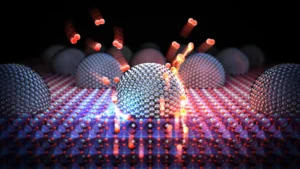
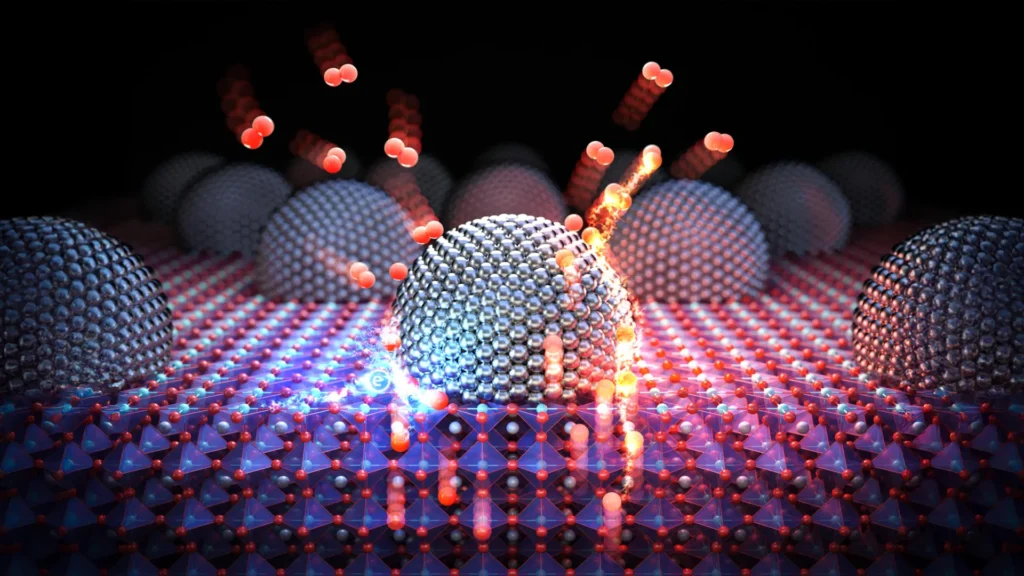
To solve this, the SNU-led team developed a sophisticated "model electrode" system. Instead of using a traditional porous electrode, they fabricated a dense, thin-film perovskite oxide electrode and utilized advanced nanolithography and self-assembly techniques to deposit silver nanoparticles with uniform size and precise spacing. This controlled environment allowed the researchers to isolate variables and quantitatively measure how changes in catalyst surface area and interface length affected reaction rates.
The Discovery: A Shift in Catalytic Reaction Sites
The team’s investigation into various metals—including silver (Ag), cobalt (Co), palladium (Pd), and platinum (Pt)—revealed that silver provided the most significant boost to catalytic performance. More importantly, the experiments revealed a surprising "spatial switch" in silver’s catalytic role.
Electricity Generation (Oxygen Reduction Reaction)
During the electricity generation phase, the researchers observed that the reaction rate was directly proportional to the length of the boundary where the silver nanoparticles touched the perovskite electrode. This indicates that in SOFC mode, the interface acts as the "hot spot" for activity. The silver nanoparticles facilitate the transfer of electrons to oxygen molecules at this specific junction, accelerating their reduction into oxygen ions that then migrate through the solid electrolyte.
Hydrogen Production (Oxygen Evolution Reaction)
Conversely, when the device was switched to hydrogen production mode, the data told a different story. The reaction rate no longer correlated with the interface length; instead, it scaled with the total surface area of the silver nanoparticles. In this OER mode, the silver surface itself becomes the primary site where oxygen ions are oxidized and combined to form oxygen gas. The silver acts as a mediator that lowers the energy barrier for oxygen atoms to pair up and be released from the electrode surface.
Advanced Analytical Techniques and Atomic Insights
The researchers did not rely solely on macroscopic electrochemical measurements. To confirm their findings at the atomic level, they utilized synchrotron-based Ambient Pressure X-ray Photoelectron Spectroscopy (AP-XPS) at the Pohang Accelerator Laboratory (PAL). This high-tech analysis allowed the team to observe the chemical and electronic states of the electrode surface in real-time under actual operating conditions.
Combined with density functional theory (DFT) calculations—a form of atomic-scale modeling—the results showed that silver alters the electronic structure of the perovskite surface. In the reduction mode, the presence of silver creates an electronic environment that favors the adsorption and dissociation of oxygen molecules. In the evolution mode, the silver surface provides a lower-energy pathway for the recombination of oxygen intermediates, a step that is typically the bottleneck in hydrogen production.
Chronology of the Research and Institutional Support
The journey to this discovery began several years ago as part of a broader South Korean initiative to lead the global hydrogen economy. The research was supported by the Ministry of Science and ICT and the National Research Foundation of Korea through several high-priority grants (RS-2024-00452853 and RS-2025-00521316).
The timeline of the project highlights the interdisciplinary nature of modern energy research:
- Phase 1 (2021-2022): Development of the model electrode platform and initial screening of various metal catalysts.
- Phase 2 (2022-2023): Precise measurement of reaction kinetics and identification of the silver "switch" phenomenon.
- Phase 3 (2023-2024): Synchrotron analysis and theoretical modeling to confirm the underlying atomic mechanisms.
- Final Publication (2024): The work was featured as the Outside Back Cover of Energy & Environmental Science, signaling its high impact on the scientific community.
Expert Reactions and Future Applications
Professor WooChul Jung emphasized that this research moves beyond the simple "more is better" philosophy of catalyst application. "This research is significant because it quantitatively evaluates the performance of nanocatalysts while also identifying their actual reaction sites and operating mechanisms," Jung stated. "We plan to further establish this as a new design principle that can be applied to various energy conversion materials and catalytic systems."
Dr. Jinwook Kim, the lead author of the study, noted that the implications extend to the practical manufacturing of energy devices. By understanding that the interface is key for fuel cells and the surface is key for electrolyzers, manufacturers can tailor the morphology of the catalysts—such as using flatter, spread-out particles for SOFCs and more spherical, high-surface-area particles for SOECs.
Dr. Kim, who is transitioning from a postdoctoral role at Northwestern University to an assistant professorship at the University of Seoul, intends to expand this research into other "reversible" energy systems. Reversible solid oxide cells (R-SOCs) are particularly promising as they can act as a battery of sorts—storing excess renewable energy as hydrogen during the day and burning that hydrogen to provide electricity at night.
Broader Economic and Environmental Implications
The findings arrive at a critical moment for the global energy transition. As countries strive to meet Net Zero targets by 2050, the demand for "green hydrogen"—hydrogen produced without carbon emissions—is expected to skyrocket. Currently, the high cost of electricity and the inefficiency of electrolysis remain major barriers. By improving the OER kinetics through optimized silver nanocatalysts, the amount of electricity required to produce a kilogram of hydrogen can be reduced, making green hydrogen more competitive with fossil-fuel-based alternatives.
Furthermore, the advancement of distributed power systems using SOFCs could revolutionize urban planning. If buildings can generate their own electricity and heat more efficiently using these optimized cells, it reduces the load on national power grids and increases energy security.
A Platform for Future Innovation
Beyond silver and solid oxide cells, the model electrode platform developed by the SNU/KAIST/KBSI team serves as a powerful tool for the broader scientific community. It can be used to study other types of catalysts, such as those used in CO2 reduction, ammonia synthesis, and advanced battery technologies. By providing a way to "see" where reactions happen in a controlled manner, this research platform is likely to accelerate the development of a wide range of electrochemical technologies necessary for a cleaner future.
The study concludes that the future of energy catalysis lies in "dynamic optimization"—the recognition that a material’s role can and will change depending on the electrochemical environment. As this principle is integrated into industrial manufacturing, the efficiency of clean energy production is poised for a significant leap forward.