Astronomers utilizing the James Webb Space Telescope (JWST) have identified a celestial phenomenon that challenges the existing understanding of the early universe: the "black hole star." Led by Rohan Naidu, a NASA Hubble Fellow and Pappalardo Fellow at the MIT Kavli Institute for Astrophysics and Space Research (MKI), a team of researchers has provided a compelling explanation for the mysterious "little red dots" that have populated JWST’s deep-space imagery since its deployment. These objects, which appear as tiny, crimson pinpricks in the distant cosmos, are now believed to be massive black holes enshrouded in gargantuan envelopes of hydrogen gas, creating a hybrid structure that mimics the appearance of a star but possesses the power of a quasar.
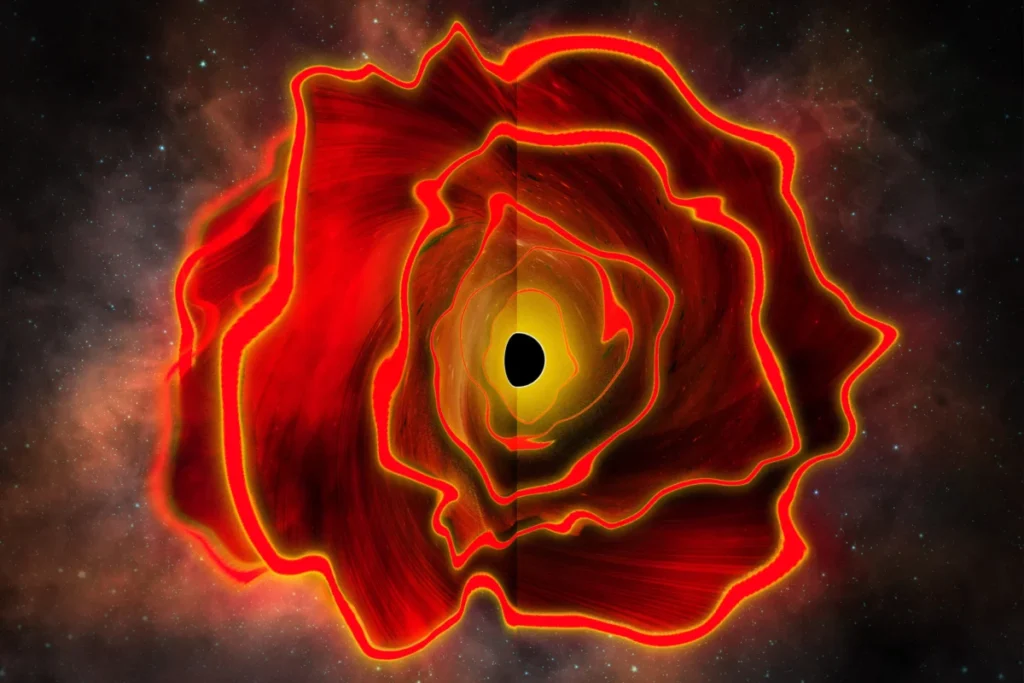
The discovery centers on an object designated MoM-BH*-1, a source so bright and unusual that it has forced a re-evaluation of how the first structures in the universe formed. According to the study, this object contains a central black hole approximately 100,000 times as massive as the sun. Surrounding this gravitational powerhouse is an extended envelope of gas roughly the size of our entire solar system. This "stellar atmosphere," while resembling a star in its spectral signatures, is powered not by nuclear fusion but by the intense energy released as the central black hole consumes surrounding matter.
The Mirage or Miracle Survey: A Search for the First Galaxies
The identification of MoM-BH*-1 was an unexpected outcome of the "Mirage or Miracle" (MoM) survey. The primary objective of the MoM team was to locate the most distant and earliest galaxies in existence, dating back to a period just a few hundred million years after the Big Bang. During this epoch, the first stars were beginning to illuminate the darkness of the early universe, and the first galactic structures were coalescing from primordial gas.
Since the JWST began transmitting data, astronomers have been puzzled by the prevalence of extremely bright galaxies appearing much earlier in cosmic history than theoretical models predicted. These "miracle" galaxies seemed to possess stellar masses and luminosities that defied the standard timeline of cosmic evolution. Rohan Naidu and his colleagues sought to determine if these observations were truly indicative of massive early galaxies or if they were "mirages"—astrophysical phenomena that mimic the appearance of large galaxies while being something else entirely.
While scanning JWST images for potential targets, the team noticed a specific feature: a dot that was exceptionally red and remarkably bright. In the context of infrared astronomy, redness often suggests extreme distance or the presence of obscuring dust. However, the data from MoM-BH*-1 suggested a more complex reality.
Deciphering the Spectral Signature of the Red Dot
To understand the nature of the red dot, the researchers analyzed its light spectrum. In astronomy, the color of an object is often a byproduct of "redshift"—the stretching of light waves as the universe expands—or "extinction," where dust particles scatter blue light and allow only redder wavelengths to pass through. Robert Simcoe, the MKI Director and Bruno B. Rossi Professor of Experimental Physics at MIT, noted that the initial assumption was that the object was shrouded in cosmic dust, similar to how wildfire smoke can turn the sun a deep crimson.
However, the spectral data did not align with the characteristics of dust-reddened light. Instead, the team observed a "Balmer break," a sharp drop-off in light intensity below certain wavelengths. This signature is typically found in the atmospheres of stars like Vega, where dense hydrogen gas absorbs specific photons. The Balmer break observed in MoM-BH*-1 was the deepest ever recorded in any astronomical object, which initially suggested the presence of an incredibly dense stellar atmosphere.
Furthermore, the chemical composition of the object appeared remarkably pure. The light contained almost no traces of "metals"—a term astronomers use for any element heavier than hydrogen and helium. This lack of heavy elements is a hallmark of the very early universe, before generations of stars had lived and died, seeding the cosmos with carbon, oxygen, and iron.
The Physics of a Black Hole Star
The contradiction between the object’s stellar-like spectrum and its extreme luminosity led the team to employ advanced computer simulations. They sought to determine if a structure composed purely of hydrogen and helium, without the presence of dust, could produce such a deep red color and a profound Balmer break.
The simulations confirmed that an extremely dense screen of hydrogen could indeed produce these effects. However, the sheer brightness of the object presented a new problem. MoM-BH*-1 is approximately 100 billion times brighter than a standard star. At such scales, nuclear fusion—the process that powers the sun and other stars—is insufficient to explain the energy output.
The only known mechanism capable of generating such vast amounts of energy in a compact space is the accretion of matter onto a supermassive black hole. By incorporating an active black hole into their models, the researchers found a perfect match for the JWST data. The resulting model describes a "black hole star": a central black hole of 100,000 solar masses surrounded by a cocoon of hydrogen gas. This cocoon is so dense that it behaves like a stellar surface, absorbing the high-energy radiation from the black hole and re-emitting it as the bright, red light observed by the telescope.
Solving the Little Red Dot Mystery
The discovery of MoM-BH*-1 provides a potential solution to one of the most debated topics of the JWST era. Since the telescope’s launch, "little red dots" have appeared in nearly every deep-field image, sparking intense discussion among cosmologists. These dots were initially theorized to be either very small, dense galaxies or distant quasars obscured by dust.
The MIT-led study suggests that many, if not all, of these little red dots could be black hole stars. While MoM-BH*-1 is unique because it is bright enough to completely outshine its host galaxy, other red dots may represent similar black hole-cocoon structures embedded within early galactic environments.
"Every little red dot is consistent with being a black hole star," Naidu explained. This finding suggests that the early universe was populated by these hybrid objects, which have since disappeared in the modern cosmic era. The transition from these "black hole stars" to the conventional supermassive black holes found at the centers of modern galaxies represents a critical, previously missing link in the history of cosmic structure.
Chronology of the Discovery and Research
The timeline of this discovery reflects the rapid pace of modern infrared astronomy:
- December 2021: The James Webb Space Telescope is launched, equipped with the Near-Infrared Camera (NIRCam) and Near-Infrared Spectrograph (NIRSpec).
- July 2022: First images are released, revealing the first "little red dots" in deep-field surveys like SMACS 0723.
- 2023: The "Mirage or Miracle" (MoM) survey is initiated by Rohan Naidu and his team to investigate whether early bright galaxies are as massive as they appear.
- Late 2023: MoM-BH*-1 is identified as a primary candidate for detailed spectral analysis due to its extreme brightness and unusual redness.
- 2024: Simulations are conducted at MIT and collaborating institutions to model the "black hole star" hypothesis. The team concludes that the object is a 100,000-solar-mass black hole within a solar-system-sized hydrogen envelope.
- Present: The findings are published, offering a new framework for understanding the early growth of black holes and the nature of the first luminous objects.
Supporting Data and Technical Specifications
The research relies on several key data points that differentiate MoM-BH*-1 from other known astronomical bodies:
- Mass Ratio: The central black hole’s mass (100,000 suns) is massive for the early universe but small compared to modern supermassive black holes like Sagittarius A*.
- Luminosity: At 100 billion times the brightness of the sun, the energy output suggests an accretion rate that is near the "Eddington limit," the theoretical maximum at which a black hole can consume matter before the outward pressure of light halts the inflow.
- Size: The hydrogen envelope’s radius is estimated to be comparable to the distance from the sun to the outer reaches of our solar system (the Kuiper Belt or Oort Cloud), making it vastly larger than any known conventional star.
- Spectral Range: The Balmer break observed occurs at a wavelength consistent with high-redshift hydrogen, confirming the object’s existence in the very early universe.
Broader Impact and Implications for Cosmology
The implications of the "black hole star" discovery are profound. For decades, cosmologists have struggled with the "seed" problem: how supermassive black holes at the centers of galaxies grew so large so quickly after the Big Bang. If black holes began their lives enshrouded in massive hydrogen cocoons, as MoM-BH*-1 suggests, it could indicate a period of rapid, "obscured" growth that allowed them to bypass traditional limits on accretion.
Furthermore, this discovery suggests that some of the "miracle" galaxies discovered by JWST may not be galaxies at all. If a significant portion of the light from these early sources is coming from black hole stars rather than billions of individual stars, then the calculated stellar masses of early galaxies may need to be revised downward. This would bring observations back into alignment with standard cosmological models, resolving the tension between JWST data and the Cold Dark Matter (Lambda-CDM) theory.
The research also highlights the unique capabilities of the JWST. By observing in the mid-to-near infrared, the telescope can peer through the gas of the early universe to see objects that were previously invisible to the Hubble Space Telescope. As more "little red dots" are analyzed, the scientific community expects to find a diverse population of these objects, each providing a snapshot of the chaotic and energetic conditions of the infant universe.
This research was supported by the MIT Department of Physics, NASA, and the Space Telescope Science Institute. The collaboration included MIT co-authors Wendy Sun and Robert Simcoe, along with researchers from multiple international institutions, marking a significant milestone in the ongoing mission to map the origins of our universe.