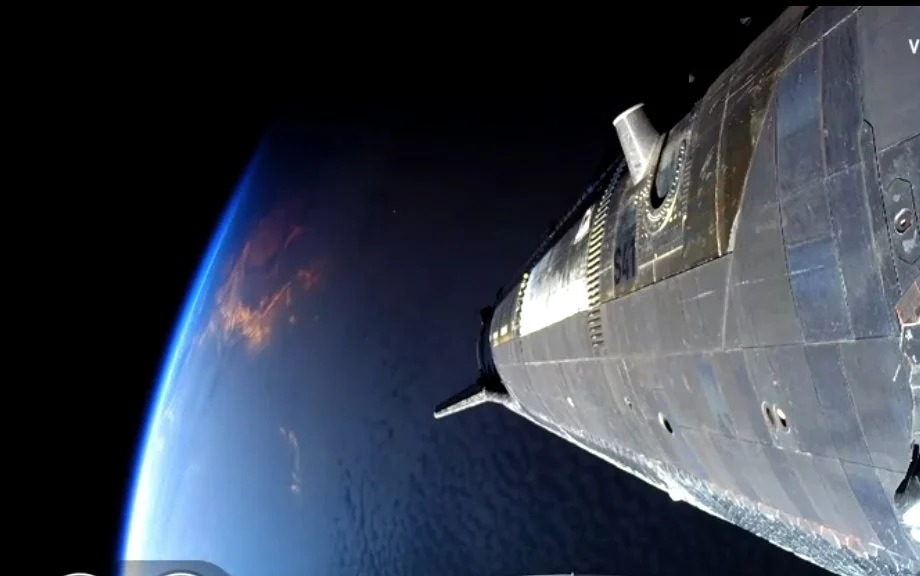
The monumental SpaceX Starship rocket successfully completed its first-ever orbital flight and achieved its longest mission to date on Monday, culminating in a controlled splashdown near Hawaii at 10:58 a.m. Central Time. This significant milestone, designated as Flight 14, marks a pivotal step in the development of the reusable super heavy-lift launch vehicle, demonstrating its capability to reach Earth orbit and deploy vital payload.
The ambitious approximately three-hour mission commenced from SpaceX’s Starbase facility in Boca Chica, Texas, at 7:48 a.m. Central Time. The powerful Super Heavy booster, the first stage of the Starship system, executed its planned separation and splashdown in the Gulf of Mexico just seven minutes into the flight. Meanwhile, the Starship upper stage, powered by its advanced Raptor engines, continued its ascent into orbit. A key objective of this phase was the successful deployment of the first batch of V3 Starlink satellites, designed to enhance SpaceX’s global broadband constellation.
"This was a pretty cool milestone," stated Dan Huot, SpaceX Communications Manager, during the company’s livestream of the event. "Starship’s first orbital flight, the first of many." Huot’s assessment underscores the profound significance of Flight 14, positioning it as a foundational success for the future of Starship development.
While the initial mission plan envisioned a 10-hour flight duration, mission parameters were adjusted following an earlier-than-anticipated shutdown of one of the Raptor Vacuum engines on the upper stage. This anomaly prompted mission controllers to re-evaluate the flight profile. Although a suborbital trajectory was briefly considered, the decision was ultimately made to proceed with an orbital insertion and the deployment of the Starlink satellites. This strategic choice was informed by a thorough assessment of the health and performance of the remaining engines, particularly the three center sea-level engines crucial for both orbital insertion and the deorbit burn.
"We looked at all indicators of health on those remaining engines," Huot explained, emphasizing the meticulous evaluation undertaken by the mission control team. "Particularly the three center sea-level engines that we need for the orbital insertion burn and for the deorbit burn." This detailed scrutiny ensured that the flight could proceed with the highest probability of success for its primary objectives.
Prior to Flight 14, SpaceX had conducted 13 suborbital flights of integrated Starships, a deliberate strategy aimed at maximizing public safety while simultaneously gathering extensive data on the new design. According to the company’s mission description for Flight 14, these earlier flights were crucial for "allowing for maximum learning" about the complex systems of Starship. The overarching goals for Flight 14 extended beyond reaching orbit and deploying satellites. They also included a critical deorbit burn utilizing a single Raptor engine while in space, followed by a meticulously controlled reentry, descent, and splashdown in the Pacific Ocean.
The duration of previous integrated Starship flights had been capped at approximately 65 minutes. The achievement of orbital velocity in Flight 14 signifies a critical transition, enabling "the next phase of developing Starship to be fully and rapidly reusable," according to a statement released by SpaceX. This shift from suborbital hops to orbital capabilities is fundamental to the long-term vision for Starship.
SpaceX’s published flight plan indicated an intention to reach an altitude of approximately 275 kilometers above Earth. Telemetry data displayed on the livestream confirmed that the Starship upper stage successfully achieved this target altitude, validating the accuracy of the mission planning and execution.
The deployment of the 26 Starlink satellites was also described as "wildly successful" by Huot. He further confirmed that the newly deployed satellites were transmitting as planned, indicating their immediate integration into the operational constellation and their readiness to contribute to global internet coverage.
Strategic Importance and Future Applications
The success of Starship Flight 14 carries profound implications for both SpaceX’s commercial ambitions and its critical partnerships with government agencies. Notably, SpaceX holds significant NASA contracts totaling $2.9 billion, specifically for the development of Starship lunar lander variants. These landers are slated to play a pivotal role in NASA’s Artemis program, aiming to return astronauts to the Moon starting in 2028. The ability of Starship to reliably reach orbit and deploy significant payloads is a prerequisite for these lunar missions.
Beyond its lunar aspirations, Starship is central to SpaceX’s strategy for expanding its Starlink broadband constellation. The V3 Starlink satellites deployed on Flight 14 are a significant upgrade, offering "10x the capacity compared to a single launch of V2 mini Starlink satellites on Falcon 9," as highlighted by the company. This substantial increase in capacity will enable Starlink to serve more users with higher bandwidth, particularly in underserved regions globally.
Advanced In-Flight Data Collection
A particularly innovative aspect of Flight 14 involved the inclusion of advanced diagnostic capabilities within the deployed Starlink satellites. Three of the newly launched satellites are equipped with specialized cameras designed to "scan Starship’s heatshield." This data collection is crucial for engineers to meticulously assess the performance of the heatshield during atmospheric reentry. The objective is to identify areas for potential improvements in future missions, with a specific focus on tiles featuring new designs, such as novel attachment mechanisms. Additionally, engineers are keenly interested in evaluating the performance of curved tiles, which are intended "to reduce heating in gaps between tiles," as detailed in the mission description. This detailed analysis of reentry dynamics will be instrumental in refining Starship’s design for increased durability and reusability.
Chronology of Flight 14
- 7:48 a.m. Central Time: Starship Flight 14 lifts off from SpaceX’s Starbase facility in Boca Chica, Texas.
- Approximately 7:55 a.m. Central Time: The Super Heavy booster separates and successfully splashes down in the Gulf of Mexico.
- Subsequent Ascent: The Starship upper stage continues its journey into Earth orbit.
- Engine Anomaly: One Raptor Vacuum engine on the upper stage shuts down earlier than anticipated.
- Mission Re-evaluation: Mission controllers assess flight options, considering both suborbital and orbital trajectories.
- Decision to Orbit: The decision is made to proceed with an orbital insertion and satellite deployment, based on engine health assessments.
- Orbital Insertion: Starship successfully achieves Earth orbit, reaching an altitude of approximately 275 kilometers.
- Starlink Deployment: 26 V3 Starlink satellites are successfully deployed into orbit.
- Deorbit Burn: A deorbit burn is initiated using a single Raptor engine.
- Controlled Reentry and Splashdown: Starship undergoes a controlled reentry and descent, culminating in a splashdown near Hawaii at 10:58 a.m. Central Time.
Supporting Data and Milestones
- Flight Duration: Approximately 3 hours, the longest flight for the Starship program to date.
- Orbital Altitude Achieved: Approximately 275 kilometers.
- Payload Deployed: 26 V3 Starlink satellites.
- Previous Suborbital Flights: 13 integrated Starship flights conducted since 2023, with durations up to 65 minutes.
- Engine Configuration: Starship upper stage equipped with Raptor Vacuum engines for orbital operations.
- V3 Starlink Capacity: 10 times greater than V2 mini Starlink satellites launched on Falcon 9.
- NASA Contracts: $2.9 billion for lunar lander variants.
Analysis of Implications
The successful orbital flight of Starship Flight 14 represents a significant leap forward for SpaceX and the broader space industry. The demonstration of orbital capability is a critical precursor to a wide range of future applications, including large-scale satellite constellation deployment, interplanetary missions, and, crucially, human spaceflight. The ability to deploy Starlink satellites with significantly enhanced capacity directly addresses the growing demand for global internet access and strengthens SpaceX’s market position.
Furthermore, the data gathered from the reentry phase, particularly regarding heatshield performance, will be invaluable for refining the design of Starship, moving it closer to its goal of rapid and full reusability. This reusability is the cornerstone of SpaceX’s vision to drastically reduce the cost of space access, opening up new possibilities for scientific research, commercial ventures, and exploration. The successful integration of Starship into NASA’s lunar exploration plans further solidifies its strategic importance.
The controlled splashdown, a key objective of the mission, showcases SpaceX’s increasing mastery over the complex dynamics of reentry and descent for such a massive vehicle. While challenges remain, particularly concerning the earlier engine shutdown, the overall success of Flight 14 provides a robust foundation for continued development and testing. The company’s iterative approach, prioritizing learning and safety, continues to yield tangible progress towards its ambitious long-term goals. The future of space transportation appears increasingly shaped by the capabilities demonstrated by Starship.