In a landmark achievement for the field of condensed matter physics and materials science, a collaborative research team in Japan has successfully observed a nearly instantaneous electronic transformation within a metal-organic framework (MOF). The researchers, representing the Institute of Science Tokyo (Science Tokyo), Tohoku University, and the Nagoya Institute of Technology, utilized cutting-edge ultrafast laser spectroscopy to witness a transition that occurs within a mere 30 femtoseconds—a timeframe so brief it represents a millionth of a billionth of a second. This discovery, which identifies a previously unknown "intermediate" electronic state, provides a fundamental blueprint for the future of light-controlled materials and high-speed optoelectronic devices.
The study, recently published in the prestigious journal Physical Review Letters, centers on the phenomenon of "photoinduced states." Under normal conditions, materials exist in equilibrium, dictated by variables such as temperature and pressure. However, when bombarded with specific wavelengths of light, certain materials can be "pushed" into hidden states that possess entirely different physical, optical, or electrical properties. Capturing the birth of these states has long been a "holy grail" for scientists, as the initial triggers of these transformations occur at speeds that surpass the capture capabilities of conventional instrumentation.
The Mechanics of Ultrafast Observation
To capture a process occurring at 30 femtoseconds (fs), the research team had to develop an experimental setup capable of even higher resolution. Led by Assistant Professor Tadahiko Ishikawa from the Department of Chemistry at Science Tokyo, the group employed time-resolved reflectance spectroscopy using ultrashort laser pulses. These pulses lasted only six femtoseconds, providing the "shutter speed" necessary to freeze the motion of electrons and atoms in real-time.
The material under investigation was a specific type of metal-organic framework. MOFs are a class of crystalline materials composed of metal ions or clusters coordinated to organic ligands to form one-, two-, or three-dimensional structures. They are highly prized in chemistry for their porosity and versatility, often used for gas storage, carbon capture, and catalysis. However, their potential in electronics—specifically how their electronic structures react to light—remains an expanding frontier.
By measuring the reflectance spectrum of the MOF immediately after it absorbed a laser pulse, the team could track how the material’s ability to interact with light evolved. Within the first 30 fs, the researchers noted a dramatic shift in the spectrum, signaling the emergence of a new optical absorption band. This was the signature of a "hidden state"—a phase of matter that does not exist under standard thermal conditions but can be "unlocked" through light-matter interaction.
The Chronology of a 30-Femtosecond Transformation
The breakthrough of the study lies not just in seeing the final hidden state, but in identifying the sequence of events that leads to its formation. Through a combination of experimental data and complex theoretical calculations, the researchers reconstructed a chronological timeline of the transformation:
- Pulse Absorption (0–6 fs): The MOF is struck by an ultrashort laser pulse, injecting energy into the electronic system and exciting the electrons from their ground state.
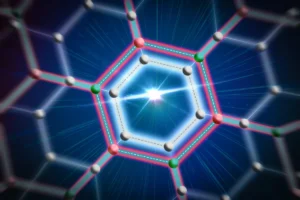
- The Intermediate Bond-Order Wave (6–20 fs): Before the atoms themselves have time to move significantly, the electrons undergo a redistribution. The team discovered an intermediate electronic state characterized by a "bond-order wave." In this state, the electronic bonds between neighboring sites in the framework alternate between stronger and weaker configurations in a repeating spatial pattern.
- Structural Relaxation (20–30 fs): The internal electronic pressure from the bond-order wave begins to push on the nuclei of the atoms. Small displacements in atomic positions occur, stabilizing the system.
- The Hidden State (30 fs and beyond): The combination of electronic redistribution and atomic shifting culminates in the "photoinduced hidden state."
The discovery of the bond-order wave as a precursor is significant because it suggests that the electronic "software" of the material changes before the physical "hardware" (the atoms) has a chance to respond. This suggests that the speed of such transformations is limited primarily by electronic dynamics rather than the slower movement of heavy atomic nuclei.
Theoretical Synergy and Data Validation
The experimental findings were validated through a robust partnership with theoretical physicists. While the laser spectroscopy provided the "visual" evidence of change, the underlying physics were clarified by Samiran Banu (a doctoral student at the time, now at RIKEN) and collaborators from Tohoku University and the Nagoya Institute of Technology.
Theoretical modeling indicated that the hidden state formed at the 30-fs mark possesses polar characteristics. In a polar state, positive and negative electrical charges are distributed asymmetrically across the material’s structure. This is a critical finding for the development of future technologies; if a material can be toggled between non-polar and polar states using light in less than a trillionth of a second, it could serve as the basis for ultrafast optical switches or next-generation memory storage devices that operate at petahertz (PHz) frequencies—thousands of times faster than current gigahertz (GHz) processors.
Implications for Material Science and Optoelectronics
The ability to manipulate material properties with light, known as "optical control of matter," is a burgeoning field with the potential to revolutionize how we build computers and sensors. Historically, changing a material’s state required thermal intervention (heating or cooling) or the application of external magnetic or electric fields. These methods are inherently limited by the speed at which heat can dissipate or fields can be cycled.
Light-induced transformations, however, offer a shortcut. By bypassing the need for thermal equilibrium, scientists can create "transient phases" that have properties like superconductivity, ferroelectricity, or magnetism, which might only last for a fraction of a second but are sufficient for processing information.
"By revealing these intermediate states, our method could help design materials that can be efficiently controlled using light," explained Assistant Professor Ishikawa. The research suggests that by "tuning" the organic molecules or metal ions within a MOF, scientists might be able to customize the intermediate states, effectively choosing which hidden state the material will settle into.
Broader Context: The Race for Femtosecond Control
The Japanese team’s work sits within a broader global context of "ultrafast science." For decades, researchers have been pushing the boundaries of time resolution. The 1999 Nobel Prize in Chemistry was awarded to Ahmed Zewail for showing that it was possible to see atoms in a molecule move during a chemical reaction using femtosecond spectroscopy.
The current research takes this a step further by focusing on the collective behavior of electrons in complex, solid-state frameworks. Unlike simple molecules, MOFs involve vast networks of interacting particles. Observing a coherent electronic transformation across such a structure in 30 fs is a testament to the precision of modern Japanese laser engineering.
Industry experts suggest that the "hidden states" described in this study could eventually lead to:
- Optical Computing: Using light pulses instead of electricity to perform logic operations, drastically reducing heat and increasing speed.
- Smart Sensors: Materials that change color or conductivity instantly upon exposure to specific light frequencies.
- Energy Harvesting: More efficient solar cells that can capture and convert energy through intermediate electronic states before energy is lost as heat.
Future Research Trajectories
While the current study focused on a specific metal-organic framework, the methodology—combining 6-fs laser pulses with advanced theoretical calculations—is applicable to a wide array of materials. The research team plans to extend this approach to explore other classes of advanced materials, such as strongly correlated electron systems and two-dimensional van der Waals materials.
One of the primary goals of future research will be to determine how to extend the lifetime of these "hidden states." Currently, while the states form in 30 fs, they often decay quickly as the energy dissipates. Finding ways to "lock" these states for longer periods, or to toggle them on and off with high repetition rates, will be the next hurdle in moving this from a laboratory curiosity to a functional technology.
The collaboration between Science Tokyo, Tohoku University, and the Nagoya Institute of Technology highlights the strength of the Japanese academic ecosystem in the physical sciences. By pooling resources in spectroscopy, material synthesis, and quantum theory, the institutions have provided a rare glimpse into the "shutter-speed" limit of chemical and physical change.
As the scientific community continues to digest these findings, the 30-femtosecond threshold stands as a new benchmark in our understanding of the relationship between light and matter. The discovery of the bond-order wave intermediate state ensures that the path toward light-driven technology is no longer hidden, but increasingly clear.