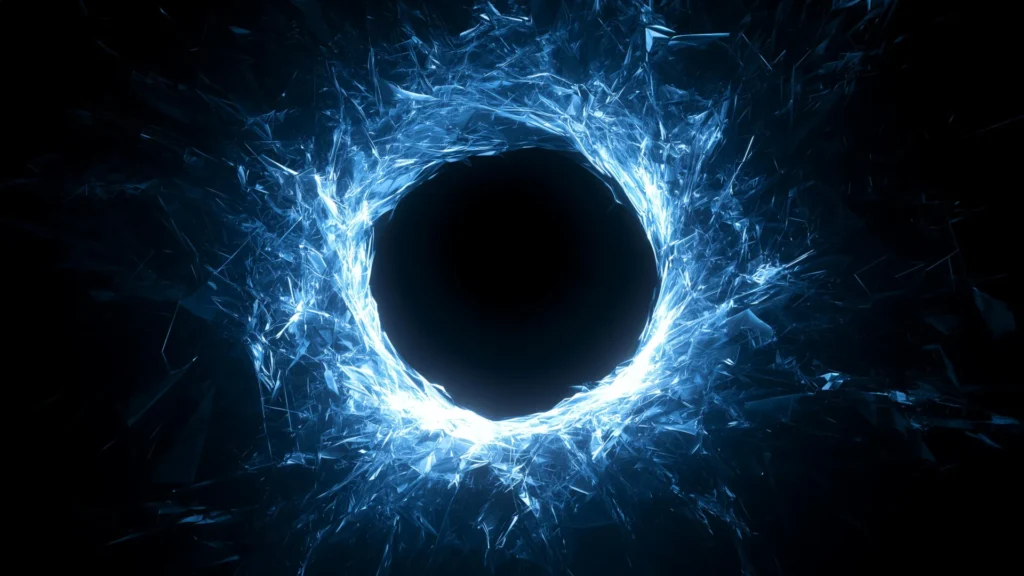
The boundaries of modern physics have long suggested that black holes are not exclusively the domain of massive, dying stars or the centers of sprawling galaxies. While the most recognizable black holes are millions or even billions of times the mass of our sun, the fundamental laws of General Relativity allow for the existence of microscopic black holes—objects so small they could theoretically fit within the palm of a human hand, yet possess the density required to warp spacetime into an inescapable abyss. Until recently, the precise mathematical description of how these tiny entities form remained one of the most elusive challenges in theoretical physics. Researchers from Goethe University Frankfurt and TU Wien have now announced a significant breakthrough, deriving an exact formula for the process known as "critical collapse" by utilizing a radical mathematical approach involving infinite dimensions.
This discovery provides a long-sought analytical framework for a phenomenon that was previously only observable through complex computer simulations. By demonstrating how spacetime can organize itself into a repeating, crystal-like pattern before collapsing into a black hole, the research team has opened a new window into the early universe and the fundamental nature of gravity itself.
The Mathematical Bridge to the Infinitesimal
At the heart of this research is the concept of critical collapse. In the standard model of stellar evolution, a black hole forms when a massive star exhausts its nuclear fuel and collapses under its own gravity. However, in the chaotic environment of the early universe—seconds after the Big Bang—energy and matter were distributed in high-density fluctuations. Under these conditions, even a modest concentration of energy could reach a "critical state."
In this state, the system exists on a knife-edge. A microscopic fluctuation in energy determines whether the matter will simply disperse back into the void or condense into a primordial black hole. This threshold behavior is analogous to phase transitions in chemistry, such as the point at which liquid water turns to ice. While physicists have understood the qualitative aspects of this transition for decades, the non-linear nature of Albert Einstein’s field equations made it nearly impossible to calculate the exact point of collapse without the aid of supercomputers.
The new formula derived by the Frankfurt and Vienna teams changes this paradigm. By moving beyond traditional four-dimensional calculations, the researchers found a way to simplify the underlying mathematics, allowing them to describe the birth of a black hole with "paper and pencil" precision.
Deciphering Critical Collapse: The Threshold of Spacetime
To understand the significance of this breakthrough, one must look at the sensitivity of spacetime at the critical limit. Prof. Daniel Grumiller from TU Wien describes this phenomenon using the analogy of a phase transition. When water reaches zero degrees Celsius, it does not necessarily freeze instantly; it requires a specific trigger to begin the transition into a regular, repeating molecular pattern—an ice crystal.
In the context of gravity, spacetime behaves in a conceptually similar manner. Einstein’s theory dictates that mass and energy curve the geometry of the universe. Under "normal" circumstances, this curvature is stable. However, when energy is compressed into a sufficiently small volume, the curvature becomes extreme. At the critical point of collapse, spacetime undergoes a structural transformation.
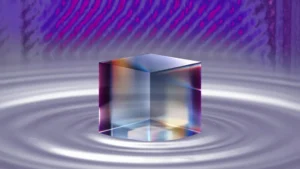
"Sometimes a tiny, seemingly insignificant cause is enough to trigger a huge and dramatic change," says Prof. Grumiller. The researchers found that just before a black hole forms, spacetime can arrange itself into what they call a "spacetime crystal." This is not a crystal in the traditional sense of solid matter, but rather a periodic, repeating configuration of the curvature of space and time itself. This state is inherently unstable; it represents a cosmic crossroads. If the energy density is just below the limit, the crystal dissolves, and spacetime returns to its flat, vacuum state. If the limit is exceeded by even a fraction, the crystal collapses, and a black hole is born.
From 1993 to Today: The Thirty-Year Mathematical Quest
The journey toward this discovery began in 1993, when physicist Matthew Choptuik used high-powered computer simulations to study the collapse of scalar fields. Choptuik discovered that the formation of black holes at the threshold of collapse exhibited "universality" and "self-similarity." He found that regardless of the initial conditions, the resulting black holes followed a predictable power law—now known as Choptuik scaling.
For thirty years, this remained a "numerical" discovery. Physicists could see it happening on their monitors, but they could not explain it through pure mathematical derivation. The equations of General Relativity are a set of ten interlinked differential equations that are notoriously difficult to solve in four dimensions (three of space, one of time) because every change in mass affects the geometry, which in turn affects how the mass moves.
The breakthrough by Christian Ecker, Florian Ecker, and Daniel Grumiller involved a clever "mathematical detour." Instead of struggling with the complexities of four-dimensional spacetime, they expanded the problem into a hypothetical universe with an infinite number of dimensions.
The Infinite Dimension Shortcut: Simplifying the Incalculable
The concept of using extra dimensions to solve physics problems is not new—string theory famously utilizes ten or eleven dimensions—but the "infinite dimension" approach is a specific mathematical tool used to filter out noise. In a universe with infinite dimensions, the gravitational interactions become more "localized" and symmetrical. Many of the complex, non-linear variables that make four-dimensional physics so difficult effectively drop out of the equation or become constants.
"Our universe has four dimensions," explains Christian Ecker of the Institute for Theoretical Physics at Goethe University Frankfurt. "But in principle, nothing prevents us from writing down physical equations for a larger number of dimensions… Surprisingly, the opposite can happen: calculations become much easier when the number of dimensions approaches infinity."
By solving the problem of critical collapse in this infinite-dimensional setting, the team was able to derive an exact analytical formula. They then used a technique known as "1/D expansion" to map that solution back down to the four dimensions of our reality. This method acts as a systematic approximation, where the infinite-dimensional solution serves as a rock-solid foundation that can be refined to match our universe’s specific conditions.
Primordial Black Holes and the Dark Matter Connection
The implications of being able to mathematically define microscopic black hole formation extend far beyond theoretical curiosity. One of the greatest mysteries in modern astronomy is the nature of Dark Matter—the invisible substance that makes up roughly 85% of the matter in the universe.
Many scientists hypothesize that Dark Matter could be composed of "primordial black holes" (PBHs). These are black holes that were not formed by stars but were created during the high-energy fluctuations of the early universe, just moments after the Big Bang. Because these black holes could be microscopic, they would be incredibly difficult to detect through traditional light-based telescopes, yet they would exert the gravitational pull necessary to hold galaxies together.
By providing a precise formula for how these black holes form during critical collapse, the Frankfurt and Vienna researchers have given cosmologists a tool to calculate how many PBHs might have been produced in the early universe. If the "critical state" required to form a spacetime crystal was common in the early cosmos, it could mean the universe is teeming with tiny, ancient black holes that account for the missing mass we attribute to Dark Matter.
Collaborative Innovation and Future Research
The study, which bridges the gap between numerical relativity and analytical mathematical physics, represents a major milestone for the European physics community. The collaboration between Goethe University Frankfurt and TU Wien demonstrates how interdisciplinary approaches—combining high-level geometry with traditional gravitational theory—can solve problems that have remained stagnant for decades.
Florian Ecker of TU Wien noted that the technique is remarkably stable. "Depending on the desired precision, we can systematically improve our formulas using additional approximation methods," he stated. This means that the formula is not a "dead end" but a living mathematical framework that can be applied to other extreme gravitational phenomena, such as the merging of neutron stars or the behavior of spacetime near a singularity.
As researchers continue to refine these formulas, the focus will likely shift toward "numerical relativity" teams who can use these analytical insights to create more accurate simulations of the universe’s first moments. The ability to predict the exact energy threshold for black hole formation allows for more rigorous testing of gravitational theories against astronomical data.
A New Era for General Relativity
The derivation of this formula marks a shift in how physicists approach the "extremes" of Einstein’s universe. For over a century, General Relativity has been tested in the "weak-field" limit (like the gravity of Earth or the Sun) and the "strong-field" limit (massive black holes). However, the "critical limit"—the transition point where spacetime itself begins to oscillate and crystalize before collapsing—remained a mathematical "no-man’s-land."
By conquering this middle ground, the researchers have provided the first exact map of the transition from empty space to a black hole. This "spacetime crystal" research not only validates the simulations of the 1990s but also provides a robust theoretical foundation for the next generation of gravitational wave detectors and cosmological surveys.
In the broader context of science, this discovery serves as a reminder that the most complex problems in the universe can sometimes be solved by looking at them from a completely different perspective—even if that perspective requires imagining a universe with an infinite number of dimensions to understand our own four-dimensional home. The microscopic black hole, once a mathematical curiosity, is now a mathematically defined reality, bringing us one step closer to understanding the invisible architecture of the cosmos.