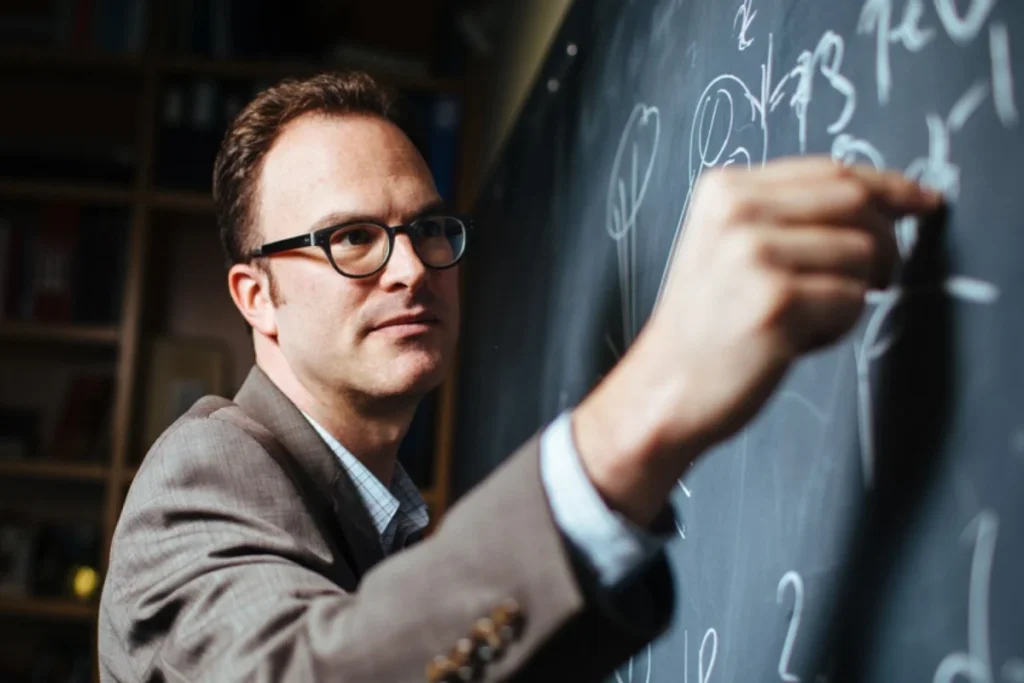
The Massachusetts Institute of Technology has officially appointed Professor Jesse Thaler as the director of the Laboratory for Nuclear Science (LNS), marking a strategic shift in the leadership of one of the world’s most prestigious centers for fundamental physics research. Effective August 1, Thaler succeeds Professor Bolek Wyslouch, who has steered the laboratory through a decade of significant growth and experimental breakthroughs. This transition comes at a pivotal moment for the scientific community, as the integration of artificial intelligence and machine learning begins to redefine the methodologies of theoretical and experimental physics. Thaler, a theoretical particle physicist and a leading figure in the application of AI to fundamental interactions, is expected to bring a multidisciplinary approach to the laboratory, bridging the gap between traditional quantum field theory and modern computational data science.
The Laboratory for Nuclear Science, established in 1946, has long been a cornerstone of MIT’s research infrastructure. Initially founded to capitalize on the rapid advancements in nuclear physics following World War II, the laboratory has evolved into a sprawling enterprise that encompasses research in cosmology, gravity, field theory, and quantum information science. As the new director, Thaler will oversee a diverse portfolio of research initiatives and manage the MIT Center for Theoretical Physics (CTP), which remains a vital component of the LNS ecosystem.
A Career Defined by Interdisciplinary Innovation
Jesse Thaler’s appointment is the culmination of a distinguished career characterized by a unique ability to synthesize disparate fields of study. He currently holds the title of William and Emma Rogers Professor of Physics within the MIT Center for Theoretical Physics—now also known as the Leinweber Institute (CTP-LI). Thaler’s academic foundation was laid at Brown University, where he earned a Bachelor of Science in math and physics in 2002, followed by a PhD in physics from Harvard University in 2006. Before joining the MIT faculty in 2010, he served as a fellow at the Miller Institute for Basic Research in Science at the University of California at Berkeley, a role that allowed him to refine his theories on particle dynamics.
Thaler’s research primary focuses on the "data deluge" generated by high-energy physics experiments. In particular, his pioneering work on particle jets at the Large Hadron Collider (LHC) at CERN has been instrumental in helping physicists distinguish between known phenomena and potential "new physics." Particle jets—sprays of particles produced by the decay of quarks and gluons—are notoriously difficult to analyze due to their complexity. Thaler has been at the forefront of developing "jet substructure" techniques, which use advanced algorithms to peer inside these sprays, allowing researchers to identify the specific particles that triggered the event.
Nergis Mavalvala, the dean of the MIT School of Science and the Curtis and Kathleen Marble Professor of Astrophysics, emphasized the importance of Thaler’s expertise in the current scientific climate. "In his research, Jesse has done pioneering work on particle jets at the Large Hadron Collider and is a leader in combining AI and machine learning with fundamental particle physics," Mavalvala stated. "The collaborative nature of his research programs will serve the Laboratory for Nuclear Science as science enters a new era of AI-driven discovery."
The Strategic Importance of AI in Modern Physics
The appointment of Thaler signals a clear commitment by MIT to remain at the vanguard of the "AI revolution" in the physical sciences. Since 2020, Thaler has served as the inaugural director of the National Science Foundation (NSF) AI Institute for Artificial Intelligence and Fundamental Interactions (IAIFI). This institute, which was recently renewed for another five-year term, serves as a hub for researchers seeking to develop AI tools that are not merely "black boxes," but are instead grounded in the rigorous laws of physics.
The necessity for such tools is driven by the sheer scale of modern experimental data. For instance, the LHC generates petabytes of data annually, far exceeding the capacity of traditional human-led analysis. AI algorithms can process this information at speeds and scales previously unimaginable, identifying patterns that might suggest the existence of dark matter, supersymmetry, or other extensions of the Standard Model of particle physics.
"In my own field of particle physics, researchers are developing cutting-edge AI algorithms to handle the data deluge from collider experiments and to perform heroic theoretical calculations," Thaler noted. He explained that while this work is aimed at discovering new physics, the resulting algorithms often have applications in other fields, such as medical imaging or climate modeling, illustrating the broader societal value of fundamental research.
As Thaler transitions to his new role at LNS, the leadership of IAIFI will be taken over by Mike Williams, a professor of physics at MIT known for his work on the LHCb experiment. This transition ensures a continuity of vision between the AI institute and the Laboratory for Nuclear Science, fostering an environment where computational innovation and experimental physics are deeply intertwined.
A Legacy of Excellence: The Laboratory for Nuclear Science
To understand the weight of Thaler’s new responsibility, one must look at the history and scope of the LNS. For nearly 80 years, the laboratory has been the site of some of the most important discoveries in the history of science. It was here that researchers contributed to the discovery of the quark—the fundamental constituent of matter—and where Nobel Prize-winning work on the J/psi particle was conducted by Samuel Ting in the 1970s.
Under the outgoing director, Bolek Wyslouch, the LNS maintained its status as a global leader in nuclear and particle physics. Wyslouch, who is also a prominent figure in heavy-ion physics at the LHC, oversaw a decade of expansion that saw the laboratory branch out into newer fields like quantum information science and gravitational wave detection. The laboratory now serves as an umbrella for a wide array of experimental groups, including those working on the Alpha Magnetic Spectrometer (AMS) on the International Space Station and various neutrino experiments around the world.
Thaler’s tenure will also involve overseeing the Center for Theoretical Physics (CTP), which recently received a transformative boost. Last year, the Leinweber Foundation made a substantial donation to establish the Leinweber Institute within the CTP, creating a network of theoretical physics research institutes. This gift represents the largest philanthropic commitment ever made to the field of theoretical physics, according to the Science Philanthropy Alliance. This influx of capital will allow Thaler to expand the laboratory’s theoretical reach, providing resources for visiting scholars, workshops, and high-risk, high-reward research projects.
Educational Reform and the Next Generation of Scientists
Beyond research, Thaler has demonstrated a profound commitment to education and the development of early-career scientists. During his time at IAIFI, he was instrumental in creating a new doctoral program in physics, statistics, and data science in collaboration with the MIT Institute for Data, Systems, and Society (IDSS). This program is designed to train a new generation of "bilingual" scientists who are equally proficient in the nuances of quantum field theory and the complexities of neural networks.
Furthermore, IAIFI established dedicated postdoctoral fellowships that allow young researchers the freedom to pursue interdisciplinary work without being tied to a specific experiment or grant. Thaler intends to bring this philosophy of intellectual freedom and cross-pollination to the LNS.
"Giving young scientists space to build connections across domains, universities, and career stages has been transformative within IAIFI," Thaler said. By fostering a culture of collaboration, he hopes to ensure that LNS remains an attractive destination for the world’s brightest minds, even as competition for talent in AI and data science intensifies from the private sector.
Future Horizons: The Genesis Mission and Beyond
The Laboratory for Nuclear Science is also set to play a major role in the Department of Energy’s (DOE) Genesis Mission. This initiative is specifically focused on AI-enabled scientific discovery, aiming to use advanced computing to solve "grand challenge" problems in nuclear science. The Genesis Mission represents a national-level recognition that the future of scientific competitiveness depends on the ability to master AI tools.
Under Thaler’s guidance, LNS will likely pursue new research projects that align with the Genesis Mission’s goals. This includes the development of AI systems that can automate the operation of particle accelerators, optimize the design of new detectors, and provide more accurate simulations of nuclear matter under extreme conditions, such as those found in the cores of neutron stars.
The implications of Thaler’s leadership extend beyond the halls of MIT. As a director of a major national laboratory, he will be a key voice in shaping the priorities of the physics community. His advocacy for AI-driven discovery suggests a future where the boundary between "theoretical" and "computational" physics continues to blur.
Analysis of Implications
The transition to Thaler’s leadership marks a definitive end to the era of "traditional" nuclear science and the beginning of a hybrid era. While the fundamental questions remain the same—What is the nature of matter? What are the forces that govern the universe?—the tools used to answer them are changing.
- Accelerated Discovery: The use of AI in LNS research is likely to accelerate the pace of discovery. By automating the filtering of "noise" from experimental data, researchers can focus on anomalies that may indicate new particles or forces.
- Interdisciplinary Collaboration: Thaler’s background suggests that LNS will become more integrated with other MIT departments, such as Electrical Engineering and Computer Science (EECS) and the Schwarzman College of Computing. This could lead to breakthroughs in quantum computing hardware and software, driven by the needs of nuclear physicists.
- Economic and Industrial Impact: The algorithms developed at LNS for particle physics often find their way into the commercial sector. By emphasizing AI, Thaler is positioning LNS as a generator of high-value intellectual property that could have significant economic implications in the tech industry.
- Policy and Funding: With Thaler at the helm, MIT is well-positioned to secure a larger share of federal funding from the NSF and DOE, both of which have prioritized AI in their recent budget requests.
As Professor Jesse Thaler prepares to take the lead on August 1, the Laboratory for Nuclear Science stands at the threshold of a new chapter. With a robust history of excellence behind it and a future defined by the transformative power of artificial intelligence, the laboratory is poised to continue its mission of uncovering the fundamental truths of the universe. The scientific community will be watching closely as Thaler implements his vision, potentially setting a new standard for how physics is conducted in the 21st century.