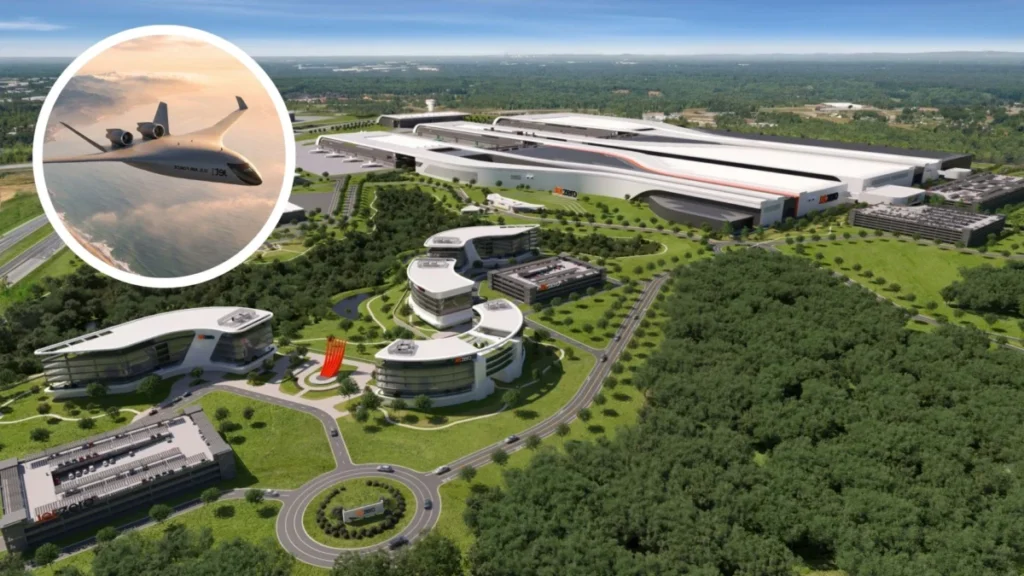
JetZero, a pioneering aircraft developer, has taken a significant step towards establishing its ambitious aircraft manufacturing hub in North Carolina, securing preliminary support from the Export-Import Bank of the United States (EXIM) for a potential financing package that could reach an impressive $3 billion. This pivotal development, announced during the prestigious 2026 Farnborough International Airshow, underscores a growing national commitment to strengthening domestic manufacturing, fostering innovation, and asserting American leadership in the next generation of aerospace technology.
A Landmark Agreement at Farnborough
The agreement materialized in the form of a Letter of Interest (LOI) signed between JetZero and EXIM, a crucial document that, while not a final approval of funding, signifies a formal intent by both parties to evaluate financing options for JetZero’s proposed manufacturing campus in Greensboro. This evaluation will proceed under EXIM’s "Make More in America Initiative" (MMIA), a program designed to support U.S.-based manufacturing and supply chain resilience. The selection of the Farnborough International Airshow, a global nexus for aerospace innovation and commerce, as the venue for this announcement amplifies the international significance of JetZero’s plans and the U.S. government’s strategic interest in its success. Such events often serve as critical platforms for companies to unveil major projects, attract investment, and forge strategic partnerships, positioning the JetZero announcement firmly within the global aerospace narrative.
The Engine of American Manufacturing: EXIM’s MMIA
The Export-Import Bank of the United States plays a vital role in supporting American jobs by facilitating the export of U.S. goods and services. Its "Make More in America" Initiative, under which JetZero’s project is being considered, was specifically launched to enhance the competitiveness of U.S. industries by supporting domestic manufacturing projects that produce goods for export. The initiative aims to address critical supply chain vulnerabilities, accelerate the re-shoring or near-shoring of production, and foster job creation within the United States. Since its inception, the MMIA has focused on strategic sectors, including advanced manufacturing, renewable energy, biotechnology, and critical minerals, recognizing the imperative to reduce reliance on foreign supply chains and bolster national economic security. For a project of JetZero’s scale and innovative nature, EXIM’s potential involvement is a clear signal of its alignment with national strategic priorities: supporting groundbreaking technology, creating high-value jobs, and enhancing America’s industrial capacity. The estimated $3 billion financing package, if approved, would represent one of the largest commitments under the MMIA to date, reflecting the transformative potential seen in JetZero’s vision.
North Carolina’s Ascent as an Aerospace Hub
If the project advances as anticipated, the Greensboro site is slated to become the cornerstone of JetZero’s U.S. manufacturing strategy as the company prepares to introduce its revolutionary blended-wing body (BWB) aircraft to the market. North Carolina has emerged as an increasingly attractive destination for advanced manufacturing, particularly within the aerospace sector. The state boasts a robust workforce, a network of technical colleges and universities producing skilled labor, and a favorable business environment complemented by strategic incentive programs. The Piedmont Triad region, encompassing Greensboro, High Point, and Winston-Salem, has specifically cultivated an aerospace and aviation cluster, benefiting from its central East Coast location, logistical advantages, and existing infrastructure, including Piedmont Triad International Airport (GSO).
JetZero’s projections for the Greensboro campus are ambitious, anticipating the creation of over 14,500 direct manufacturing jobs within North Carolina. Beyond direct employment, the company estimates that the project will catalyze approximately 53,000 additional jobs across a vast ecosystem of suppliers, logistics providers, and other ancillary industries throughout the United States. This ripple effect underscores the profound economic multiplier typical of large-scale manufacturing endeavors, promising to invigorate local and national economies. The proposed financing from EXIM would be instrumental in covering essential expenditures, including the construction of state-of-the-art manufacturing facilities, the implementation of advanced factory systems, the acquisition of cutting-edge production equipment, and other eligible project costs. JetZero firmly believes that this substantial investment will not only fortify domestic aircraft manufacturing capabilities but also significantly expand the nation’s capacity to export high-quality, U.S.-built aerospace products globally, reinforcing America’s position as a leading aerospace exporter.
Pioneering the Future of Flight: JetZero’s Blended-Wing Vision
At the heart of JetZero’s manufacturing plans lies its innovative blended-wing body (BWB) aircraft design. Unlike traditional tube-and-wing aircraft, the BWB integrates the wing and fuselage into a single, seamless structure, which offers substantial aerodynamic and structural advantages. This design significantly reduces drag and increases lift, leading to a projected 50% reduction in fuel burn compared to conventional airliners. This efficiency gain is not merely an economic advantage; it carries profound environmental implications, promising a dramatic reduction in carbon emissions, a critical goal for the aviation industry striving to achieve net-zero targets.
JetZero, founded with a mission to decarbonize air travel, has been steadily progressing with its BWB concept. The company aims to develop a family of BWB aircraft, including a regional jet and a larger commercial variant, capable of operating on sustainable aviation fuel (SAF) or eventually hydrogen. Earlier this year, JetZero began construction of a full-scale demonstrator model, the Z5, which will serve as a critical testbed for proving the aerodynamic performance and operational viability of the BWB design. The successful deployment of this demonstrator and subsequent certification would mark a paradigm shift in aircraft design, offering a tangible pathway to more sustainable and cost-effective air travel. The Greensboro manufacturing campus is envisioned as the primary production facility for these next-generation aircraft, making its development crucial to realizing JetZero’s vision for the future of aviation.
Innovation in Production: The Digital Factory
The Greensboro campus is not merely a manufacturing facility; it is designed as a living laboratory for advanced manufacturing technologies. Earlier this year, JetZero announced strategic partnerships with industrial software giant Siemens and professional services firm Deloitte. These collaborations are aimed at developing the facility using cutting-edge digital engineering and AI-native platforms, specifically tailored for modern aircraft production. This groundbreaking approach involves creating a complete digital twin of the factory before any physical construction commences.
This virtual model allows engineering teams to meticulously simulate every aspect of the production process: from the layout of production lines and equipment to the intricate movements of workers and the flow of materials. By building and testing the factory in a virtual environment, designers can experiment with countless configurations, proactively identify potential bottlenecks, and make crucial adjustments digitally. This iterative process eliminates the need for costly and time-consuming modifications once physical construction has begun – a common and expensive challenge in traditional aerospace manufacturing. The adoption of a digital-first strategy, incorporating elements of Industry 4.0 and advanced simulation, remains relatively uncommon in the aerospace sector, where changes to established production lines can incur significant costs and delays. JetZero asserts that this innovative, data-driven process will culminate in one of the most advanced and adaptable aircraft manufacturing plants in the United States, simultaneously mitigating development risks as production scales up to meet anticipated demand for its groundbreaking aircraft.
Navigating the Path to Final Approval
Despite the impressive headline figure of $3 billion, it is crucial to reiterate that the Letter of Interest does not guarantee federal financing. As EXIM Bank explicitly stated, an LOI merely establishes a formal framework for further discussions and detailed evaluation. It signifies that EXIM sees significant potential in JetZero’s project and is willing to dedicate resources to assess whether it fully meets the stringent requirements for support under the Make More in America Initiative. The process from LOI to final approval is rigorous and multi-faceted.
Tom O’Leary, JetZero’s CEO and co-founder, described the LOI as an "important milestone" for the company’s manufacturing plans. He emphasized, "This Letter of Interest marks an important step toward building the most advanced aerospace manufacturing campus in the country and bringing tens of thousands of high-quality jobs to North Carolina." O’Leary further articulated JetZero’s appreciation for EXIM’s expressed interest in supporting American manufacturing leadership and future exports, aligning the project with broader national economic objectives. Before EXIM’s Board of Directors can consider any formal financing request, the agency must complete comprehensive underwriting, legal, and environmental reviews. These due diligence steps are critical to ensure financial prudence, legal compliance, and environmental responsibility. EXIM underscored that the LOI does not constitute a loan commitment or an obligation of federal funds, maintaining transparency regarding the provisional nature of the agreement.
Statements and Strategic Alignment
While specific statements from North Carolina state officials were not immediately available following the announcement, the state’s economic development agencies and political leadership have consistently expressed strong support for projects that attract high-tech manufacturing and create skilled jobs. Governor Roy Cooper’s administration, for instance, has actively pursued strategies to position North Carolina as a leader in advanced manufacturing and clean energy, making a project like JetZero’s a natural fit for the state’s long-term economic vision. The potential for 14,500 direct jobs, coupled with tens of thousands more across the supply chain, represents a transformative economic opportunity that aligns perfectly with state priorities for sustainable growth and workforce development.
Similarly, EXIM Bank’s ongoing engagement with JetZero, even prior to this LOI, signals a consistent strategic interest. JetZero revealed that this latest agreement expands upon an existing relationship with EXIM, where earlier discussions had focused on manufacturing tooling. The new framework, however, encompasses the broader Greensboro production campus, indicating an escalated level of commitment and a more holistic view of the project’s national importance. EXIM’s mission to enhance U.S. competitiveness and create American jobs through exports provides a strong rationale for its consideration of JetZero’s innovative and job-intensive endeavor.
Broader Implications for U.S. Industrial Competence
If approved, the EXIM financing would provide critical backing for one of the largest aerospace manufacturing projects currently planned in the United States. This would not only provide a significant boost to JetZero’s efforts but also send a powerful signal regarding the U.S. government’s resolve to strengthen the country’s industrial base for next-generation commercial aircraft. The aerospace sector is a cornerstone of American innovation and economic strength, contributing significantly to GDP and employing millions directly and indirectly. Investment in advanced manufacturing facilities for novel aircraft designs like the BWB is crucial for maintaining global leadership in an increasingly competitive market.
Furthermore, the project’s emphasis on digital twins and AI-native platforms positions it at the forefront of the Fourth Industrial Revolution within aerospace. This approach could establish new benchmarks for efficiency, flexibility, and risk reduction in aircraft production, potentially influencing manufacturing strategies across the broader industry. The ability to simulate and optimize complex factory operations before physical construction offers a blueprint for future industrial development, promising faster ramp-ups, higher quality, and reduced costs. By supporting such an innovative manufacturing ecosystem, the U.S. stands to gain a strategic advantage in developing and producing advanced, environmentally friendly aircraft that will be vital for global transportation in the coming decades.
Challenges and Outlook
While the Letter of Interest represents a monumental step forward, JetZero still faces significant hurdles. Securing the final EXIM financing will require navigating complex financial, legal, and environmental assessments. Beyond financing, the company must also manage the inherent technical challenges of bringing a revolutionary aircraft design like the blended-wing body to market, including certification processes, material science advancements, and supply chain development. The timeline for such large-scale projects is often extensive, requiring sustained investment and unwavering commitment.
However, the preliminary support from EXIM, coupled with JetZero’s strategic partnerships and innovative approach to both aircraft design and manufacturing, positions the company as a key player in the future of aviation. The potential for tens of thousands of jobs, a significant reduction in aviation’s carbon footprint, and the establishment of a cutting-edge manufacturing hub in North Carolina underscores the profound national and global implications of this project. The world will be watching closely as JetZero and EXIM proceed with their evaluations, anticipating the potential for a new era in American aerospace manufacturing and sustainable air travel.