The evolution of modern consumer electronics, from the vibrant organic light-emitting diode (OLED) displays on the latest smartphones to the high-efficiency photovoltaic cells powering renewable energy grids, is fundamentally rooted in the meticulous world of precision optics. For decades, the development of these technologies has relied on exhaustive experimental cycles where scientists measure the optical properties of new materials using lasers and complex light-focused setups. However, these experiments are notoriously difficult to execute, often requiring months of manual labor to align delicate mirrors, lenses, and sensors with microscopic accuracy. In a landmark development for the field of experimental physics, researchers at the Massachusetts Institute of Technology (MIT) have developed a fully autonomous, reconfigurable robotic optics laboratory designed to eliminate the physical tedium and time-intensive nature of these essential scientific processes.
The system, which will be formally presented at the upcoming International Conference on Intelligent Robots and Systems (IROS), represents a significant leap toward the "lights-out" laboratory—a facility capable of operating 24/7 without human intervention. By combining advanced robotics, computer vision, and specialized software, the MIT team has demonstrated that a machine can not only assemble a complex optical experiment from scratch but also fine-tune it to a level of precision that rivals or exceeds the capabilities of the most experienced human technicians.
The Challenge of Manual Optical Alignment
To understand the magnitude of this innovation, one must consider the environment of a traditional optics lab. A typical tabletop experiment often resembles a "miniature city," densely packed with an array of optical components including beam splitters, polarizers, lenses, and mirrors. Each of these components must be positioned and angled with extreme precision. Even a deviation of a few microns or a fraction of a degree can render an entire experiment useless.
Historically, this alignment process has been performed manually. A scientist must physically stand over the table, turning tiny knobs on component mounts while monitoring a sensor or a camera feed to see how the light beam responds. This process is not only physically taxing but also prone to human error and environmental interference. Vibrations from footsteps in a hallway or slight fluctuations in room temperature can shift an alignment, forcing the researcher to start the calibration process all over again.
While some modern labs use motorized stages to assist in these tasks, these are typically "one-off" solutions designed for a specific setup. Until now, there has been no integrated system capable of taking a collection of loose parts and transforming them into a fully functioning, aligned optical experiment autonomously.
Architecture of the Robotic Optics Lab
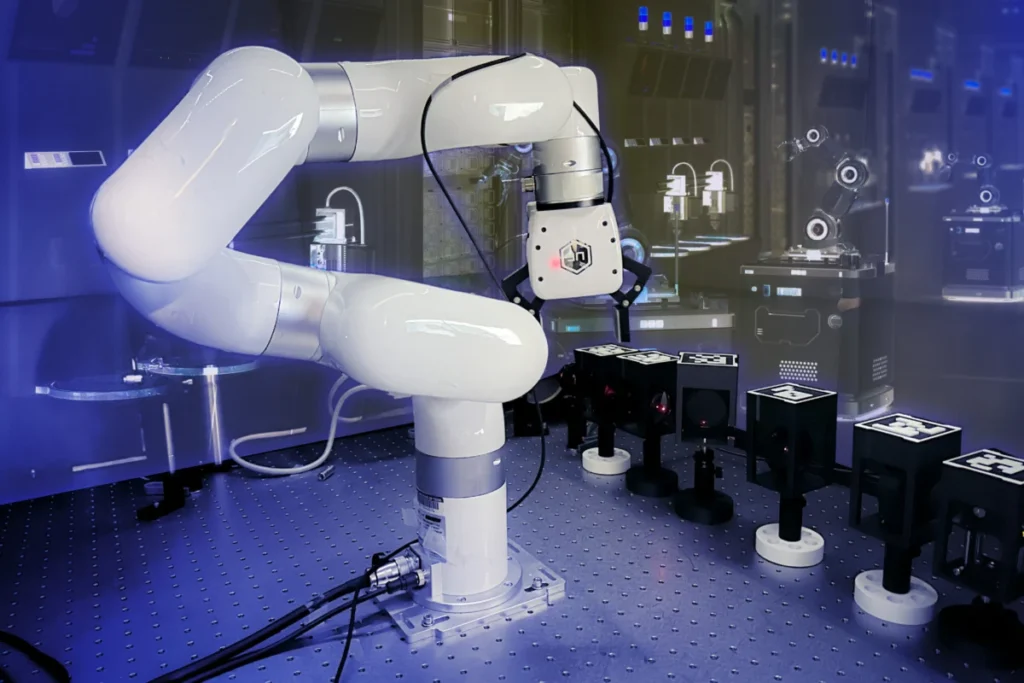
The MIT system is built around a high-precision robotic arm featuring seven moveable joints, providing the dexterity necessary to navigate the crowded environment of an optical table. This arm is mounted on a specialized metallic tabletop that serves as the foundation for the experiments.
The core innovation lies in how the robot interacts with standard optical components. The researchers developed custom 3D-printed plastic housings for every lens and mirror used in the system. These housings serve several critical functions:
- Ergonomics for Robotics: They provide a standardized gripping surface, allowing the robot to pick up and place components safely without risking damage to the delicate glass surfaces.
- Identification: The top of each housing is etched with a unique QR code. Using overhead cameras, the system can instantly identify the component, its dimensions, its focal length, and its specific optical properties.
- Stability: Each housing is equipped with a magnetic base. When the robot places a component on the metallic table, the magnets provide immediate stability, ensuring the part does not shift during the experiment or while the robot is moving nearby.
To handle the "fine-tuning" phase, the team engineered a proprietary, Wi-Fi-enabled adjustment tool. This motorized device clips onto the manual adjustment knobs of standard optical mounts. Once the robotic arm has placed a component in its approximate location, the software can wirelessly trigger this tool to make sub-micron adjustments to the angle and position of the optics.
The Software Stack and Computer Vision
Hardware is only half of the equation; the "intelligence" of the system resides in its sophisticated software stack. The researchers developed a suite of programs that allows the robot to "see" and "think" its way through an experimental setup.
A pair of high-resolution cameras mounted above the table provides a continuous bird’s-eye view of the workspace. This vision system allows the robot to map the table in real-time, identifying the location of every component and planning paths that avoid collisions. The software handles the complex mathematics of "pick-and-place" logistics—calculating how to approach a component, how to orient it, and how to navigate around already-placed items.
Furthermore, the team created a virtual user interface that bridges the gap between the scientist and the machine. Researchers can design an experiment in a digital environment, dragging and dropping icons representing mirrors and lasers. Once the design is finalized, the robot translates that digital map into physical reality, fetching the necessary parts and arranging them on the table.
Demonstration: Building a Functional Laser Cavity
To prove the system’s efficacy, the MIT team tasked the robot with one of the more challenging foundational tasks in optics: building a laser cavity. A laser cavity requires two mirrors to be placed on either side of a gain medium (such as a crystal). Light must bounce back and forth between these mirrors with perfect alignment to amplify the beam and create a functional laser.
This task is a benchmark for human skill; a new graduate student might spend several hours or even days attempting to achieve perfect alignment for a stable laser cavity. The MIT robot, however, completed the entire process—including 50 distinct maneuvers to pick, place, and align the components—in just 30 minutes.
Beyond mere assembly, the system demonstrated an impressive "self-healing" capability. When the researchers intentionally disturbed the setup by moving a component or introducing vibrations, the robot’s sensors detected the drop in laser intensity. The system then automatically re-engaged the fine-adjustment tool to realign the mirrors and restore the laser’s performance. This ability to maintain stability in real-time is a critical advantage for long-term experiments that must run for weeks or months.
Broader Implications for Scientific Discovery
The implications of an autonomous, reconfigurable optics lab extend far beyond the walls of MIT. Professor Marin Soljacic, a lead researcher on the project, emphasizes that the primary benefit is the liberation of human intellect. "A robot isn’t going to get bored," Soljacic noted. "It can work 365 days, 24 hours a day, on very boring things. That will free up so much creativity and time for scientists to then push theories and see what we can do."
By automating the "technician" aspect of science, the pace of discovery is expected to accelerate. In fields like material science, where researchers must test hundreds of different chemical compositions to find the best candidate for a new solar cell, the ability to run experiments autonomously and continuously could reduce development timelines from years to months.
Moreover, the team is working on a cloud-based version of the laboratory. This would allow scientists from smaller institutions or developing nations to access world-class experimental hardware remotely. A researcher in another country could upload an experimental protocol, and the robotic lab in Cambridge would execute the experiment, collect the data, and send it back—effectively democratizing high-end experimental physics.
Industry Applications and Current Research
While the initial focus has been on foundational physics, the practical applications for industry are vast.
- Telecommunications: Testing new fiber-optic components and signal-processing hardware.
- Consumer Electronics: Rapid prototyping of lenses for cameras and sensors for augmented reality (AR) and virtual reality (VR) headsets.
- Renewable Energy: Characterizing the efficiency of next-generation thin-film solar materials.
- Climate Change: The MIT team is currently using the robotic lab to investigate carbon-capture materials. By subjecting these materials to specific light frequencies, they can observe how they interact with carbon dioxide at a molecular level, potentially leading to more efficient ways to scrub greenhouse gases from the atmosphere.
Timeline and Future Development
The MIT team’s work is the culmination of several years of interdisciplinary research involving the Research Laboratory of Electronics (RLE) and the Department of Physics. Following the presentation at the IROS conference, the researchers plan to expand the physical scale of the lab, allowing for larger and more complex experimental layouts.
Future iterations of the system may include an automated "library" or storage system where a secondary robot could fetch components from a warehouse and deliver them to the main experimental table. This would create a truly closed-loop system where the robot could run an experiment, analyze the data, decide it needs a different lens to verify a result, fetch that lens, and modify the setup without any human ever entering the room.
The project received support from a diverse array of organizations, reflecting its broad relevance. Funding and resources were provided by the Korea Foundation for Advanced Studies, the U.S. National Science Foundation (NSF), the U.S. Army Research Office, Shell International Exploration and Production Inc., and the MIT Generative AI Impact Consortium.
As the scientific community moves toward "Science 2.0"—an era defined by big data and automation—the robotic optics lab stands as a sentinel of change. It signals a shift away from the "lone scientist at the workbench" model toward a future where human ingenuity is amplified by the tireless precision of machines, paving the way for the next generation of technological breakthroughs.