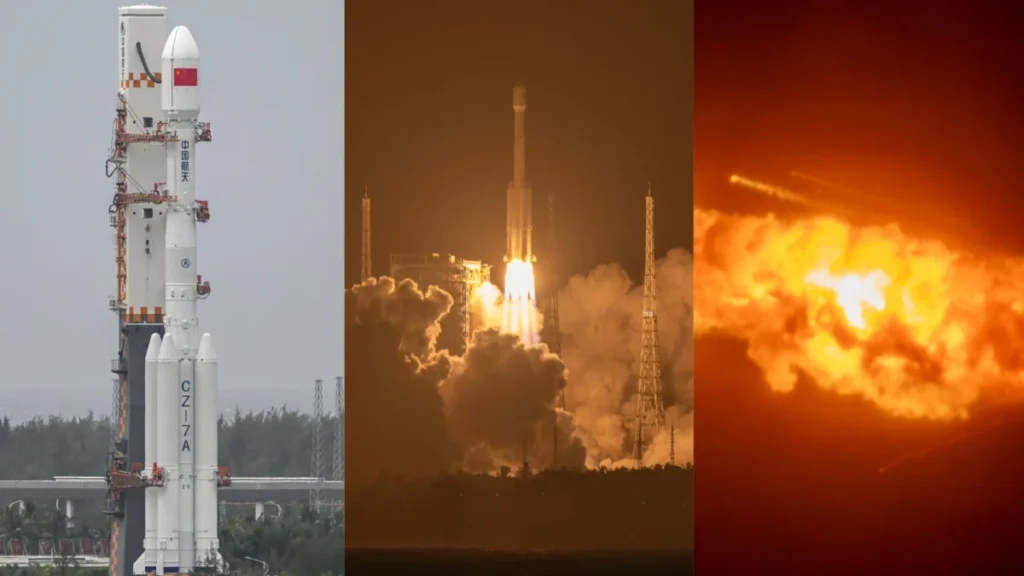
A Long March 7A rocket experienced a catastrophic failure shortly after liftoff on Monday, resulting in the destruction of a valuable communications satellite and bringing an abrupt end to China’s latest orbital mission. The incident, which occurred at approximately 8:02 p.m. Beijing time, saw the 60-meter-tall launch vehicle erupt into a fireball during its initial ascent from the Wenchang Space Launch Site on Hainan Island, casting a stark reminder of the inherent risks in spaceflight.
The ill-fated mission was intended to carry the ChinaSat-4B satellite into a geostationary transfer orbit, a critical step towards positioning it in geostationary orbit, approximately 35,786 kilometers above the Earth’s equator. This highly sought-after orbital slot allows satellites to remain fixed over a specific geographical region, providing continuous communication services. However, roughly 85 seconds after clearing the launch pad, before it could even complete its initial powered flight phase, the rocket suffered a major anomaly. Videos captured by nearby observers depicted the vehicle disappearing behind a rapidly expanding cloud of thick smoke and debris, signaling the immediate and total loss of both the launcher and its sophisticated payload over the South China Sea.
The Unfolding Disaster: A Chronology of Failure
The launch commenced on schedule at 20:02 local time (12:02 GMT) from the Wenchang Space Launch Site, a coastal facility renowned for handling China’s larger and more advanced rockets due to its advantageous equatorial location, which provides an extra boost from Earth’s rotation. The Long March 7A, a medium-lift launch vehicle, ignited its engines with the characteristic roar, ascending skyward on a column of fire and exhaust.
For the initial moments, the flight appeared nominal, a powerful testament to China’s advanced rocket engineering. However, the mission’s trajectory veered catastrophically off course around 85 seconds into flight. This crucial juncture is significantly earlier than the typical several minutes required for the Long March 7A to complete its first-stage burn and separation sequence. The suddenness and early timing of the failure strongly suggest a critical event occurred within the rocket’s propulsion system or structural integrity during the most dynamically stressful phase of ascent, where the vehicle experiences maximum aerodynamic pressure (Max-Q). The visual evidence of an explosion followed by disintegration points towards either a major structural failure, a sudden engine shutdown or malfunction leading to an uncontrolled cascade, or the activation of the flight termination system, a safety mechanism designed to destroy a rocket that deviates dangerously from its planned trajectory or becomes uncontrollable.
Following the visible anomaly, the debris field rapidly dispersed over the waters of the South China Sea, effectively ending the mission and any hope for the ChinaSat-4B. The incident quickly became a subject of intense scrutiny within the global space community, with satellite tracking networks confirming the absence of any new objects in orbit that would correspond to the planned mission.
Official Response and Early Speculation
China’s state news agency, Xinhua, officially confirmed the failure several hours after liftoff, echoing an announcement from the China Academy of Launch Vehicle Technology (CALT), the primary developer of the Long March rocket series. These official confirmations, while acknowledging the loss, were notably brief and provided no immediate details regarding the technical cause of the failure. This aligns with standard practice in space agencies globally, where a comprehensive investigation is launched before any definitive conclusions are drawn.
The lack of an immediate public explanation has naturally led to various theories among spaceflight observers and analysts. The visual characteristics of the failure, particularly the sudden eruption and disintegration, have led some experts to suggest that the flight termination system (FTS) might have been activated. The FTS is a critical safety feature present on most launch vehicles, designed to terminate a mission by destroying the rocket in a controlled manner if it poses a threat to populated areas, deviates significantly from its flight path, or experiences an uncontrollable anomaly. The activation of an FTS typically involves detonating explosive charges that rupture propellant tanks, ensuring the rapid destruction of the vehicle. If the FTS was indeed activated, it would imply that onboard sensors detected a critical deviation or failure that rendered the rocket uncontrollable and unsafe to continue its flight. However, without official confirmation, this remains a speculative but plausible explanation given the observed events.
Investigators from CALT and other relevant agencies will now undertake a meticulous and extensive root cause analysis. This process typically involves reviewing vast amounts of telemetry data transmitted by the rocket during its brief flight, analyzing photographic and video evidence, and potentially recovering debris from the South China Sea, though ocean recovery presents significant challenges. The timing of the failure, so early in the ascent, will provide crucial engineering details, as it narrows down the potential causes to events occurring during the initial high-stress phase of atmospheric flight.
The Long March 7A: A Key Player in China’s Space Ambitions
The Long March 7A (Chang Zheng 7A, CZ-7A) is a vital component of China’s expanding and increasingly sophisticated space launch fleet. Standing approximately 60 meters (nearly 200 feet) tall, it is a three-stage, medium-lift launch vehicle designed primarily to place heavier payloads into geostationary transfer orbit (GTO) and other high-energy orbits. It is an enhanced variant of the Long March 7, featuring an additional upper stage to achieve these higher-energy trajectories.
The rocket utilizes kerosene and liquid oxygen (LOX) as its primary propellants, a choice that represents a modern and environmentally friendlier approach compared to the highly toxic hypergolic fuels used in some older Long March variants. This "green" propellant combination offers advantages in terms of safety, cost, and reduced environmental impact. With a GTO payload capacity of around 7,000 kilograms (approximately 15,400 pounds), the Long March 7A is essential for deploying large communications and navigation satellites, as well as components for future deep-space missions. Its design makes it a workhorse for China’s growing requirements for high-altitude missions, complementing the heavier Long March 5 for even larger payloads and the Long March 2 and 3 series for various other orbital needs.
This recent accident marks the 18th mission for the Long March 7A rocket series since its debut in 2020. Notably, its inaugural flight also ended in failure, experiencing an engine malfunction that led to its loss. Following that initial setback, Chinese engineers undertook a thorough investigation and implemented corrective measures, successfully returning the launcher to service in 2021. Since then, the Long March 7A had achieved a series of successful missions, demonstrating improved reliability and establishing itself as a dependable vehicle for critical national space objectives. This track record of success makes the current failure a particularly unwelcome and scrutinizing event for China’s space program.
The Lost Payload: ChinaSat-4B and its Strategic Importance
The primary payload for the failed mission was the ChinaSat-4B satellite, an advanced communications satellite intended for a geostationary orbital slot. Satellites in geostationary orbit are indispensable for a wide array of modern services, including high-definition television broadcasting, radio transmission, broadband internet connectivity, and critical disaster relief communications. Once operational, ChinaSat-4B was expected to significantly enhance China’s domestic and international communication infrastructure, providing reliable and high-capacity services across a vast geographical area.
The loss of ChinaSat-4B represents a significant financial blow, given the substantial cost of designing, manufacturing, and launching such a sophisticated spacecraft. More critically, it creates a delay in the planned expansion of communication services, potentially impacting various sectors reliant on satellite connectivity.
Beyond commercial applications, the context of China’s space program often involves dual-use technologies. While ChinaSat-4B was primarily presented as a commercial communications satellite, it is widely understood by international space observers that some lower-numbered ChinaSat spacecraft have historically been associated with military communications applications. This suggests that the lost payload could potentially have had strategic significance beyond purely commercial communications, possibly intended to augment secure, high-bandwidth communication networks vital for China’s defense and national security operations. The full extent of its intended capabilities and strategic role, however, remains unconfirmed by official sources.
A Rare Setback Amidst Rapid Expansion
The failure of the Long March 7A represents a rare setback for China’s rapidly expanding and increasingly ambitious space program. In recent years, China has emerged as a formidable force in space, challenging the long-standing dominance of the United States and Russia. Its achievements include the construction of the Tiangong space station, successful lunar missions (Chang’e program), the deployment of a Mars rover (Tianwen-1), and the establishment of its independent Beidou satellite navigation system. These successes underscore a sustained national effort to develop a comprehensive and self-reliant space capability for military, governmental, scientific, and commercial purposes.
This incident also comes at a time when China has been pushing an unusually rapid launch schedule. The previous Long March 7A mission, for instance, launched merely 12 days prior to this failure. Chinese media had highlighted this rapid turnaround as a potential record for the rocket, showcasing the country’s growing efficiency and capability in space operations. The current failure now places this ambitious launch tempo under a different, more critical spotlight. Maintaining a high launch cadence inherently introduces increased pressure on manufacturing, testing, and operational teams, and even minor oversight or cumulative stress can lead to catastrophic consequences.
For international space observers, particularly those in the U.S., the incident serves as a stark reminder of the inherent risks involved in maintaining such a high operational tempo in spaceflight. While one failure does not erase the Long March 7A’s otherwise strong recent record, it necessitates a pause and a thorough re-evaluation. The comprehensive investigation now underway will seek to determine precisely what went wrong during those critical first 85 seconds.
Broader Implications and the Path Forward
The implications of this Long March 7A failure extend beyond the immediate loss of a rocket and a satellite. Financially, the cost is substantial, encompassing the manufacturing of the booster, the satellite itself, and the opportunity cost of delayed services. Reputational damage, while not insurmountable for a program with China’s overall success, can still influence international partnerships and perceptions of reliability.
More practically, the incident will likely lead to a temporary grounding or a significantly reduced launch schedule for the Long March 7A variant, at least until the root cause of the failure is definitively identified and addressed. This could impact the deployment timeline for other critical payloads slated for this specific launch vehicle, potentially creating a ripple effect across China’s space agenda. Depending on the findings, it could necessitate design modifications, more stringent quality control measures, or changes in operational protocols.
The investigation’s findings will be crucial in determining whether the problem was an isolated manufacturing defect, an operational error, a systemic design flaw, or a combination of factors. The lessons learned from this failure will be vital for ensuring the continued safety and reliability of China’s future space endeavors. Space exploration remains one of humanity’s most challenging undertakings, where even the most advanced technologies and rigorous procedures can encounter unexpected difficulties. This incident underscores that continuous vigilance, thorough analysis, and a commitment to learning from setbacks are paramount for any nation striving for leadership in the cosmos. China’s space program, with its ambitious goals, will now face the challenge of overcoming this unexpected setback and reinforcing the reliability of its established launch vehicles.