The quest for safer, more energy-dense power sources for everything from electric vehicles to grid-scale storage has placed All-Solid-State Batteries (ASSBs) at the forefront of electrochemical research. These next-generation batteries, which replace flammable liquid electrolytes with solid counterparts, promise a revolution in energy storage by mitigating thermal runaway risks and potentially offering superior energy density and lifespan. However, realizing the full potential of ASSBs hinges critically on identifying and optimizing solid electrolyte materials that allow ions to travel through them with exceptional speed – a phenomenon often termed "superionic" or "liquid-like" conduction. Traditionally, the discovery of such materials has been a laborious and resource-intensive endeavor, plagued by time-consuming synthesis, experimental characterization, and the limitations of conventional computational modeling. Now, a groundbreaking machine learning (ML) accelerated workflow offers a powerful new route, capable of accurately predicting unique spectroscopic signatures indicative of rapid ion movement, thereby streamlining the search for advanced battery materials.
The Bottleneck in Battery Innovation: Unraveling Ion Dynamics
All-solid-state batteries represent a significant leap forward from their conventional lithium-ion counterparts, primarily due to their inherent safety advantages. By replacing the organic liquid electrolytes, which are often flammable and susceptible to dendrite formation that can lead to short circuits, with solid materials, ASSBs virtually eliminate the risk of thermal runaway. Furthermore, solid electrolytes can enable the use of lithium metal anodes, theoretically boosting energy density beyond current limits. Despite these compelling advantages, a major hurdle remains: achieving ion conductivity in solid materials comparable to that in liquids. For an ASSB to be commercially viable, its solid electrolyte must allow ions to traverse its structure at rates approaching those found in liquid electrolytes, often referred to as "superionic" conductivity.
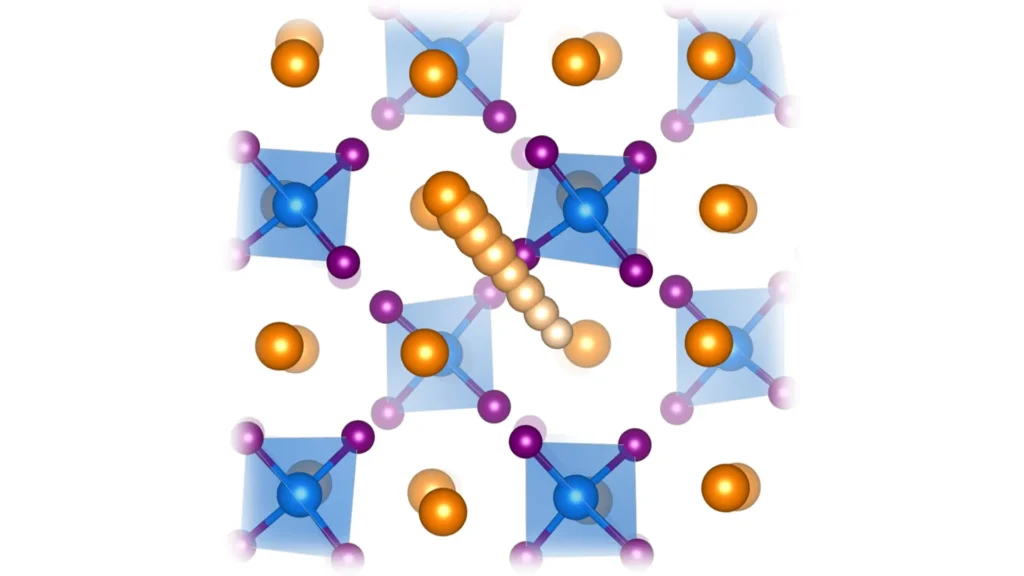
The fundamental challenge lies in the complex atomic-scale mechanisms governing ion transport within solid crystals. Unlike liquids where ions move freely, in solids, ions navigate through a rigid lattice, often hopping between interstitial sites or moving cooperatively through a network of pathways. When ions begin to exhibit "liquid-like" motion within a solid, they move with a fluidity that temporarily disrupts the ordered crystal lattice. Understanding and predicting this dynamic, disordered behavior, especially at elevated temperatures where ion mobility typically increases, has proven exceptionally difficult.
Existing methods for identifying fast-ion conductors have significant drawbacks. Experimental synthesis and characterization of novel materials are inherently slow, requiring meticulous control over reaction conditions and subsequent structural and electrochemical analyses. This "trial-and-error" approach is not only time-consuming but also costly, often yielding limited insights into the underlying atomic mechanisms. On the computational front, advanced techniques like ab initio molecular dynamics (AIMD) simulations can model ion behavior at an atomic level. However, accurately capturing the long timescales and large system sizes necessary to observe statistically significant "liquid-like" ion motion in complex, disordered systems demands extraordinary computing power, rendering large-scale, high-throughput screening practically impossible. The computational cost escalates dramatically when attempting to model the dynamic disorder and intricate vibrational properties that accompany such high ionic mobility.
A Machine Learning Paradigm Shift: Predicting Raman Signals of Liquid-Like Ion Motion
To overcome these entrenched challenges, a team of researchers has pioneered a sophisticated machine learning-accelerated workflow. This innovative approach integrates ML force fields with tensorial ML models to simulate Raman spectra with unprecedented accuracy and efficiency. The core breakthrough lies in demonstrating that a strong low-frequency Raman intensity can serve as a direct, spectroscopic fingerprint for liquid-like ionic conduction within a material.
Raman spectroscopy is a powerful analytical technique used to observe vibrational, rotational, and other low-frequency modes in a system. When light interacts with a material, most photons are elastically scattered (Rayleigh scattering), but a small fraction undergoes inelastic scattering (Raman scattering), gaining or losing energy corresponding to the material’s vibrational modes. These characteristic spectral "fingerprints" provide information about the chemical structure, phase, crystallinity, and molecular interactions.
The key insight developed by the researchers is rooted in the physics of how liquid-like ion motion interacts with the crystal lattice. When ions move through a crystalline structure in a fluid-like manner, their rapid and extensive movement temporarily perturbs the local symmetry of the lattice. This dynamic disturbance has a profound effect on the usual Raman selection rules, which dictate which vibrational modes are "Raman active" (i.e., detectable). By relaxing these rules, the liquid-like motion generates distinctive low-frequency Raman scattering signals. These unique spectral features are not merely incidental; they are directly correlated with and indicative of high ionic mobility, essentially acting as a real-time probe of the material’s conductive properties at an atomic level.
The power of the new ML-accelerated approach stems from its ability to simulate the vibrational spectra of complex and dynamically disordered materials at realistic operating temperatures with near-ab initio accuracy. Crucially, it achieves this while drastically reducing the computational cost that previously rendered such large-scale studies impractical. This efficiency gain is monumental, transforming what once required weeks or months of supercomputer time into a task that can be accomplished in a fraction of that, opening the door for systematic exploration of vast material databases.
Validation with Sodium-Ion Conductors: Unveiling Superionic Signatures
To validate their innovative methodology, the researchers applied the ML-accelerated workflow to well-known sodium-ion conducting materials, specifically focusing on Na3SbS4. Sodium-ion batteries are gaining significant attention as a sustainable and cost-effective alternative to lithium-ion technology, given the abundant global reserves of sodium. Identifying high-performance sodium superionic conductors is therefore a critical step in developing these next-generation batteries.
The application of the new method to Na3SbS4 revealed pronounced low-frequency Raman features. These signals were not random noise but precisely correlated with the symmetry breaking induced by the rapid and extensive transport of sodium ions within the material’s lattice. The presence and intensity of these spectral markers provided a robust and reliable indicator of fast ionic conduction. This finding is particularly significant because it not only confirms the method’s predictive power but also provides a theoretical framework that helps to explain earlier, often puzzling, experimental observations in superionic materials. Previous experimental Raman studies on superionic conductors had sometimes reported anomalous low-frequency scattering, the origins of which were not fully understood. This research now provides a clear atomistic explanation for these phenomena, bridging the gap between theoretical prediction and experimental evidence.
Further testing reinforced the robustness of the method. The workflow was successfully used to identify clear Raman signatures directly linked to liquid-like ion motion in other sodium-ion conducting systems. Materials that exhibited strong low-frequency Raman features were consistently found to possess high ionic diffusivity, a direct measure of how quickly ions can move through a material, along with dynamic relaxation of the host lattice—the very characteristics of superionic behavior.
In a crucial contrast, materials where ion transport primarily occurs through a more conventional "hopping" mechanism, where ions jump between fixed interstitial positions without the extensive, fluid-like disruption of the lattice, did not produce these distinctive low-frequency Raman signatures. This stark distinction underscores the specificity and reliability of the Raman signals as an indicator, highlighting how they can precisely reveal the underlying transport mechanism within a material, rather than just its overall conductivity. This capability is invaluable for materials scientists, allowing them to differentiate between different types of ion transport and focus on optimizing truly superionic pathways.
Broader Implications: Accelerating the Discovery of Advanced Battery Materials
The implications of this research extend far beyond the specific case of sodium-ion conductors. By providing a framework for interpreting diffusive Raman scattering, the study effectively broadens the understanding of how Raman selection rules can break down in dynamically disordered systems, not just in traditional superionic materials but across a wider spectrum of material classes. This expanded understanding opens new avenues for material characterization and discovery in various fields.
The ML-accelerated Raman pipeline represents a powerful convergence of atomistic simulations with experimental measurements. It creates a seamless feedback loop where theoretical predictions of Raman spectra can guide experimentalists, and experimental observations can, in turn, validate and refine computational models. This integrated approach allows scientists to evaluate candidate materials for ASSBs more efficiently than ever before, drastically cutting down the time and resources typically required for material discovery.
This strategy introduces a powerful new paradigm for data-driven discovery in energy storage research. By empowering researchers to quickly identify promising fast-ion conductors, the method could significantly accelerate the pace of development for high-performance solid-state battery technologies. The ability to rapidly screen thousands, or even millions, of hypothetical materials for the desired superionic properties, based on their predicted Raman spectra, fundamentally changes the materials discovery landscape. This means bringing safer, more efficient, and longer-lasting batteries to market faster, which has profound implications for the electrification of transportation, the stability of renewable energy grids, and portable electronics.
The findings of this pivotal research were recently published in the online edition of AI for Science, an international journal dedicated to interdisciplinary artificial intelligence research, underscoring the cutting-edge nature of the work and its position at the intersection of artificial intelligence, materials science, and energy technology. As the global demand for advanced energy storage solutions continues to surge, this machine learning breakthrough offers a beacon of hope, promising to unlock the full potential of all-solid-state batteries and drive the next wave of energy innovation.