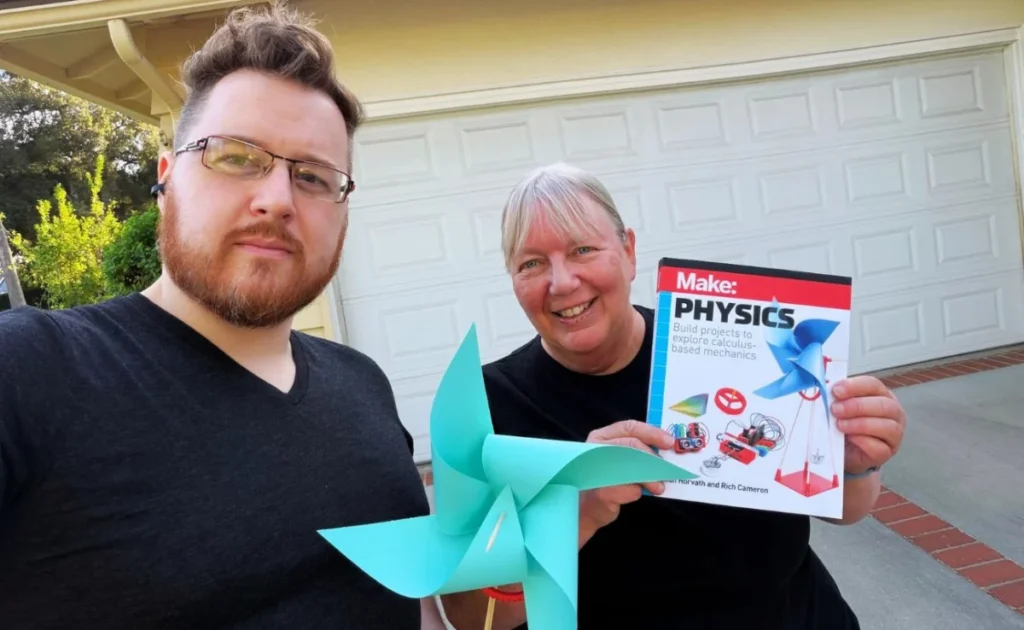
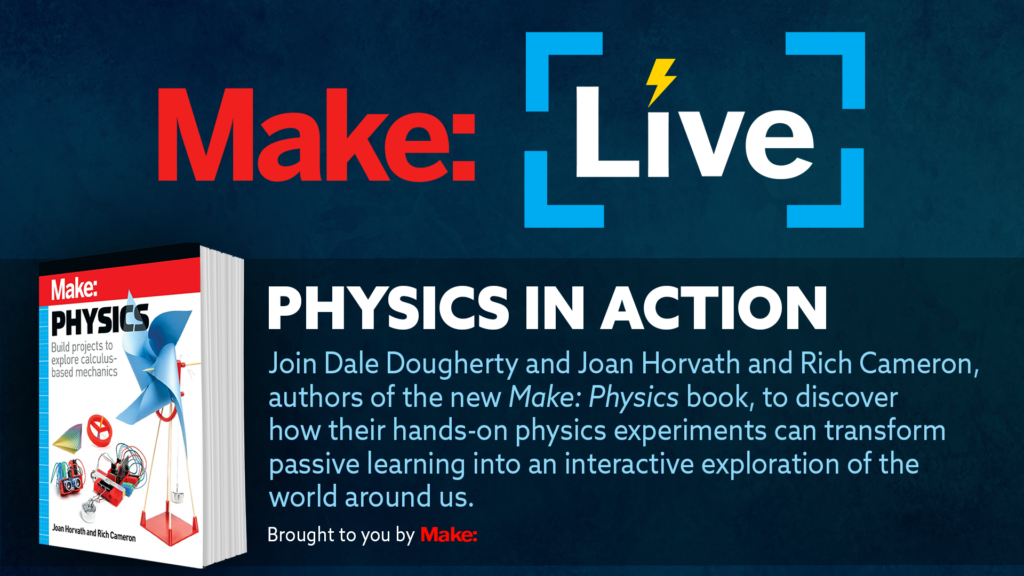
On Friday, July 24, 2026, at 1 PM Pacific Time, the "Make: Live" digital broadcast will host a comprehensive exploration of modern science pedagogy, featuring Dale Dougherty in conversation with authors Joan Horvath and Rich Cameron. The session is scheduled to focus on the release of their latest publication, Make: Physics, a work designed to bridge the gap between abstract mathematical theory and tangible, hands-on experimentation. The event comes at a pivotal time for STEM (Science, Technology, Engineering, and Mathematics) education, as institutions globally grapple with declining engagement in traditional lecture-based physics and a growing demand for practical engineering skills among high school and early college students.
The upcoming broadcast aims to dissect the "learn-by-doing" philosophy that Horvath and Cameron have championed for over a decade. By utilizing accessible "maker-level" materials—such as BBC micro:bit microcontrollers and custom 3D-printed components—the authors have developed a curriculum that targets advanced high school students, first-year engineering undergraduates, and adult learners seeking to reestablish their understanding of the physical world. The discussion will feature insights from Dr. Simon Huss, STEAM Director at Windward School, and Dr. Mina Sun, a scientist specializing in advocacy for blind and non-visual learners, highlighting the book’s potential impact on diverse educational environments.
The Shift Toward Experiential Physics
For decades, physics education has been characterized by a heavy reliance on textbooks and theoretical problem sets. While this approach builds a foundation in mathematical logic, it often leaves a conceptual void for students who struggle to visualize how calculus-based formulas translate into real-world motion. Make: Physics seeks to address this disconnect by integrating kinematics, energy, momentum, and rotational dynamics into projects that students can physically build and manipulate.
The integration of the BBC micro:bit—a low-cost, programmable device equipped with various sensors—represents a significant shift in how data is collected in the classroom. Unlike traditional laboratory equipment, which can be prohibitively expensive for underfunded districts, maker-tech solutions allow students to conduct high-level experiments at a fraction of the cost. During the "Make: Live" session, the authors intend to demonstrate how these simple models can illustrate complex concepts like acceleration and torque more effectively than passive observation.
A Decade of Maker-Tech Advocacy
Joan Horvath and Rich Cameron are not newcomers to the intersection of making and science. For more than ten years, the duo has worked with educators and research scientists to demystify advanced technology. Their previous collaborations have covered topics ranging from 3D printing to specialized electronics, always with an emphasis on democratizing the tools of creation.
Their approach in Make: Physics is particularly notable for its treatment of calculus. Rather than presenting calculus as an intimidating prerequisite, the book treats it as a descriptive language for the physical events occurring in the projects. By showing how a derivative represents a rate of change that can be measured by a sensor, the authors aim to empower students who might otherwise be deterred by the rigor of engineering mathematics.
Educational Perspectives: The Classroom and Beyond
The inclusion of Dr. Simon Huss in the "Make: Live" discussion provides a critical empirical perspective. As the STEAM Director at Windward School, Dr. Huss has firsthand experience with the implementation of project-based learning. Educators have long noted that student retention rates increase significantly when theoretical knowledge is applied to solve a physical problem. Dr. Huss is expected to discuss the behavioral and cognitive shifts observed when students move from being consumers of information to active creators of scientific models.
Furthermore, the session will address a frequently overlooked aspect of STEM education: accessibility. Dr. Mina Sun’s participation highlights the book’s relevance to the non-visual learning community. Traditional physics education relies heavily on visual diagrams and graphs. However, the hands-on nature of the projects in Make: Physics allows for tactile learning. By feeling the resistance of a 3D-printed gear or the vibration of a motor, students with visual impairments can gain a conceptual understanding of physics that was previously difficult to access through standard curricula. This move toward "inclusive making" is seen as a vital step in diversifying the future scientific workforce.
Technological Integration: 3D Printing and Microcontrollers
A core component of the Make: Physics methodology is the use of 3D printing to create precise scientific instruments. In the past, the lack of precision in homemade apparatuses often led to inconsistent experimental results, which could frustrate learners. Today, high-precision 3D printers allow students to manufacture components that meet the exact specifications required for meaningful data collection.
The use of the BBC micro:bit further modernizes the experience. These devices, which feature built-in accelerometers and Bluetooth connectivity, allow students to export real-time data to their computers for analysis. This mirrors the workflow of professional engineers and data scientists, providing students with professional-grade skills while they are still in secondary school. The "Make: Live" session will feature live demonstrations of these technologies in action, illustrating how a few dollars’ worth of filament and a small processor can replace thousands of dollars of proprietary lab gear.
Broader Implications for Science Literacy
The release of Make: Physics and the subsequent "Make: Live" event reflect a broader trend in global education: the push for "Scientific Literacy" over mere rote memorization. As the global economy becomes increasingly reliant on automation, renewable energy, and advanced manufacturing, the ability to understand the underlying physics of these systems is becoming a baseline requirement for many career paths.
Data from the U.S. Bureau of Labor Statistics and other international bodies suggest that STEM-related occupations are projected to grow at a rate significantly higher than non-STEM occupations over the next decade. However, the "pipeline" for these careers often narrows at the high school level, where students frequently opt out of physics and advanced math due to perceived difficulty. By lowering the barrier to entry through making, Horvath and Cameron are attempting to keep that pipeline open for a broader demographic.
Chronology of the Maker Movement in Education
To understand the significance of this event, one must look at the timeline of the Maker Movement’s integration into formal education:

- 2005-2010: The launch of Make: magazine and the first Maker Faires. The focus is primarily on hobbyists, DIY electronics, and "hacking" consumer goods.
- 2011-2015: Desktop 3D printing becomes affordable. Schools begin to install "Makerspaces," though many lack a structured curriculum to link the tools to core academic subjects.
- 2016-2020: The rise of low-cost microcontrollers like the BBC micro:bit and Arduino in the classroom. Educators begin to call for "Maker Literacy," emphasizing the process of design and iteration.
- 2021-2025: A shift toward specialized maker-science curricula. Publications like Make: Physics represent the maturation of the movement, moving beyond "fidget spinners" to rigorous scientific inquiry.
- 2026 and Beyond: The normalization of the "Maker-Scientist" model, where the laboratory and the workshop are seen as one and the same.
Analysis: The Impact on Lifetime Learners
Beyond the classroom, Make: Physics targets "lifetime learners"—adults who may have felt alienated by science in their youth or those working in unrelated fields who wish to understand the mechanics of the modern world. The "Make: Live" event serves as a call to action for this demographic, suggesting that it is never too late to engage with the principles of energy and motion.
The social implication is a more informed citizenry capable of making better-reasoned decisions regarding technology and policy. When individuals understand the physics of energy transfer or the mechanics of rotation, they are better equipped to evaluate everything from automotive safety to environmental sustainability.
Conclusion and Event Details
The July 24 session of "Make: Live" stands as more than just a book promotion; it is a showcase of the evolving landscape of scientific communication. By bringing together authors, educators, and advocates for accessibility, Dale Dougherty and the Make: team are highlighting a holistic approach to learning that values physical intuition as much as mathematical prowess.
Participants are encouraged to bring their questions to the live stream, which will be hosted across Make:’s digital platforms. The session promises to provide a roadmap for how educators and parents can revitalize science education in their own communities. For those unable to attend the live broadcast, the session will likely be archived as part of the Make: Live series, serving as a permanent resource for the maker community.
Make: Physics is currently available through the Maker Shed and other major book retailers. The authors, Joan Horvath and Rich Cameron, continue to produce work that emphasizes the empowerment of the individual through the mastery of technology and the understanding of the natural laws that govern our universe.