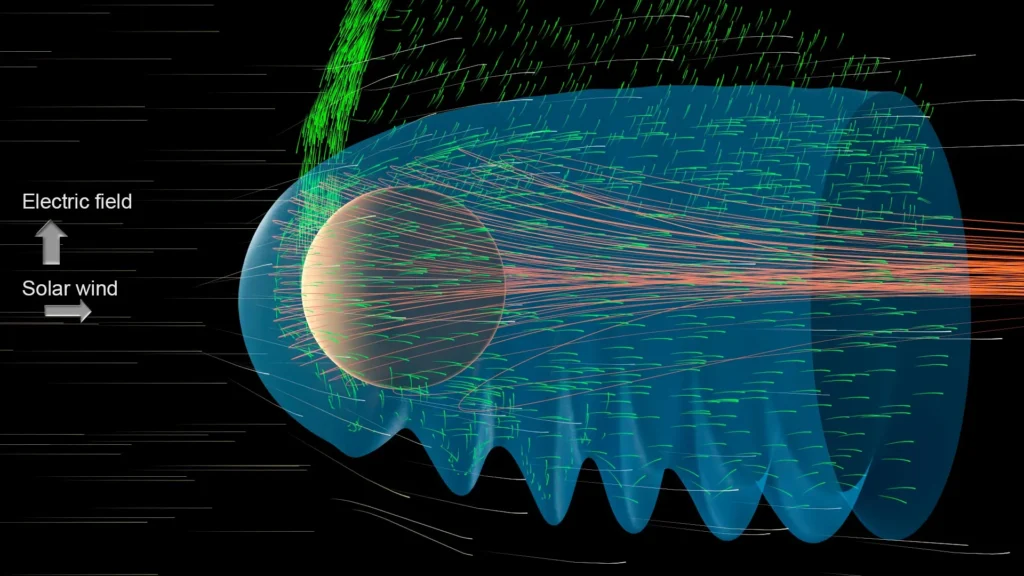
The relentless solar wind, a continuous stream of charged particles emanating from the Sun, poses a constant threat to planetary atmospheres. While Earth’s robust magnetic field acts as a formidable shield, deflecting the majority of this energetic onslaught, Mars lacks such a global defense. This vulnerability leaves the Martian upper atmosphere exposed, where the solar wind can effectively strip away atmospheric particles, gradually diminishing the planet’s gaseous envelope and carrying it into the vastness of space. A groundbreaking new study, spearheaded by researchers at Boston University and published in the prestigious journal Science Advances, reveals a striking analogy for this process: the solar wind’s interaction with Mars’s upper atmosphere mirrors the way wind creates waves and vortices on the surface of Earth’s oceans. This celestial phenomenon, driven by a dynamic interplay between the solar wind and atmospheric plasma, is a key driver behind Mars’s significant atmospheric loss, offering crucial insights into the planet’s dramatic transformation from a potentially habitable world to the cold, arid desert observed today.
The Kelvin-Helmholtz Mechanism: A Cosmic Oceanographic Analogy
The study’s central finding is the identification of a specific atmospheric process, driven by what scientists term Kelvin-Helmholtz waves, as a significant contributor to the "bulk escape" of Martian atmospheric ions. These enormous boundary waves, analogous to the rolling waves and swirling eddies that form when wind passes over water, are generated at the interface between the solar wind and the Martian upper atmosphere. As the fast-moving solar wind flows past the slower-moving atmospheric gases, instabilities arise, leading to the formation and amplification of these Kelvin-Helmholtz waves. These waves, in turn, churn and mix the upper atmosphere, creating vast, turbulent clouds of plasma that facilitate the escape of atmospheric particles into space.
Chi Zhang, a research scientist at Boston University’s Center for Space Physics and the first author of the study, explained the visual parallel. "On Earth, wind passing over a body of water can create rolling waves and swirling vortices. At Mars, the solar wind appears to produce a similar effect by ‘stirring’ the outer boundary of the upper atmosphere," Zhang stated. This stirring action is critical because it disrupts the delicate balance of the atmosphere, making it more susceptible to being carried away by the solar wind.
A Symphony of Spacecraft Data: Unraveling the Mystery
The groundbreaking nature of this research is largely due to the unprecedented combination of data from two key interplanetary missions: NASA’s Mars Atmosphere and Volatile Evolution (MAVEN) mission and the Chinese National Space Administration’s (CNSA) Tianwen-1 mission. For years, scientists had theorized about the mechanisms responsible for Mars’s atmospheric loss, but a critical limitation existed: a single spacecraft could not simultaneously observe the undisturbed solar wind upstream of Mars while also measuring the atmospheric ions escaping closer to the planet. This observational gap made it challenging to directly link specific solar wind conditions to atmospheric escape events.
The MAVEN mission, launched in 2013, has been meticulously studying Mars’s upper atmosphere, providing detailed measurements of atmospheric ions and their escape rates. Tianwen-1, which arrived at Mars in 2021, carries instruments capable of characterizing the solar wind before it interacts with the Martian atmosphere. By meticulously analyzing data from both MAVEN and Tianwen-1, Zhang and his colleagues were able to achieve what was previously impossible: a direct, simultaneous comparison of changing solar wind conditions with the dynamics of Martian atmospheric particles being ejected into space.
"By combining the two sets of observations, the researchers could directly compare changing solar wind conditions with the movement of Martian atmospheric particles into space," the study highlights. This synergistic approach allowed the team to identify specific instances where fluctuations in the solar wind directly correlated with increased atmospheric ion loss, providing robust evidence for the proposed escape mechanisms.
The Crucial Role of Kelvin-Helmholtz Waves in Atmospheric Drainage
The study’s findings build upon earlier work by Zhang and his colleagues, published in Nature Communications, which demonstrated the power of simultaneous MAVEN and Tianwen-1 data in linking solar wind changes to Martian atmospheric conditions. This new research takes that understanding a significant step further by pinpointing Kelvin-Helmholtz waves as a primary driver of these atmospheric ion escape events.
The researchers found "clear evidence that these waves generate the large plasma clouds associated with atmospheric escape." These plasma clouds, previously observed but not fully understood, are now understood to be a direct consequence of the wave activity. Furthermore, the study revealed that this atmospheric drainage is not a uniform process across the entire planet. Instead, it is predominantly observed on specific sides of Mars, a phenomenon that depends on the orientation of the solar wind’s electric field.
"Instead, it is mainly observed on one side of the planet, depending on the direction of the solar wind electric field," Zhang elaborated. This directional dependency suggests a complex interaction where the planet’s rotation and its interaction with the interplanetary magnetic field play a role in shaping where these waves are most effective at stripping away the atmosphere.
A Timeline of Discovery: From Hypothesis to Empirical Evidence
The journey to understanding Mars’s atmospheric loss has been a long and iterative one, involving decades of observation and theoretical development.
- Early Observations: As early as the Mariner missions in the 1960s and 1970s, scientists began to suspect that Mars’s thin atmosphere was a result of significant atmospheric escape over geological timescales.
- The MAVEN Mission’s Arrival (2014): MAVEN was specifically designed to investigate the role of solar wind and solar energetic particle interactions in driving atmospheric loss. Its initial findings confirmed that Mars is losing a substantial amount of its atmosphere to space.
- Tianwen-1’s Arrival (2021): The inclusion of Tianwen-1’s solar wind monitoring capabilities provided a crucial missing piece of the puzzle, enabling direct correlation studies.
- The Nature Communications Study (Prior to Science Advances): This earlier research laid the groundwork by demonstrating the effectiveness of combining MAVEN and Tianwen-1 data for studying solar-wind-driven phenomena at Mars.
- The Science Advances Study (Current Research): This latest publication solidifies the role of Kelvin-Helmholtz waves as a major contributor to atmospheric ion escape, providing direct observational evidence for this mechanism.
This chronological progression illustrates how scientific understanding evolves through continuous data collection, refinement of observational techniques, and the collaborative efforts of international space agencies.
Broader Implications: Understanding Planetary Evolution and Habitability
The implications of this research extend far beyond Mars itself. Understanding how planets lose their atmospheres is fundamental to comprehending planetary evolution and the potential for life beyond Earth. Mars is thought to have once possessed a thicker atmosphere, capable of supporting liquid water on its surface, a key ingredient for life as we know it. The gradual stripping away of this atmosphere, a process accelerated by the solar wind, is believed to be a primary reason for its current cold and dry state.
"Mars is thought to have once been potentially habitable, with a thicker atmosphere and surface liquid water," Zhang emphasized. "Understanding how it became the cold, dry planet we see today is important for understanding how planetary environments evolve over time." This research provides a critical piece of that puzzle, explaining a significant mechanism that contributed to this dramatic transformation.
Furthermore, the processes identified at Mars are likely to be at play on other planets, particularly those lacking a global magnetic field. This includes many exoplanets, planets orbiting stars other than our Sun, for which scientists are actively searching for signs of habitability. "This process could also occur on other planets that lack a strong magnetic field, including some exoplanets," noted Chuanfei Dong, a faculty member at BU’s Center for Space Physics and an assistant professor of astronomy in the College of Arts & Sciences. This broadens the significance of the findings, making them relevant to the search for life across the cosmos.
Future Research and Next Steps: Continuing the Quest
While this study marks a significant leap forward, the researchers are keen to delve deeper into the intricacies of these atmospheric escape processes. Future research will focus on precisely identifying the conditions that favor the formation and growth of Kelvin-Helmholtz waves, as well as quantifying their exact contribution to atmospheric escape from Mars.
"We want to know when these waves are most likely to form, how they evolve, and how strongly they can drive atmospheric escape," Dong stated. Answering these questions will necessitate further advancements in spacecraft instrumentation and sophisticated computer simulations that can model these complex plasma interactions.
Although the MAVEN mission is nearing the end of its operational life, its extensive data archive will continue to be a valuable resource for scientists. Moreover, NASA’s upcoming ESCAPADE (Ensemble of Mars Small Satellites for Characterizing Atmosphere and the Ionosphere) mission, which has already launched, is poised to carry forward the investigation. ESCAPADE will provide a vital new platform for studying solar-wind-driven atmospheric loss at Mars, building upon the legacy of MAVEN and the discoveries detailed in this Science Advances paper.
Official Responses and Scientific Community Reactions
While no direct "official response" in the traditional sense is typically issued for scientific publications, the broader scientific community is expected to welcome these findings with considerable interest. The publication in Science Advances, a highly respected peer-reviewed journal, signifies the robustness and significance of the research. Scientists specializing in planetary science, space physics, and astrobiology will undoubtedly incorporate these findings into their ongoing work and theoretical models.
Dr. Anya Sharma, a planetary scientist at the European Space Agency (ESA), not directly involved in the study, commented, "The identification of Kelvin-Helmholtz waves as a significant driver of atmospheric escape at Mars is a crucial step. This research elegantly bridges observational data from multiple missions, providing a level of detail that has been elusive until now. It fundamentally advances our understanding of how planets lose their atmospheres and the implications for habitability."
The collaboration between NASA and CNSA, as exemplified by the use of MAVEN and Tianwen-1 data, also underscores the growing international cooperation in space exploration, a trend that is essential for tackling complex scientific challenges of this magnitude.
Conclusion: A Vanishing World and a Cosmic Warning
The ongoing stripping of Mars’s atmosphere by the solar wind, now more clearly understood through the identification of Kelvin-Helmholtz waves, serves as a stark reminder of the dynamic and often harsh environment of space. For Mars, this process has led to its transformation into the desolate yet fascinating world we see today. For humanity, the study of this phenomenon offers invaluable insights into the evolution of planetary climates, the conditions necessary for life, and the ongoing quest to understand our place in the universe. The dual-spacecraft approach pioneered by Zhang and his team promises to unlock further secrets of Mars and potentially other worlds, painting a more complete picture of planetary destiny across the cosmos.