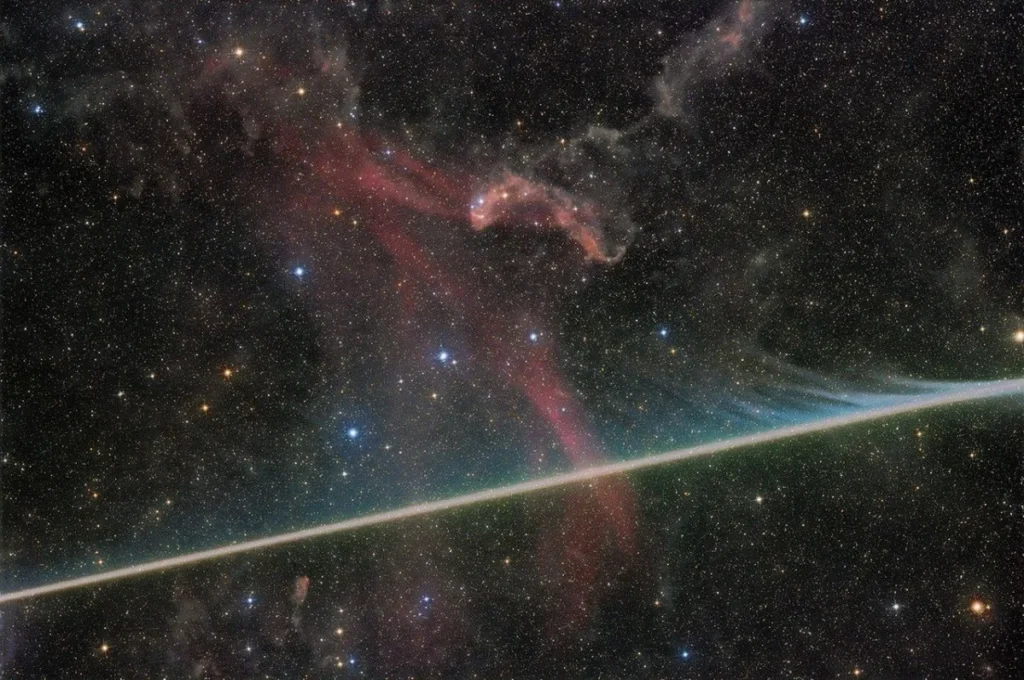
A breathtaking celestial event, captured by astronomers at the Death Valley Observatories in Nevada, USA, has provided a stunning visual testament to the ephemeral beauty of our solar system. The image, featured by NASA’s Astronomy Picture of the Day (APOD), showcases a vibrant meteor streak dramatically bisecting a dark starfield, with the faint glow of the Great Lacerta Nebula subtly present in the background. This fleeting phenomenon, captured during a long exposure, offers a rare glimpse into the fiery demise of a meteoroid as it encounters Earth’s atmosphere.
The photograph, taken last month, presents a stark contrast between the inky blackness of space and the incandescent trail left by the meteor. The streak itself is a complex tapestry of light, exhibiting faint evaporating wisps in a spectrum of colors. This chromatic display is not merely an aesthetic marvel; it is a direct indicator of the meteoroid’s chemical composition, providing valuable data for scientists studying the makeup of extraterrestrial materials. Near the center of the image, a faint red nebula, identified as the Great Lacerta Nebula, offers a subtle cosmic backdrop, highlighting the vastness and depth of the observed sky.
The Science Behind the Streak
The phenomenon of a meteor streak is the result of a meteoroid, often no larger than a pebble, entering Earth’s atmosphere at tremendous speeds. The immense friction generated by this rapid passage causes the meteoroid and the surrounding air molecules to heat up intensely. This incandescence is what creates the visible streak of light. The meteoroid itself, subjected to these extreme conditions, begins to vaporize, shedding material that contributes to the visual spectacle.
"The glow of a meteor is a complex interplay of several factors," explains Dr. Anya Sharma, a planetary scientist not directly involved in the observation but familiar with the phenomenon. "The primary source of light is the incandescence of the meteoroid itself due to friction and compression of the air in front of it. However, the excitation of atmospheric gases, such as nitrogen and oxygen, by the incoming material also plays a significant role, contributing to the various colors observed. The specific colors, such as reds, greens, and blues, can hint at the presence of elements like sodium, magnesium, and nickel within the meteoroid’s composition."
The wind-blown gas and dust left in the meteor’s wake can persist for a short period, creating the wispy appearance seen in the APOD image. The colors observed in these trails are crucial for compositional analysis. For instance, a yellow or orange hue might indicate the presence of sodium, while a green tinge could suggest magnesium. More complex elements can produce a range of other colors, offering a unique spectroscopic fingerprint of the celestial visitor.
A Glimpse into Death Valley’s Dark Skies
The location of this capture, the Death Valley Observatories in Nevada, is significant. Death Valley National Park is renowned for its exceptionally dark skies, making it an ideal site for astronomical observations. The low levels of light pollution allow for the detection of fainter celestial objects and phenomena, such as the subtle Great Lacerta Nebula, and the detailed observation of transient events like meteors. The observatories themselves are dedicated to advancing astronomical research, and images like this underscore the value of preserving such pristine viewing conditions.
The observation was made last month, placing it within a period that is generally favorable for meteor shower activity. While the specific meteor captured was not part of a major, named shower, its appearance serves as a reminder of the constant bombardment of Earth by small particles from space.
A Season of Celestial Spectacles
The APOD article highlights that the current period is particularly conducive to meteor viewing. Three distinct meteor showers are currently active: the Delta Aquariids, the Alpha Capricornids, and the upcoming Perseids. While the Delta Aquariids and Alpha Capricornids are ongoing, their visibility is currently being hampered by the bright glow of a gibbous Moon.
The Perseids, however, are poised to offer a spectacular display in the coming days. This annual meteor shower, originating from the debris trail of Comet 109P/Swift-Tuttle, is known for producing a high rate of bright meteors. The peak of the Perseid shower is anticipated in approximately ten days.

Anticipating the Perseid Peak: A Perfect Storm of Darkness and Celestial Activity
This year’s Perseid meteor shower promises to be an exceptional event for several reasons. Crucially, the peak of the shower is expected to coincide with a new Moon. A new Moon phase means the sky will be significantly darker, devoid of the Moon’s ambient light, which typically washes out fainter meteors. This dark sky backdrop will allow for the observation of a greater number of meteors, including those with lower brightness.
Furthermore, for observers in specific geographical locations, the Perseid peak may align with a total solar eclipse. While the article notes this possibility, it’s important to clarify that a total solar eclipse and a meteor shower peak are distinct events, though their proximity in timing this year is noteworthy. A total solar eclipse occurs when the Moon passes directly between the Sun and Earth, casting a shadow on Earth and briefly obscuring the Sun. The coincidence of these events, if they occur in close temporal proximity for certain observers, would create an unparalleled astronomical spectacle, combining the drama of a solar eclipse with the fleeting beauty of numerous meteors.
The Compositional Clues of Meteor Trails
The scientific implications of capturing and analyzing meteor trails are profound. Each streak of light is a fleeting opportunity to study the composition of material that has traveled vast distances through space. By analyzing the spectral data from these trails, astronomers can infer the presence of various elements and compounds, shedding light on the formation and evolution of the solar system.
The meteoroid that created the "Meteor Gecko" streak, for example, is believed to have been a small pebble. Its vaporization in the atmosphere provides a direct sample of the material that constitutes such objects. The colors observed in the streak offer clues about its origin, whether it be rocky, metallic, or perhaps a carbonaceous chondrite, a type of meteorite rich in organic compounds.
Broader Implications for Space Science and Public Engagement
The Astronomy Picture of the Day program, managed by NASA, plays a crucial role in public outreach and education. By showcasing stunning images like the "Meteor Gecko" streak, APOD introduces the wonders of the universe to a global audience, fostering interest in science and astronomy. The program’s daily offerings, accompanied by explanations from professional astronomers, demystify complex celestial phenomena and inspire curiosity.
The "Meteor Gecko" image, with its vivid depiction of a meteor’s final moments, serves as a powerful educational tool. It illustrates fundamental concepts in physics and astronomy, such as friction, atmospheric entry, and spectroscopy. The fact that this image was captured from a dedicated observatory in a location known for its dark skies also highlights the importance of preserving such environments for scientific research and public enjoyment.
The mention of "Sky Surprise: What picture did APOD feature on your birthday? (>1995)" further emphasizes APOD’s commitment to engaging the public. This feature allows individuals to connect with the history of astronomical discovery on a personal level, exploring the vast archive of images and finding a piece of cosmic history relevant to their own lives.
The Ongoing Cosmic Ballet
The continuous stream of meteoroids entering Earth’s atmosphere is a testament to the dynamic nature of our solar system. These small celestial bodies are remnants from the formation of planets, asteroids, and comets, offering invaluable insights into the early history of our solar system. Studying them helps scientists refine models of planetary formation, understand the distribution of elements in the cosmos, and assess potential impact risks.
The image captured at the Death Valley Observatories is more than just a beautiful photograph; it is a scientific data point, a piece of cosmic history, and a beacon of inspiration. It reminds us that even in the vast emptiness of space, there are constant, dynamic processes at play, and that with the right tools and dedicated observation, we can witness and understand these breathtaking celestial events. As the Perseid meteor shower approaches its peak, skywatchers around the world will have another opportunity to marvel at the transient beauty of meteors, a dazzling reminder of the ongoing cosmic ballet unfolding above us. The "Meteor Gecko" serves as a vivid precursor, an exceptional capture that underscores the scientific richness and visual splendor that astronomical observation continues to unveil.