
The month of August has historically been a crucible for significant developments in aviation and aerospace, marked by pioneering achievements, critical regulatory steps, and even dramatic incidents that have shaped the trajectory of flight. Across the decades, August has witnessed the establishment of foundational aviation bodies, daring record attempts, the first flights of groundbreaking aircraft, and pivotal moments in space exploration. This retrospective delves into key events that occurred in August, highlighting their immediate impact and lasting legacies.
1926: Laying the Groundwork for Regulated Aviation and Ambitious Flights
The year 1926 proved to be a foundational period for American aviation. On August 11th, William MacCracken Jr., a pivotal figure in shaping aerial policy, was appointed as the first assistant secretary of commerce for aeronautics. His leadership spearheaded the newly formed Aeronautics Branch, an organization that would become the direct precursor to the modern Federal Aviation Administration (FAA). This appointment was a direct result of the landmark Air Commerce Act of 1926, a piece of legislation designed to foster the growth of civil aviation by establishing safety standards, regulating air traffic, and promoting the development of airways. MacCracken’s role was instrumental in translating the act’s provisions into tangible regulatory frameworks, setting the stage for a more organized and safer aviation industry in the United States. The Aircraft Yearbook of 1927 would later document this crucial development, underscoring the significance of establishing a dedicated federal body to oversee the burgeoning field of aeronautics.

Just twelve days later, on August 23rd, the world of aviation was abuzz with a reported world altitude record. French pilot Jean Callizo claimed to have reached an astonishing 40,820 feet (12,422 meters) in a Blériot-Spad S.61. This altitude, if verified, would have represented a significant leap forward in high-altitude flight capabilities. However, the triumph was short-lived and marred by controversy. Subsequent investigations revealed that Callizo had tampered with the barograph, the instrument used to record altitude. Facing charges of falsification, Callizo eventually pleaded guilty. In response, the Aero Club of France, the official body for sanctioning aviation records, struck all of his achievements from its records, a stern reminder of the importance of integrity in the pursuit of aeronautical milestones. The December 1926 issue of U.S. Air Services and subsequent reports in the New York Times detailed the saga, illustrating the intense scrutiny and the high stakes involved in record-breaking attempts during this era.
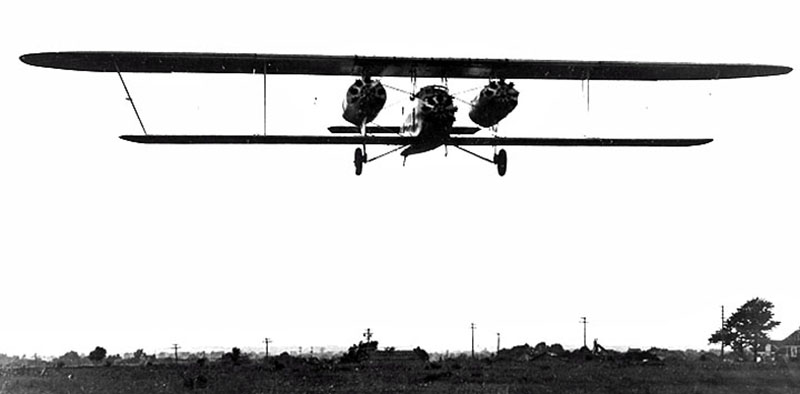
Also on August 23rd, a different kind of aviation milestone was being etched into history with the first flight of the Sikorsky S-35 biplane. This three-engine behemoth, designed by the visionary Igor Sikorsky, took to the skies for the first time from Roosevelt Field in New York. The S-35 was not just another aircraft; it was engineered with a specific, ambitious goal: to compete for the $25,000 Orteig Prize, offered for the first non-stop flight between New York and Paris. The aircraft’s initial flight demonstrated impressive speed, reaching 233 kph. However, its subsequent attempts to achieve the transatlantic crossing were fraught with disaster. The first attempt was aborted due to a critical fuel leak, a common challenge in early long-distance aviation. The second attempt ended tragically when the S-35 crashed shortly after takeoff. While the pilot, Captain René Fonck, and his co-pilot miraculously escaped injury, the aircraft’s other two crew members perished. This event, documented by historians Dominick A. Pisano and F. Robert Van Der Linden in their work "Charles Lindbergh and the Spirit of St. Louis," and in Sikorsky’s own product history, serves as a stark reminder of the inherent risks and the relentless pursuit of innovation that characterized early aviation, even in the face of profound loss. The visual legacy of the S-35, captured in photographs from its test flights, continues to evoke the daring spirit of its era.
1951: A Resurgent Japan and the Dawn of Missile-Centric Naval Aviation
The post-World War II era saw dramatic shifts in global aviation, and August 1951 was no exception. On August 1st, Japan Airlines (JAL) was officially established. The terms of the Allied Peace Treaty imposed significant restrictions on Japan, including a prohibition on Japanese pilots operating commercial aircraft. Consequently, JAL’s nascent operations were initially reliant on leased pilots and aircraft from Northwest Airlines. This unusual arrangement highlighted the complex geopolitical landscape of the time. Early flights were confined to domestic routes, with the airline gradually expanding its reach to international destinations beginning in 1954. R.E.G. Davies’ "A History of the World’s Airlines" chronicles this period, emphasizing the resilience and determination of Japan’s aviation sector as it rebuilt itself on the global stage. The establishment of JAL marked a crucial step in Japan’s post-war recovery and its re-emergence as a significant player in international air travel.
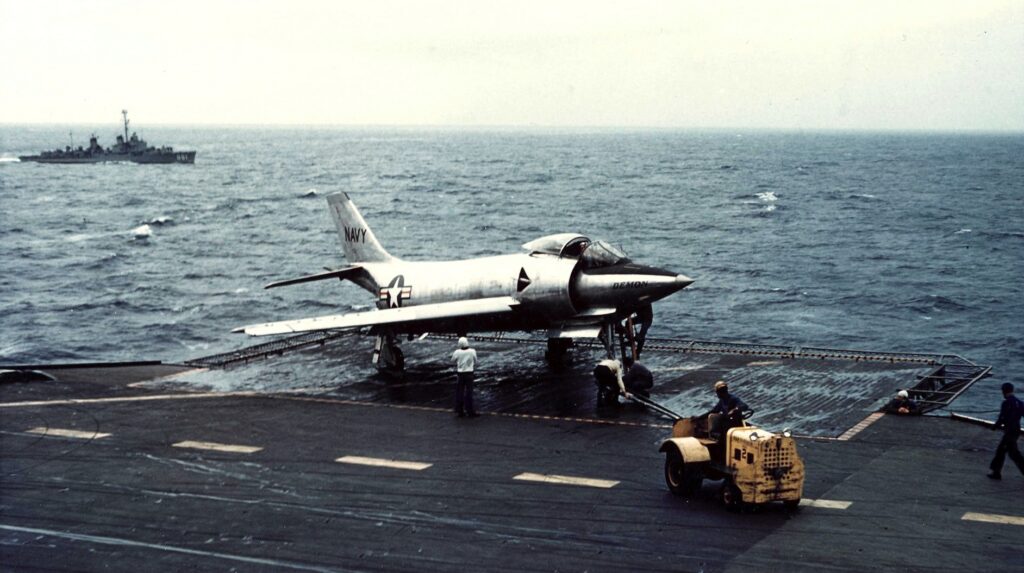
Just a week later, on August 7th, a significant advancement in naval aviation took place with the first flight of the McDonnell XF3H-1 Demon prototype. Piloted by McDonnell test pilot Bob Edholm, this carrier-based aircraft represented a bold new direction for the U.S. Navy. The XF3H-1 featured a swept-wing design and was conceived as the first Navy fighter exclusively armed with radar-guided air-to-air missiles, eschewing traditional guns. This was a revolutionary concept, reflecting the evolving nature of aerial combat and the increasing sophistication of missile technology. However, the initial prototypes suffered from underpowered performance. The aircraft’s fortunes were ultimately salvaged through a critical engine upgrade, which transformed its operational capabilities. Production variants of the Demon would go on to serve in the U.S. Navy until 1965, a testament to its eventual success despite early challenges. Gordon Swanborough and Peter Bowers’ "United States Navy Aircraft Since 1911" and "The Aircraft Yearbook, 1951" provide detailed accounts of the XF3H-1’s development and its impact on naval fighter design. The images of the Demon, particularly the second prototype on the USS Coral Sea, underscore its role as a harbinger of future missile-armed combat aircraft.
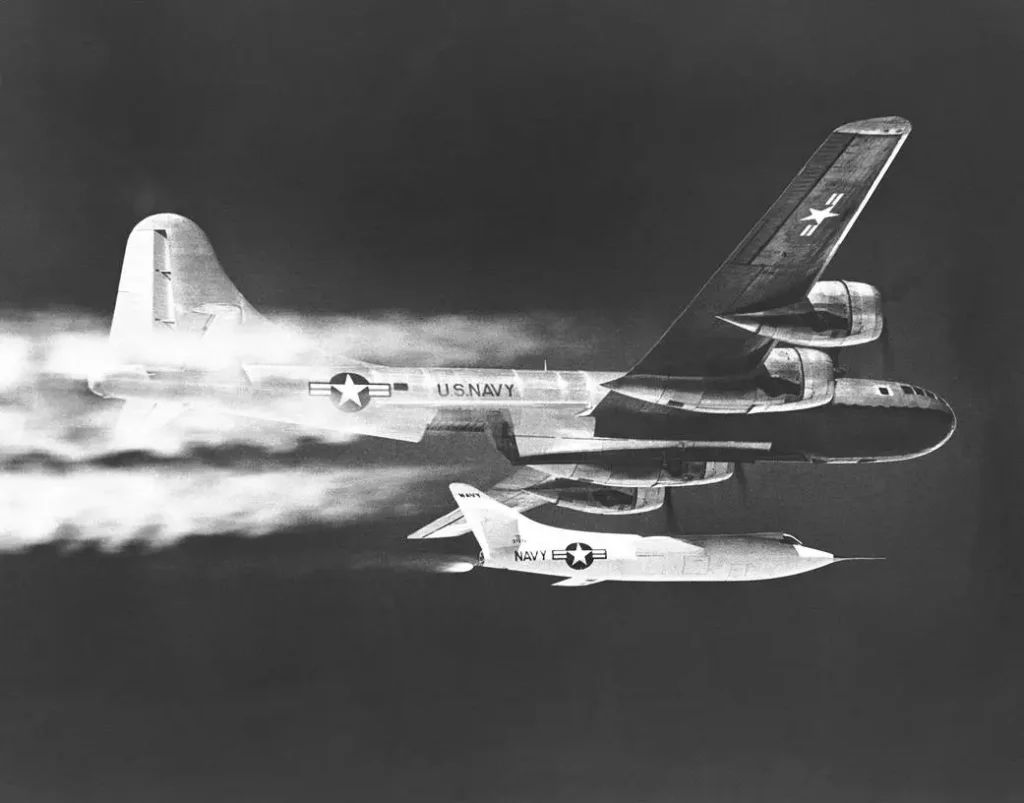
In the realm of experimental flight, August 15th saw an unofficial world altitude record being set by Douglas test pilot William Bridgeman. Piloting one of the rocket-powered Douglas D-558-2 Skyrockets, Bridgeman ascended to an astonishing 79,494 feet. The Skyrocket, a highly advanced research aircraft, was carried aloft by a P2B-1S carrier aircraft before igniting its Reaction Motors Inc. XLR-8 engine. This allowed it to climb rapidly, reaching a speed of Mach 1.35 during its ascent. Richard P. Hallion’s "Supersonic Flight" details this remarkable achievement, placing it within the broader context of supersonic and high-altitude flight research. The Skyrocket program was instrumental in gathering crucial data on aerodynamic performance at extreme speeds and altitudes, paving the way for future advancements in jet fighter and space technology. The iconic image of the Skyrocket being released from its carrier aircraft serves as a visual reminder of the daring experiments conducted in the skies during this era.
1976: Lunar Exploration, European Ambitions, and Unexplained Phenomena
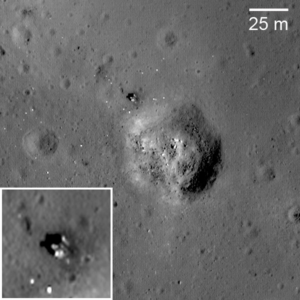
The Soviet Union continued its ambitious lunar exploration program in August 1976 with the launch of Luna 24 on August 9th. This mission was the final in the Luna series and was tasked with returning a sample of lunar soil to Earth. Nine days later, the probe successfully touched down on the Moon’s Mare Crisium plain. Its mission involved drilling to a depth of 2 meters into the lunar surface, successfully collecting approximately 170 grams of regolith. This sample provided invaluable scientific data about the composition and history of the Moon. "Aviation Week," in its October 11, 1976 issue, reported on this significant achievement, highlighting the ongoing competition in space exploration between the United States and the Soviet Union. The Luna 24 mission represented a crucial contribution to our understanding of the Moon’s geology and the broader solar system. NASA’s subsequent Lunar Reconnaissance Orbiter imaging of the Luna 24 landing site offers a tangible link to this historic mission.
Across the Atlantic, the European Space Agency (ESA) was making its own strategic moves in space. On August 19th, ESA announced plans to display a full-scale model of the Spacelab modular laboratory at the upcoming Farnborough International Aerospace Exhibition. This public showcase was a concerted effort to generate interest and foster collaboration within the British public and commercial sectors for European space endeavors. ESA’s exhibit also featured a one-tenth-scale model of the Ariane launcher, the nascent European heavy-lift rocket, and full-size models of the Meteosat and OTS satellites, demonstrating the breadth of their developing space capabilities. This initiative, documented in NASA’s "Astronautics and Aeronautics, 1976," signaled ESA’s growing ambition to become a significant independent player in space exploration and utilization.
The human element of space exploration was also prominent in August 1976. On August 24th, Soyuz 21 cosmonauts Boris Volyonov and Vitaly Zholobov returned to Earth after a 48-day mission aboard the Salyut 5 space station. This mission was the first of three planned flights to the station, with a primary objective of assessing its military surveillance capabilities. The successful completion of their long-duration stay demonstrated the growing Soviet capacity for extended human presence in orbit and for conducting potentially sensitive research. The mission’s findings, as detailed in NASA’s "Astronautics and Aeronautics, 1976," contributed to the ongoing development of space station technology and orbital operations.
Meanwhile, on August 30th, the People’s Republic of China continued its independent space program by launching its sixth satellite from the Jiuquan Satellite Launch Centre. Designated as China 6, the spacecraft reportedly maintained orbit for approximately 17 months, signifying China’s consistent progress in satellite technology and space deployment. This launch, also noted in NASA’s "Aeronautics and Astronautics, 1976," underscored the expanding global participation in space activities beyond the two superpowers.
Adding a touch of mystery to the month’s events, the journal Science reported in its August 20th, 1976 issue on the public display of the U.S. Air Force’s Project Blue Book files. This extensive 20-year investigation into unidentified flying objects (UFOs) had attracted considerable public attention since its opening at the National Archives in July. The project, concluded in 1969, officially determined that none of the 12,618 cases investigated indicated extraterrestrial activity. However, a significant 701 cases remained unexplained, fueling ongoing public fascination and debate about the nature of these phenomena. The article in Science highlighted the enduring public interest in the unknown, even as official investigations concluded.
2001: High-Altitude Records, Emergency Landings, and Launch Vehicle Evolution
The turn of the millennium brought new heights and dramatic incidents to August aviation. On August 13th, NASA’s solar-powered Helios Prototype achieved a remarkable feat, reaching an altitude of 96,864 feet. This flight set a new world altitude record for winged aircraft and, crucially, demonstrated sustained flight at this extreme altitude, remaining above 96,000 feet for a full 40 minutes. NASA Facts from the Dryden Flight Research Center documented this achievement, underscoring the potential of advanced, uncrewed aerial vehicles for high-altitude atmospheric research and surveillance. The Helios program represented a significant leap in solar-powered flight technology, pushing the boundaries of endurance and altitude for winged aircraft. The images of Helios soaring over Kauai, Hawaii, capture the ethereal nature of this groundbreaking flight.
A dramatic testament to human skill and aircraft resilience occurred on August 24th with Air Transat Flight 236. En route from Toronto to Lisbon, the Airbus A330 suffered a fuel leak, leading to a complete loss of engine power over the Atlantic Ocean. Captain Robert Pichéd and First Officer Dirk DeJager executed an extraordinary emergency landing at Lajes Airport in the Azores, gliding the massive jetliner for an astounding distance without engine power. The landing was particularly challenging due to limited electrical and hydraulic power, preventing the deployment of flaps and spoilers. Consequently, the aircraft touched down at a significantly higher speed than normal, relying solely on its brakes for deceleration. While 16 of the 306 passengers and crew sustained injuries, miraculously, there were no fatalities. This incident, detailed in "Air & Space Magazine," holds the record for the longest recorded glide without engine power by a jet airliner, showcasing the exceptional professionalism of the flight crew and the inherent safety design of modern aircraft. The FAA photograph of Air Transat Flight 236 on the tarmac at Lajes serves as a poignant reminder of this harrowing yet successful emergency landing.
Concluding the month of significant August events in 2001, Japan’s H-IIA launch vehicle made its inaugural flight on August 29th. This new rocket represented a substantial upgrade from its predecessor, the H-II, incorporating crucial improvements such as strap-on solid fuel boosters. These enhancements significantly increased its reliability and payload capacity, positioning Japan as a more competitive player in the global satellite launch market. The launch, reported by Flight International, marked a pivotal moment for Japan’s space program, demonstrating its continued commitment to developing advanced launch capabilities. The image of the H-IIA lifting off encapsulates the nation’s growing prowess in space technology.
From the regulatory foundations laid in the early 20th century to the cutting-edge technological advancements and dramatic emergency responses of the 21st, August has consistently been a month of profound significance in the annals of aviation and aerospace history. These events, spanning nearly a century, collectively illustrate the enduring human drive for exploration, innovation, and mastery of the skies and beyond.