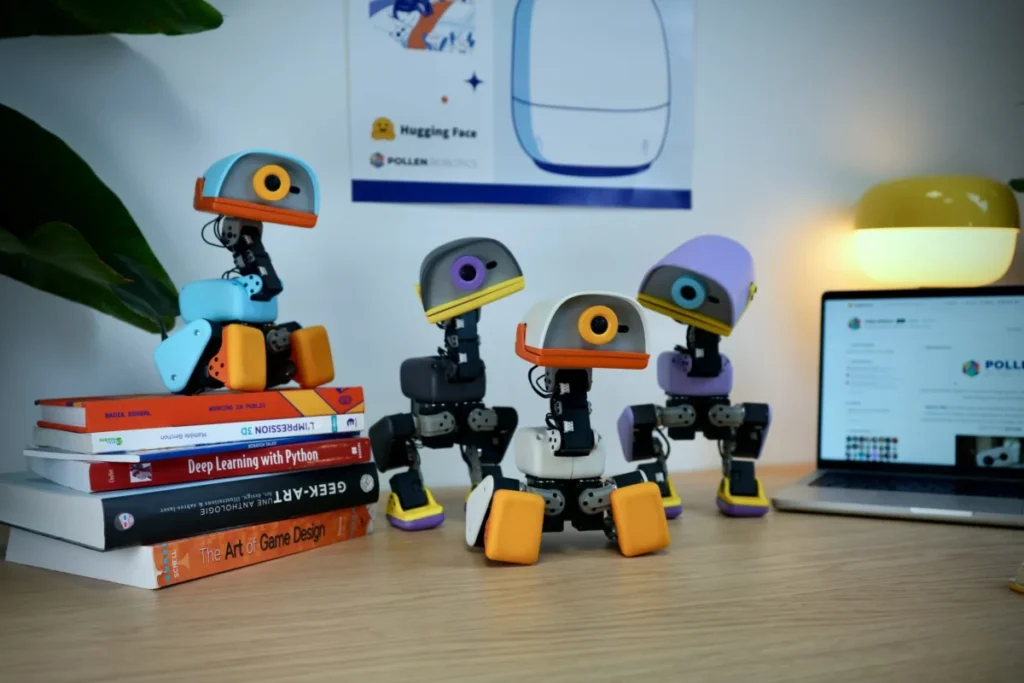
The landscape of consumer robotics is undergoing a significant transformation as the focus shifts from industrial utility to accessible, educational, and aesthetically engaging platforms. In a notable collaboration between Pollen Robotics and the artificial intelligence platform Hugging Face, a new bipedal robot named Microduck has been introduced to the market. Priced at $400, this open-source, trainable robot represents the latest evolution in a lineage of bipedal designs that prioritize both technical sophistication and human-centric design. The Microduck is specifically engineered to serve as a bridge between complex reinforcement learning theories and practical, hands-on experimentation, offering a low-cost entry point for researchers, students, and hobbyists.
The Evolution of Bipedal Droids: From Disney to the DIY Community
The development of the Microduck is not an isolated event but rather the culmination of several years of progress in the "waddling robot" niche. The movement gained significant public attention when Disney Research showcased its BDX droid, a highly expressive, bipedal robot designed for use in its theme parks, such as Star Wars: Galaxy’s Edge. The BDX droid utilized advanced gait control and reinforcement learning to navigate uneven terrain while maintaining a character-driven, "charming" persona.
Recognizing the potential of this form factor, the robotics community began a grassroots effort to democratize the technology. This led to the creation of the Open Duck Mini, a project sponsored by Hugging Face and Pollen Robotics. The Open Duck Mini was designed to be a DIY-friendly version of the Disney concept, allowing users to 3D print components and assemble their own walking robots. The Microduck is the refined, commercially available successor to these earlier iterations, streamlining the assembly process and providing a standardized hardware platform for software development.
Technical Specifications and Hardware Architecture
The Microduck’s design is a deliberate blend of form and function. Standing as a compact bipedal unit, its physical proportions are optimized for stability and resilience—qualities essential for a robot intended for reinforcement learning (RL). In RL, the agent (the robot) learns through a process of trial and error, meaning that frequent falls and mechanical failures are an inherent part of the training process.
The robot’s "pigeon-toed" gait and "bowlegged" skating movements are not merely aesthetic choices; they provide a wider base of support that assists the balance algorithms during the early stages of training. Each unit is equipped with a unique "voice," a feature implemented through onboard audio synthesis, which enhances the robot’s ability to communicate its internal state or respond to environmental stimuli.
From a hardware perspective, the Microduck utilizes high-torque servos and a centralized processing unit capable of handling the demands of real-time motor control. While the initial version does not include high-level natural language processing (NLP) onboard, its architecture is designed to be extensible. The inclusion of an open-source Software Development Kit (SDK) allows users to interface the robot with external compute resources, such as a local PC or cloud-based AI models, to add capabilities like vision-based navigation or voice recognition.

The Role of Reinforcement Learning and Open Source AI
The primary value proposition of the Microduck lies in its integration with the Hugging Face ecosystem. Hugging Face has become the central repository for modern AI, and its involvement in the Microduck project signals a growing interest in "embodied AI"—the application of machine learning models to physical bodies that interact with the real world.
The Microduck repository, hosted on GitHub, provides the community with access to the robot’s source code, 3D models, and training scripts. By making the SDK open source, Pollen Robotics and Hugging Face are encouraging a decentralized development model. This allows a global network of developers to contribute to the robot’s capabilities, from optimizing its walking gait to developing complex behavioral models.
Reinforcement learning on the Microduck typically involves a simulation-to-reality (Sim2Real) pipeline. Developers can train the robot’s neural networks in a virtual environment where thousands of walking attempts can be simulated in seconds. Once a stable policy is developed, it is "deployed" to the physical Microduck. This approach significantly reduces the wear and tear on the hardware and accelerates the development cycle for complex maneuvers.
Accessibility and the Democratization of Robotics
Historically, bipedal robotics has been a field reserved for well-funded research institutions and corporations like Boston Dynamics or Agility Robotics. Systems like the Atlas or Digit cost hundreds of thousands of dollars and require specialized maintenance. The Microduck, at $400, represents a radical departure from this trend.
By lowering the financial barrier to entry, Pollen Robotics is enabling a broader demographic to engage with bipedal locomotion. This is particularly relevant for educational institutions that may not have the budget for high-end industrial robots but wish to provide students with experience in modern AI and robotics. The Microduck serves as a tangible tool for teaching the principles of kinematics, control theory, and machine learning.
Official Responses and Community Expectations
The launch of the Microduck has been met with enthusiasm from both the AI and maker communities. Representatives from Pollen Robotics have emphasized the collaborative nature of the project. In a statement regarding the future of the platform, a spokesperson noted that while certain features like onboard language processing are not present at launch, the technical feasibility is high. The company expects the community to take the lead in expanding the robot’s capabilities, predicting that user-contributed features could emerge within weeks of the first units being delivered.
This reliance on the community is a hallmark of the open-source philosophy. Rather than providing a finished, closed product, Pollen Robotics is providing a "platform for innovation." This strategy not only fosters a loyal user base but also ensures that the robot’s software ecosystem evolves much faster than it would under a traditional proprietary model.

Broader Impact and Implications for the Future of AI
The Microduck arrives at a time when the tech industry is increasingly focused on the "last mile" of robotics—bringing AI out of the screen and into the physical home. While the Microduck is currently a tool for learning and experimentation, its development provides insights into the future of domestic robotics.
Analysis of the current trajectory suggests that as training models continue to improve and hardware becomes more affordable, the "excuses" for not integrating robots into daily life are diminishing. The Microduck’s ability to handle "lightweight debris" like socks suggests a future where similar, more advanced versions could perform basic household chores. However, the current focus remains on the "charm" and the "learning." By making robots that are visually appealing and "cute," developers can bypass the "uncanny valley" and create machines that humans are more likely to accept in their personal spaces.
Furthermore, the Microduck project highlights the shift toward "Edge AI"—performing complex computations on or near the device. As microcontrollers become more powerful, the ability to run lightweight neural networks locally on a $400 robot will become a standard feature, reducing latency and increasing the robot’s autonomy.
Pre-order Timeline and Availability
The Microduck is currently available for pre-order through the Pollen Robotics website. The company has set a target for the first round of deliveries to be completed before Christmas 2026. This timeline allows for the scaling of manufacturing processes and the final refinement of the open-source libraries that will accompany the hardware.
For those who prefer a more hands-on approach, the project maintains its roots in the DIY scene. Users who have the necessary tools, such as 3D printers and soldering equipment, can still opt to build their own units from scratch using the documentation provided in the GitHub repository. However, the $400 pre-assembled or kit-based Microduck provides a more reliable and standardized experience for those who wish to focus primarily on the software and AI training aspects of the project.
In conclusion, the Microduck is more than a novelty; it is a sophisticated tool designed to accelerate the field of embodied AI. Through its partnership with Hugging Face and its commitment to open-source principles, Pollen Robotics is positioning the Microduck as a foundational platform for the next generation of robotics researchers and enthusiasts. As the community begins to receive these units, the collective progress in bipedal locomotion and reinforcement learning is expected to see a significant uptick, further blurring the line between high-end research and consumer technology.